
A croton can look almost unreal at the garden center. One leaf is striped yellow and green. Another is turning orange, red, or burgundy. You bring the plant home, place it beside a window—and a few days later, perfectly good-looking leaves start landing on the floor.
That reaction makes crotons seem much more difficult than they really are.
The problem is that crotons respond visibly to changes in their environment. A move, colder air, wetter soil, less light, or a sudden change in routine can cause leaf drop. Good Croton Plant Care is therefore less about constantly doing something to the plant and more about creating the right conditions and keeping them reasonably stable. Wisconsin Extension specifically notes that rapid environmental changes can shock crotons and cause leaves to fall.
Quick answer: Give a croton bright light, a well-draining potting mix, warmth, moderate to high humidity, and water when roughly the upper ½ to 1 inch of mix has dried. Protect it from prolonged cold, avoid keeping the roots soggy, and don’t panic over a few fallen leaves immediately after moving the plant.
Croton Plant Care at a Glance
| Care Factor | Best Starting Point | Common Problem |
| Light | Bright indirect light indoors; brighter exposure after careful acclimation | Too little light reduces color; abrupt intense sun can damage foliage |
| Water | Water when roughly the top ½–1 inch of mix dries | Keeping soil constantly wet or allowing prolonged severe dryness |
| Soil | Fertile, airy, well-drained potting mix | Dense mix that remains saturated |
| Pot | Drainage holes; size appropriate to the root ball | Decorative pots trapping drainage water |
| Temperature | About 60–85°F | Cold drafts and temperatures around or below 50°F |
| Humidity | Moderate to high | Very dry heated or air-conditioned air |
| Fertilizer | Moderate feeding during active growth | Feeding a stressed or waterlogged plant |
| Repotting | Move up only modestly when roots outgrow the pot | Jumping into a much larger container |
| Pruning | Prune to shape and encourage branching | Ignoring irritating sap or removing too much unnecessarily |
These starting points are consistent with University of Wisconsin and NC State Extension guidance.
What Is a Croton Plant?
The garden croton is Codiaeum variegatum, a member of the Euphorbiaceae, or spurge, family. Kew recognizes Codiaeum variegatum as the accepted species name and gives its native range broadly from Malesia into the southwestern Pacific.
Crotons are evergreen shrubs or small trees in warm tropical environments, but in much of the United States they’re grown as colorful houseplants or seasonal container plants.
The attraction is the foliage. Hundreds of cultivated forms have been selected for leaves that may be oval, narrow, lobed, twisted, spotted, veined, or splashed with combinations of green, yellow, orange, pink, red, bronze, and purple.
That color is also a useful clue to plant health. A croton can technically remain alive in a dim location while gradually becoming greener, thinner, and less impressive. Surviving and thriving aren’t always the same thing.
How Much Light Does a Croton Need?
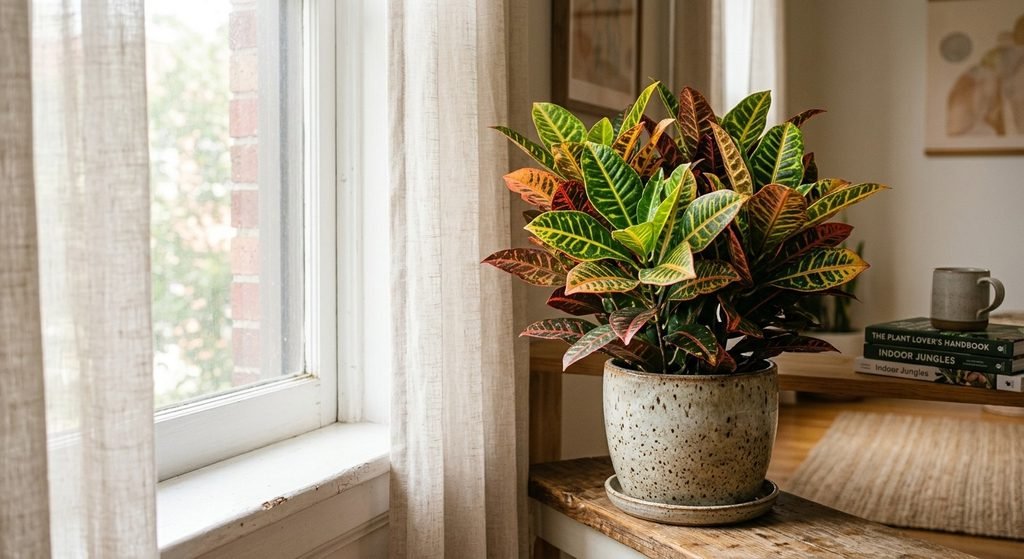
Quick answer: Indoors, bright indirect light is the safest starting point. Crotons need substantial light to maintain colorful foliage, but plants moved abruptly into intense sun can suffer damage.
Wisconsin Extension says crotons develop their best color in bright indirect light indoors. Higher light generally improves coloration and produces more compact growth, while insufficient light can cause leaves to become greener.
Indoor light
A bright window is usually more suitable than a dark interior shelf.
Depending on the direction of the window, season, glass, climate, and distance from the window, good locations may include:
- A bright east-facing exposure
- A bright filtered south- or west-facing exposure
- A location receiving strong ambient daylight
- A spot where some gentler direct sunlight reaches the plant without suddenly baking foliage that was previously shade-grown
Don’t treat the phrase “bright indirect light” as a measurement carved in stone. A winter window in Michigan and an unshaded summer window in Arizona can produce very different conditions.
If you’re moving a croton into stronger light, increase exposure gradually.
Outdoor sunlight
Outdoor light is more complicated.
UF/IFAS notes that many crotons perform well in full sun, while some cultivars tolerate or prefer partial shade. Wisconsin Extension similarly notes that outdoor plants can handle greater sun when conditions are suitable and the plant has been acclimated.
For a potted houseplant going outside for summer, gradual acclimation matters more than chasing a universal number of direct-sun hours.
Move it outdoors in stages rather than taking a plant accustomed to filtered indoor light and immediately setting it in harsh afternoon sun.
Signs your croton needs more light
Possible clues include:
- New leaves emerging predominantly green
- Existing coloration becoming less dramatic
- Sparse or stretched growth
- Lower leaf loss in persistently shady conditions
- Very slow new growth despite otherwise suitable care
NC State notes that bright light supports better foliage color and that too much shade can contribute to lower-leaf loss.
Signs the light may be too intense
Watch for foliage that becomes scorched, bleached, dull, or damaged soon after a dramatic increase in exposure.
Wisconsin Extension notes an interesting distinction: insufficient light can make leaves greener, while excessive direct sun can leave them looking gray or dull.
That means “more light” isn’t always the answer. The goal is enough light to support strong color without overwhelming an unacclimated plant.
How to Water a Croton Properly
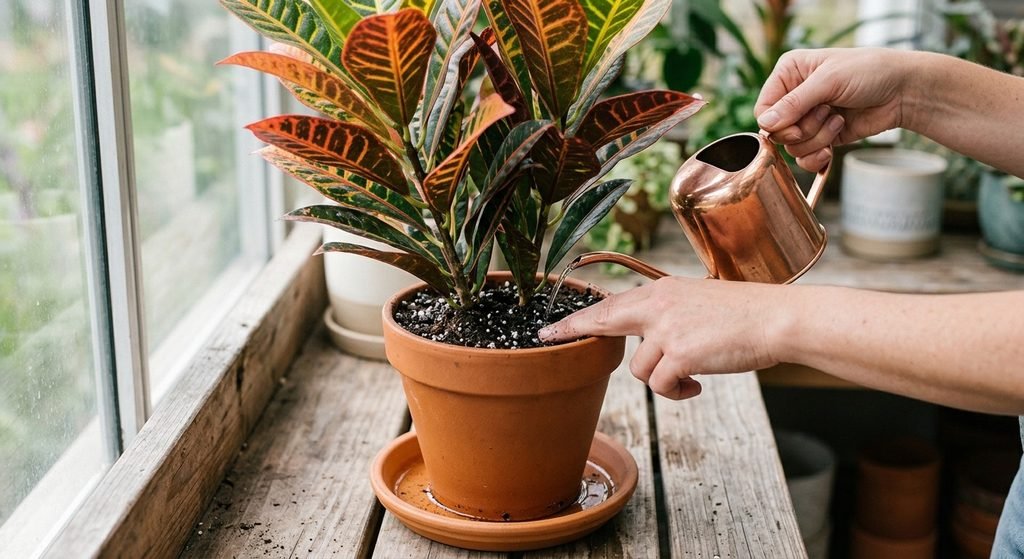
Quick answer: Check the potting mix instead of the calendar. A practical starting point is to water when approximately the top ½ to 1 inch has dried, then water thoroughly and allow the excess to drain.
A fixed schedule sounds convenient, but crotons don’t know what day of the week it is.
A plant beside a sunny window in July may use water much faster than the same plant during a dark January. Pot size, root density, humidity, temperature, light, and the potting mix all change how quickly moisture disappears.
How to tell when your croton needs water
Push a finger into the upper portion of the potting mix.
If the surface is dry but the layer immediately underneath still feels clearly moist, waiting may be appropriate. Once roughly the upper ½ to 1 inch has dried, water thoroughly enough to moisten the root ball and allow extra water to flow out of the drainage holes.
Then empty any water sitting in the saucer or decorative outer pot.
A moisture meter can be useful as a secondary check, particularly with large containers, but it shouldn’t replace looking at the soil, plant, pot weight, and drainage.
Overwatering vs. underwatering
Both extremes can produce wilt, leaf drop, or discoloration, so the appearance of the leaf alone may not give you the answer.
| What You Notice | What to Check |
| Yellowing plus soil that stays wet for days | Drainage, pot size, watering frequency, root condition |
| Wilt while soil is saturated | Possible root stress; don’t automatically add more water |
| Limp foliage plus very dry, lightweight soil | Underwatering may be involved |
| Dry brown edges with rapidly drying mix | Check watering, heat, humidity, and root crowding |
| Leaf drop after dramatic wet/dry swings | Stabilize the moisture routine |
The most useful question isn’t “How often should I water?” It’s “How quickly is this particular pot drying under its current conditions?”
Best Soil and Pot for Croton Plants
Crotons prefer fertile, well-drained growing media. The roots need moisture, but they also need oxygen.
For most indoor plants, there’s no need to invent an elaborate “croton soil recipe.” Look for a quality houseplant potting mix that drains readily rather than dense garden soil that compacts inside a container.
Drainage matters more than decorative looks
The container should have functional drainage holes.
A beautiful ceramic planter with nowhere for water to escape can create a much harder watering problem than a simple nursery pot.
One practical arrangement is to keep the croton in a draining inner pot placed inside a decorative cachepot. Just remove the inner pot for watering and empty any collected water before putting it back.
Pot size matters, too
More space isn’t automatically better.
Wisconsin Extension recommends moving a croton into a pot only about 1–2 inches larger when repotting. A disproportionately large volume of damp potting mix can stay wet around a small root system for too long.
What if the soil stays wet for a week or longer?
Don’t immediately assume the plant simply needs less water.
Check the system:
- Does the pot have drainage holes?
- Is water trapped in an outer container?
- Is the plant in an oversized pot?
- Is the mix unusually dense or compacted?
- Is the plant receiving enough light?
- Has the room become cooler?
- Has seasonal growth slowed?
The solution may be correcting drainage, light, pot size, or potting mix rather than merely stretching the watering interval.
Temperature and Humidity
Croton is a tropical plant, and warm, relatively stable conditions suit it much better than repeated temperature swings.
Wisconsin Extension gives a preferred range of roughly 60–85°F and notes that prolonged temperatures below 50°F can trigger leaf drop. NC State likewise recommends bringing plants indoors as temperatures approach 50°F.
What temperature is too cold for a croton?
Treat 50°F as an important warning point, not a target temperature.
A potted croton spending summer outdoors should come inside before cold nights become routine. Don’t wait for frost damage.
Also protect indoor crotons from:
- Cold exterior doors
- Drafty winter windows
- Air-conditioning vents
- Heating vents
- Large day-to-night temperature swings
Does croton need humidity?
Crotons generally prefer moderate to high humidity rather than extremely dry indoor air.
If winter heating or air conditioning dries your home substantially, a room humidifier can be useful, particularly if you keep several tropical plants together.
For another tropical-foliage example, HomeWorks Daily’s prayer plant care guide also explains why humidity needs to be considered together with watering, light, and drainage rather than treated as a cure-all.
How to Fertilize Croton Plants
Crotons can benefit from fertilizer during active growth, but fertilizer should support an already functional growing environment—not compensate for one that’s failing.
Wisconsin Extension notes that one or two feedings during the growing season may be sufficient for moderate growth, with more frequent feeding used when faster growth is desired.
For homeowners, the simplest approach is:
- Use a fertilizer labeled for houseplants.
- Apply it primarily during active growth.
- Follow the product’s dilution and frequency directions.
- Avoid exceeding the label because the plant looks unhappy.
- Reduce unnecessary feeding when growth slows.
If a croton is dropping leaves in soggy soil, more fertilizer isn’t the fix.
Correct the root-zone problem first.
How to Repot a Croton
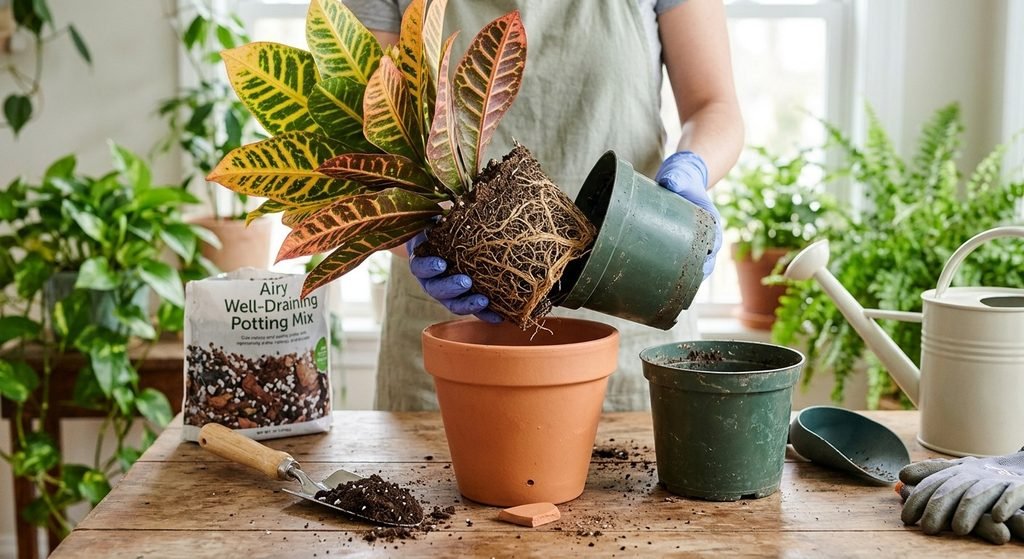
Repot because the plant needs it, not because a calendar says it’s “repotting season.”
Consider repotting when roots are crowded, roots emerge from drainage holes, the existing medium has broken down, drainage has deteriorated, or the plant dries unusually fast because roots occupy most of the container.
To repot:
- Choose a container with drainage holes that’s only modestly larger—about 1–2 inches wider is a practical guideline.
- Prepare fresh, well-draining potting mix.
- Slide the plant from its old container carefully.
- Inspect the roots and remove obviously dead or rotten material if present.
- Replant at approximately the same depth.
- Water to settle the new mix and let excess water drain.
- Return the plant to a stable, suitably bright location rather than changing several environmental conditions at once.
Wisconsin Extension recommends moving up only slightly in pot size and repotting once the plant has genuinely outgrown its container.
How to Prune a Croton
Pruning can keep a croton compact and encourage branching if it becomes tall or leggy.
Wisconsin Extension notes that crotons can be cut back in early spring before new growth to encourage branching.
You don’t have to prune hard, though. For an indoor specimen, selective trimming may be enough to:
- Remove dead or damaged leaves
- Shorten a leggy stem
- Improve symmetry
- Encourage fuller growth
- Control height
Use clean, sharp pruners.
Croton stems and leaves release clear sap when damaged. NC State identifies the sap and plant tissues as potential skin irritants, so gloves are sensible if you have sensitive skin, and hands should be washed after pruning.
How to Propagate Croton
Croton can be propagated vegetatively, which is preferable when you want a new plant with the same characteristics as a named cultivar.
Wisconsin Extension lists air layering and softwood cuttings, while UF/IFAS also identifies softwood tip or leaf-bud cuttings among propagation methods for Codiaeum variegatum.
For a straightforward home propagation attempt:
- Select a healthy stem rather than damaged or pest-infested growth.
- Make the cut with a clean tool.
- Remove foliage that would be buried in the propagation medium.
- Place the cutting into an appropriate moist, well-drained propagation medium.
- Keep it warm and prevent the medium from becoming waterlogged.
- Maintain stable conditions while roots develop.
Wear gloves when handling fresh cut stems because of the irritating sap.
Why Is My Croton Dropping Leaves?
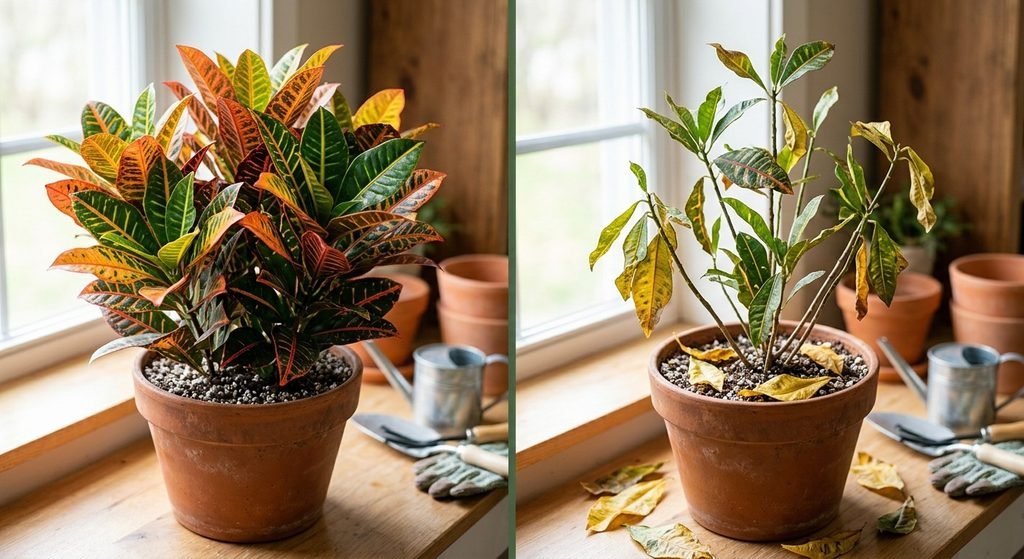
Quick answer: If leaf drop started soon after buying, moving, repotting, or relocating the plant, environmental shock is a strong possibility. Also check soil moisture, temperature, light, and pests before changing the care routine.
Crotons have a reputation for reacting dramatically to relocation, and this is supported by extension guidance: changing conditions too quickly can trigger leaf loss.
Imagine you bring home a healthy croton from a bright, warm nursery. You put it six feet from a window in a cooler room and immediately repot it.
The plant has just experienced new light, new humidity, new temperature, disturbed roots, and new soil simultaneously.
Leaf drop doesn’t necessarily tell you which change caused the problem. It tells you the plant has experienced stress.
Diagnose leaf drop in this order
1. Ask what changed.
Was the plant just purchased, moved, repotted, brought indoors for winter, or exposed to a new heating or cooling system?
2. Check the soil.
Very wet and very dry conditions can both contribute to leaf loss.
3. Check temperature.
Look for cold glass, exterior doors, AC vents, or outdoor temperatures approaching 50°F.
4. Check the light.
A dramatic reduction in light can stress a plant accustomed to greenhouse conditions.
5. Inspect for pests.
Look closely underneath leaves and along stems before assuming every fallen leaf is “acclimation.”
After correcting a clear problem, give the plant stability. Constantly moving it in search of the perfect spot can create another round of adjustment.
Why Are My Croton Leaves Turning Yellow?
First make sure you’re looking at actual yellowing rather than the croton’s normal variegation.
Many cultivars naturally produce bold yellow veins, dots, streaks, or patches. That’s part of the plant.
A leaf that loses its usual pattern, becomes uniformly pale or yellow, softens, and then falls is a different situation.
Possible causes include:
- Excessive moisture around the roots
- Poor drainage
- Environmental shock
- Insufficient light
- Temperature stress
- Root damage
- Natural aging of an occasional lower leaf
- Pest pressure
The useful clue is the pattern.
One older bottom leaf slowly yellowing while new growth remains strong is much less concerning than rapid yellowing across a large portion of the plant.
Before fertilizing a yellow croton, check the roots, moisture, and light.
Why Are My Croton Leaves Brown or Crispy?
Brown edges don’t point to one guaranteed cause.
Possible contributors include dry potting mix, excessively dry air, hot direct sun, temperature stress, damaged roots, or previous episodes of water stress.
Use the surrounding evidence.
A crispy leaf on a plant sitting in bone-dry soil tells a different story from a brown leaf on a plant whose roots have remained saturated for two weeks.
This same diagnostic principle applies to many indoor plants. HomeWorks Daily’s indoor azalea care guide similarly emphasizes checking moisture, drainage, temperature, and the whole environment instead of diagnosing from one leaf symptom.
Why Is My Croton Losing Its Color?
Light should be one of the first things you investigate.
Wisconsin Extension reports that insufficient light can cause croton foliage to revert toward greener shades, while higher suitable light promotes more vivid coloration.
Don’t expect an old green leaf to instantly repaint itself after you move the plant.
Watch the new growth.
If newly developing foliage emerges with stronger characteristic variegation after the plant receives more appropriate light, you’re moving in the right direction.
Variety matters, too. Some crotons naturally carry more green than others, and leaf color can change as foliage matures. Compare the plant with its own established pattern instead of assuming every croton should look like a red-and-yellow ‘Petra.’
Common Croton Pests
Wisconsin Extension specifically identifies mealybugs, spider mites, and scale insects as common croton pests.
Look for:
- Fine webbing or tiny pale speckles associated with spider mites
- White cottony material around stems or leaf joints from mealybugs
- Firm brown or tan bumps attached to stems and leaves from scale
- Sticky residue
- Yellowing or premature leaf drop
- Distorted new growth
If pests are present, isolate the plant from other houseplants first.
Physical removal or rinsing can help with lighter infestations. When a pesticide is necessary, University of Minnesota Extension recommends choosing products specifically labeled for indoor plants; insecticidal soaps can be effective against pests including spider mites and scale when used correctly. Homemade soap mixtures can damage plants, so use a labeled product and follow its directions.
Don’t spray a croton merely because a leaf looks unhealthy. Identify the pest first.
Common Croton Plant Problems
| Symptom | Possible Cause | What to Check First | Practical Action |
| Sudden leaf drop | Relocation or temperature shock | What changed recently? | Stabilize conditions |
| Yellow leaves + wet soil | Excess moisture/root stress | Drainage and soil moisture | Let mix dry appropriately; correct drainage |
| Wilt + dry soil | Underwatering | Root ball moisture | Water thoroughly and drain |
| Wilt + wet soil | Damaged/stressed roots | Root condition and drainage | Don’t add more water automatically |
| Crispy edges | Dry soil, dry air, heat, root stress | Soil and room conditions | Correct the actual environmental cause |
| New leaves mostly green | Insufficient light or cultivar traits | Light exposure | Increase suitable light gradually |
| Bleached/scorched patches | Excessive sudden sunlight | Window/outdoor exposure | Filter light or acclimate gradually |
| Fine webbing/stippling | Spider mites | Leaf undersides | Isolate and treat appropriately |
| Cottony deposits | Mealybugs | Stems and leaf joints | Isolate; remove/treat infestation |
| Brown attached bumps | Scale | Stems and veins | Isolate and confirm scale before treatment |
| Slow growth but healthy foliage | Season or normal growth rate | Light, temperature, roots | Don’t automatically fertilize more |
One symptom can have several causes. The table is a starting point for investigation, not a substitute for checking the plant itself.
Indoor vs. Outdoor Croton Care
| Factor | Indoor Croton | Outdoor Croton |
| Light | Bright indirect light is a strong starting point | More direct light may be tolerated after acclimation |
| Water | Drying rate depends heavily on pot and room | Heat, wind, and sun can increase water use |
| Temperature | Keep warm and away from drafts | Protect from cold; bring containers in before cold nights |
| Humidity | Indoor heating/AC may create dry air | Warm humid climates generally suit crotons |
| Winter | Growth and water use may slow | Not reliably cold-hardy in much of the US |
| Pests | Spider mites, mealybugs, scale | Inspect before bringing plants indoors |
| Placement | Windows and HVAC matter | Sun exposure and regional climate matter |
Can croton grow outdoors in the United States?
Yes—but permanent outdoor growing is mainly practical in frost-free climates.
Hardiness recommendations vary somewhat among Extension sources and local conditions. Wisconsin and NC State generally list croton as hardy around USDA Zones 11–12, while UF/IFAS discusses landscape use in warmer areas of Florida, including subtropical conditions farther north depending on site and cultivar.
For most US homeowners, a safer rule is simple: treat croton as a tropical container plant unless your location is reliably frost-free.
In colder climates, enjoy it outdoors during warm weather and bring it inside before nighttime temperatures approach 50°F.
Croton Care Through the Seasons
Spring
Increasing daylight often brings renewed growth.
This is a useful time to:
- Reassess whether the plant needs repotting
- Begin appropriate fertilization as growth resumes
- Prune leggy stems if needed
- Increase watering only as the plant starts using moisture faster
- Gradually acclimate the plant before moving it outdoors
Summer
A croton growing actively in bright, warm conditions may dry more quickly.
Check soil rather than assuming your spring watering interval still works.
Outdoor container plants may need closer monitoring because sunlight, wind, and heat can change pot moisture much faster than indoor conditions.
Fall
If your croton has spent summer outside, don’t wait for a frost warning.
Begin moving it indoors before overnight temperatures approach 50°F. Inspect the plant carefully for pests before bringing it near other houseplants.
Expect some adjustment if indoor light is substantially lower.
Winter
Growth often slows as days shorten.
The potting mix may take longer to dry, so watering usually needs to respond to that slower moisture use. NC State specifically recommends reducing watering during the cooler, lower-growth period.
Keep the plant away from cold windows and dry blasts from heating systems.
How Do You Know Whether a Croton Is Healthy or Merely Surviving?
A plant can remain alive for months without actually growing well.
A healthy croton should show several positive signals together:
- Firm stems
- Foliage with the expected coloration for its cultivar
- Gradual new growth during active periods
- Soil that dries at a reasonable pace
- No repeated mass leaf drop
- No persistent pest activity
- Roots that aren’t sitting in stagnant water
- New leaves that aren’t progressively smaller or weaker
A croton that stays almost entirely green in a dark corner, produces little new growth, and repeatedly loses lower leaves may technically be alive, but its environment probably isn’t supporting its full potential.
That’s an important distinction because the goal of care isn’t simply preventing death. It’s creating conditions where the plant can maintain the colorful foliage that made you buy it in the first place.
For comparison, HomeWorks Daily’s guide to growing Dracaena makes the same useful distinction between a foliage plant tolerating a location and actively growing well in it.
Is Croton Toxic to Pets?
Yes. Croton should be kept where pets aren’t likely to chew it.
Pet Poison Helpline identifies Codiaeum variegatum as toxic to pets and states that ingestion can cause oral and gastrointestinal irritation, including drooling, vomiting, and diarrhea. Contact with the plant’s sap may also irritate skin.
That doesn’t mean every exposure causes severe poisoning, but it does mean the plant shouldn’t be treated as pet-safe.
If a cat or dog chews a croton and develops symptoms—or if you’re uncertain how much was eaten—contact your veterinarian or an animal poison-control service for case-specific advice.
What about people?
NC State classifies croton as having low-severity poisonous characteristics in humans but notes that ingestion can cause gastrointestinal symptoms and repeated sap contact may produce dermatitis.
Keep pruned leaves and stems away from young children, avoid getting sap in the eyes, and wash exposed skin after handling cut stems.
Common Croton Plant Care Mistakes
1. Watering every Sunday regardless of soil moisture
Your home’s conditions change with season, sunlight, humidity, and temperature.
Better approach: Check the soil first.
2. Putting a nursery croton immediately into intense outdoor sun
More light may improve color, but abrupt exposure can damage leaves.
Better approach: Acclimate gradually.
3. Assuming every falling leaf means the plant needs water
Leaf drop also follows environmental shock, cold, excessive moisture, low light, and pests.
Better approach: Check what changed before acting.
4. Letting water collect inside a decorative pot
A draining nursery pot doesn’t help if its bottom sits in water.
Better approach: Empty the outer container after watering.
5. Repotting into a huge container
A large volume of unused potting mix can remain wet for too long.
Better approach: Increase pot size modestly.
6. Fertilizing a stressed plant instead of fixing the environment
Fertilizer can’t repair poor drainage or eliminate a cold draft.
Better approach: Correct light, moisture, roots, and temperature first.
7. Moving the plant repeatedly after leaf drop
If relocation caused the stress, another relocation may complicate recovery.
Better approach: Once you identify a genuinely suitable location, keep conditions steady.
8. Ignoring the undersides of leaves
Spider mites and other houseplant pests can be easy to miss until damage spreads.
Better approach: Inspect leaves and stems regularly, especially before bringing outdoor plants inside.
9. Treating every croton as though it has identical sun tolerance
Cultivars, previous growing conditions, regional sunlight intensity, and acclimation all matter.
Better approach: Observe the actual plant and adjust gradually.
10. Confusing “still alive” with healthy growth
A croton can endure poor light while steadily losing the color and dense growth you wanted.
Better approach: Watch new leaves, not just whether old stems remain alive.
Frequently Asked Questions About Croton Plant Care
Is croton easy to care for?
Croton is manageable once its environment is stable, but it can be less forgiving of sudden changes than many common houseplants. Bright light, good drainage, warmth, and consistent moisture management are the core requirements.
Can a croton survive indoors?
Yes. Crotons are widely grown as houseplants. Indoors they perform best in bright conditions with adequate warmth, drainage, and appropriate watering.
How much light does a croton need?
Bright indirect light is a strong indoor starting point. Adequate light helps maintain colorful variegation, while prolonged low light can produce greener foliage. Introduce stronger direct sunlight gradually.
How often should you water a croton?
Don’t use a rigid weekly schedule. Check the potting mix and water when roughly the top ½ to 1 inch has dried. Water thoroughly and let excess drain away.
Why is my croton dropping leaves?
Recent relocation, repotting, abrupt changes in light or temperature, watering stress, cold exposure, and pests can all contribute. If the problem started immediately after the plant moved, environmental shock is an important possibility.
Why are my croton leaves turning yellow?
First distinguish natural yellow variegation from a leaf that’s actually deteriorating. If whole leaves are yellowing, check soil moisture, drainage, recent environmental changes, temperature, roots, and pests before adding fertilizer.
Why is my croton losing its color?
Insufficient light is one of the first issues to investigate. Crotons commonly become greener in low light, while brighter appropriate conditions support stronger coloration.
Does croton need humidity?
Crotons generally prefer moderate to high humidity, although humidity alone won’t compensate for poor drainage or incorrect watering. Keep the plant away from excessively dry heating and cooling drafts.
What temperature is too cold for a croton?
Temperatures around or below 50°F can trigger leaf loss or cold stress. For indoor growth, roughly 60–85°F is a more suitable range. Bring outdoor container plants inside before cold nights become routine.
Can croton grow outdoors in the US?
Yes, especially in frost-free tropical and subtropical climates. Elsewhere, crotons are better treated as seasonal outdoor container plants that return indoors before cold weather. Extension hardiness guidance varies somewhat by locality, but croton is not a reliably cold-hardy shrub for most of the country.
What soil is best for croton?
Use fertile, well-drained potting media that holds some moisture without remaining saturated. Functional drainage holes are just as important as the potting mix itself.
How do you make a croton bushier?
Pruning leggy stems can stimulate branching. Wisconsin Extension recommends pruning before active spring growth when substantial shaping is needed.
Can you propagate croton from cuttings?
Yes. Softwood cuttings are an established propagation method for croton, and air layering is another option.
Is croton toxic to cats and dogs?
Yes. Pet Poison Helpline lists Codiaeum variegatum as toxic to pets. Chewing the plant can cause oral irritation, drooling, vomiting, or diarrhea, while sap can irritate skin.
Final Takeaway
Successful Croton Plant Care is mostly about balance and stability.
Give the plant enough light to maintain its colorful foliage, but acclimate it before exposing it to stronger sun. Water according to actual soil moisture rather than the calendar. Use a pot and potting mix that allow excess water to escape. Keep temperatures warm and reasonably stable, and protect the plant from cold drafts and nights approaching 50°F.
Most importantly, diagnose before reacting.
A fallen leaf doesn’t automatically mean “water.” A yellow leaf doesn’t automatically mean “fertilize.” Brown edges don’t automatically mean “increase humidity.”
Check the whole environment—light, soil, drainage, temperature, recent changes, roots, and pests—and change the factor that’s actually causing the problem.
That’s the difference between simply keeping a croton alive and helping it maintain the dense, dramatic foliage it’s grown for.
HomeWorks Daily focuses on practical gardening and home-care guidance homeowners can apply, and crotons reward exactly that kind of practical approach: observe first, correct the cause, and avoid unnecessary changes.









One Response