
A prayer plant can seem almost magical the first time you notice its leaves changing position. During the day, its patterned foliage spreads out, while the leaves may fold upward at night. That unusual movement is one reason these tropical houseplants have become such popular indoor favorites.
But their beauty comes with a few preferences.
Prayer plants generally do best with bright, indirect light, consistently moist but well-drained soil, warm temperatures, and good humidity. They don’t usually appreciate harsh direct sunlight or being left bone-dry for long periods.
The good news? Once you understand what the plant is trying to tell you, prayer plant care becomes much easier.
What Are Prayer Plants?
Prayer plant is the common name often used for Maranta leuconeura, a tropical perennial in the Marantaceae family. It is native to Brazil and is valued mainly for its colorful, patterned foliage rather than its flowers.
The name “prayer plant” comes from the way its leaves can move upward at night, creating an appearance that resembles hands coming together.
This isn’t simply a decorative trick. The plant’s leaves naturally change position in response to the daily light cycle.
Prayer plants are generally grown as indoor plants in climates where outdoor temperatures are too cold for them. Missouri Botanical Garden lists them as tropical plants that prefer warm conditions and notes that they are intolerant of frost.
Why Are Prayer Plants So Popular?
There’s more to these plants than their unusual leaf movement.
Prayer plants can bring several interesting features into an indoor space:
- Striking foliage: Leaves can have contrasting veins, spots, stripes, or colorful undersides.
- Compact growth: They can work well on shelves, tables, and other indoor locations.
- Interesting movement: Their leaves may change position between day and night.
- Tropical appearance: Their foliage can add a lush look without requiring a large floor area.
- Variety: Different cultivars and varieties offer noticeably different leaf patterns.
For example, Maranta leuconeura var. erythroneura has prominent red veins and colorful leaf markings.
That variety is part of the fun: two prayer plants can look quite different while sharing many of the same basic care preferences.
How Do You Care for Prayer Plants?
The easiest way to remember prayer plant care is to think warm, bright, humid, and evenly moist—but not soggy.
Here’s a quick overview:
| Care Factor | What Prayer Plants Generally Prefer | Common Mistake |
| Light | Bright, indirect light | Harsh direct sunlight |
| Water | Consistently moist soil | Allowing the soil to become very dry |
| Humidity | Moderate to high humidity | Very dry indoor air |
| Temperature | Warm indoor conditions | Cold drafts or frost |
| Soil | Moisture-retentive but well-draining mix | Heavy, poorly draining soil |
| Fertilizer | Regular feeding during active growth | Overfertilizing |
| Drainage | A pot with good drainage | Leaving roots in standing water |
The exact needs can vary with the species, cultivar, season, potting mix, indoor conditions, and climate, so use this as a starting point rather than a rigid schedule.
How Much Light Do Prayer Plants Need?
Prayer plants generally prefer bright indoor light without strong direct sun. Too much intense sunlight can bleach or damage their attractive foliage, while very low light can make healthy growth more difficult.
A spot near a bright window can work well if the plant isn’t exposed to harsh sunlight for long periods.
Signs the Light May Be Too Strong
Watch for:
- Faded-looking leaf colors
- Scorched or damaged patches
- Leaves looking washed out
- Excessive heat around the plant
If this happens, move the plant farther from the window or filter the light with a sheer curtain.
What If Your Room Is Dim?
Don’t automatically place the plant in direct sunlight to compensate.
Instead, look for a brighter location with filtered or indirect light. If natural light is consistently inadequate, an appropriate grow light can also be considered.
The goal is useful light—not maximum light.
How Often Should You Water Prayer Plants?
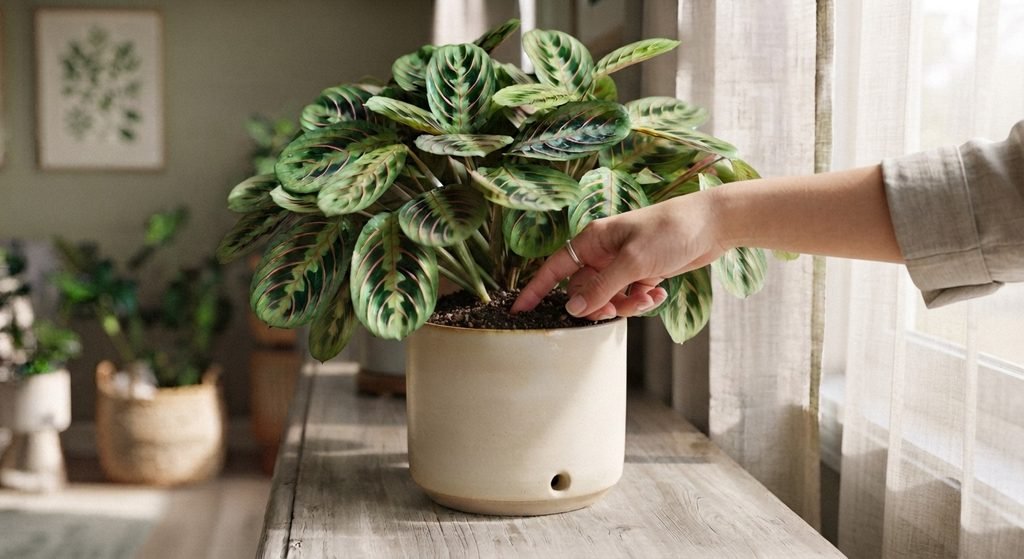
Prayer plants generally prefer soil that stays consistently moist without becoming waterlogged. Missouri Botanical Garden specifically places prayer plants among indoor plants that prefer evenly moist soil.
That means there isn’t one perfect watering schedule for every home.
A plant in a warm, bright room may use water faster than one sitting in a cooler, darker location.
Instead of watering purely by the calendar:
- Check the potting mix.
- Feel the moisture in the soil.
- Consider how quickly the pot is drying.
- Water when the plant needs it rather than following an arbitrary schedule.
- Make sure excess water can drain away.
Can You Overwater a Prayer Plant?
Yes.
“Likes moisture” does not mean “likes sitting in water.”
Poor drainage and persistently wet conditions can contribute to root problems. Missouri Botanical Garden notes that root rot can occur in poorly drained soil.
This is why watering and drainage have to be considered together.
What Type of Water Is Best for Prayer Plants?
Water quality can sometimes matter when a plant develops recurring leaf-edge problems, particularly in sensitive houseplants.
If your prayer plant repeatedly develops brown edges despite otherwise appropriate care, consider looking at the quality of your tap water as one possible factor.
However, don’t immediately assume water quality is the cause.
Check the bigger picture first:
- Is the air extremely dry?
- Is the plant getting too much direct sun?
- Is the soil drying excessively?
- Is watering inconsistent?
- Is fertilizer accumulating in the soil?
- Are there signs of pests?
A single symptom can have several possible causes.
How Much Humidity Do Prayer Plants Need?
Prayer plants come from tropical environments, so they generally appreciate higher humidity than many typical indoor plants.
Dry indoor air can contribute to leaf-edge browning and other stress symptoms.
Missouri Botanical Garden specifically suggests a humidified room or a tray of wet pebbles as possible ways to increase humidity around a prayer plant.
Ways to Improve Humidity
You can consider:
- Using a room humidifier
- Grouping compatible plants together
- Keeping the plant away from very dry heat sources
- Using a suitable humidity tray
- Monitoring the room rather than guessing
A humidifier is particularly useful when several tropical houseplants are growing in the same dry indoor environment.
Remember that humidity alone can’t compensate for poor watering or drainage.
What Temperature Is Best for Prayer Plants?
Prayer plants prefer warm conditions.
Missouri Botanical Garden notes that Maranta leuconeura is grown as a houseplant in colder climates and prefers temperatures that do not fall below about 60°F (16°C). It is also intolerant of frost.
Keep the plant away from:
- Cold drafts
- Frost
- Very cold windows during winter
- Sudden temperature changes
- Strong heat sources
A stable indoor environment is generally easier for a tropical houseplant than repeated temperature swings.
What Soil Is Best for Prayer Plants?
Prayer plants need a growing medium that can retain moisture while still allowing excess water to drain.
Missouri Botanical Garden notes that prayer plants perform well in a soil-based potting mix and emphasizes well-drained soil.
A practical mix should avoid becoming a dense, waterlogged mass.
When choosing or preparing a potting mix, think about two competing needs:
Moisture retention + drainage
You don’t want water to disappear immediately, but you also don’t want the roots sitting in stagnant water.
Choosing the Right Pot
A suitable pot can make watering easier.
Look for a container with:
- A drainage hole
- Enough room for the root system
- A size appropriate for the plant
- A stable base
Avoid automatically choosing a very large pot.
A much larger container can hold more moisture around the roots for longer, making it harder to manage watering.
A pot that fits the plant’s current root system is usually a more practical choice.
Should You Fertilize Prayer Plants?
Prayer plants can benefit from feeding during active growth, but more fertilizer isn’t necessarily better.
Missouri Botanical Garden recommends monthly fertilization during the growing season and substantially reducing fertilizer applications from autumn through late winter.
Follow the directions for your chosen fertilizer rather than assuming that a stronger concentration will produce faster growth.
If your plant is struggling because of poor light, watering problems, pests, or root damage, fertilizer isn’t a substitute for fixing the underlying issue.
How Do You Prune Prayer Plants?
Prayer plants generally don’t require aggressive pruning.
Pruning can instead be used to:
- Remove damaged foliage
- Improve the plant’s appearance
- Remove severely affected leaves
- Encourage a tidier shape
Use clean tools when trimming.
Don’t remove healthy foliage simply because one leaf looks slightly imperfect. A few cosmetic imperfections don’t necessarily mean the whole plant is unhealthy.
How Do You Propagate Prayer Plants?
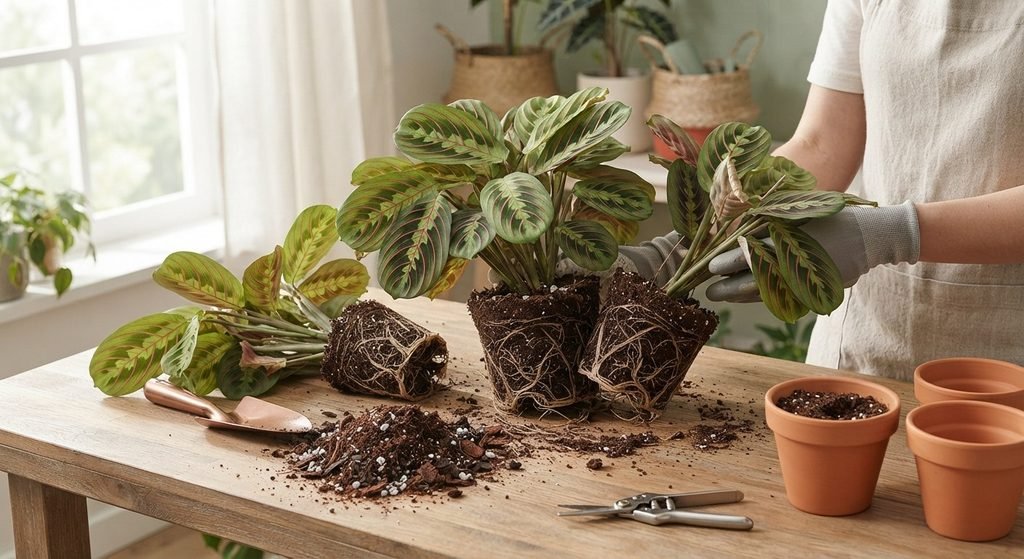
Prayer plants can be propagated through division or cuttings, depending on the plant and propagation method being used. Missouri Botanical Garden lists both cuttings and division as propagation methods for Maranta leuconeura.
Propagation by Division
Division can be useful when a mature plant has developed multiple sections.
A simplified approach is:
- Remove the plant carefully from its container.
- Examine the root system.
- Identify naturally separable sections.
- Divide carefully while preserving healthy roots.
- Replant each section in an appropriate growing medium.
- Keep the newly divided plants in suitable warm, humid conditions.
Don’t force apart sections that aren’t naturally separable.
Propagation From Cuttings
Some prayer plants can also be propagated from appropriate stem cuttings.
The success of this method depends on the plant and whether the cutting contains the necessary growth structure.
Because propagation techniques can vary among plants sold under the broad “prayer plant” label, identify the plant accurately before choosing a method.
Why Are My Prayer Plant Leaves Curling?
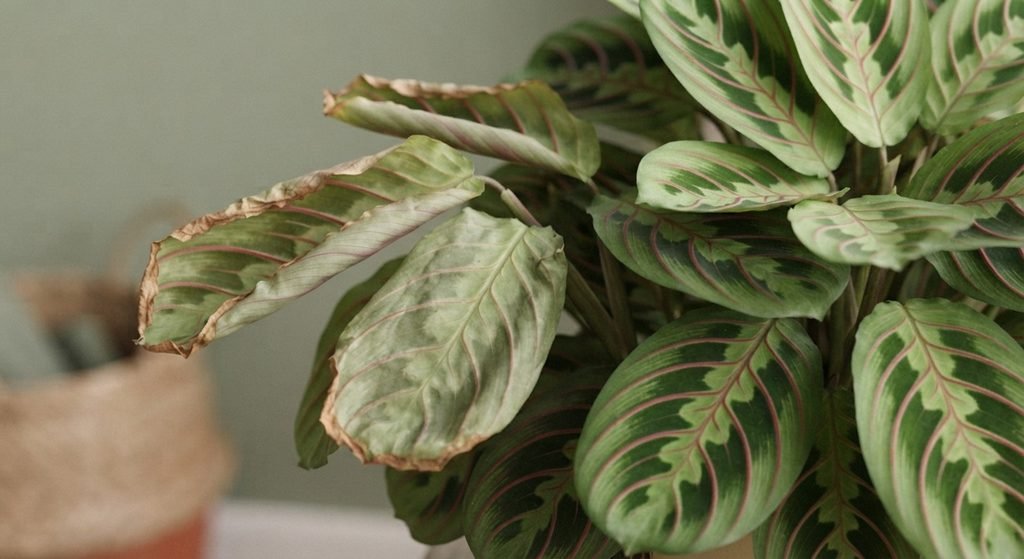
Curling leaves can be a sign that something about the plant’s growing conditions needs attention.
Possible factors include:
- The soil has become too dry
- Low humidity
- Temperature stress
- Excessive light or heat
- Root problems
- Other environmental stress
Don’t treat curling leaves as proof of one specific problem.
Start by checking the basics.
First, inspect the soil. If it is very dry, watering may be part of the issue.
Next, look at the environment. Is the plant near a heater, air conditioner, cold draft, or intense window exposure?
Then check the roots and pot. Persistently wet soil and poor drainage can cause root problems.
This symptom-based approach is more reliable than immediately changing five things at once.
Why Are Prayer Plant Leaves Turning Brown?
Brown leaf edges are another common complaint.
Potential causes include:
- Dry indoor air
- Inconsistent watering
- Excessive sunlight
- Water-quality issues
- Root stress
- Fertilizer buildup
- General environmental stress
The important point is that brown edges are a symptom, not a diagnosis.
If the brown areas are appearing repeatedly, examine the plant’s entire environment.
Ask:
- Is the soil drying too much?
- Is the room very dry?
- Is the plant receiving harsh sunlight?
- Is drainage poor?
- Are there pests?
- Has the plant recently been moved?
Looking for patterns can reveal much more than reacting to one damaged leaf.
Why Are Prayer Plant Leaves Turning Yellow?
Yellow leaves can have several causes, including watering problems and root stress.
If the soil remains wet for a long time, investigate drainage before adding more water.
Check:
- Whether the pot has drainage holes
- Whether water is collecting in the container
- Whether the potting mix is staying saturated
- Whether the roots appear healthy
- Whether the plant has been exposed to other environmental stresses
Missouri Botanical Garden notes that poorly drained conditions can contribute to root rot in prayer plants.
Avoid assuming that every yellow leaf means the plant simply needs more water.
Why Is My Prayer Plant Drooping?
Drooping can happen when a plant is stressed.
Check the soil first.
If the soil is extremely dry, the plant may be responding to insufficient moisture. If the soil is constantly saturated, the opposite problem may be occurring.
Also check:
- Light conditions
- Temperature
- Humidity
- Recent repotting
- Root condition
- Pest activity
A useful rule is to investigate the environment before reaching for fertilizer or changing the entire care routine.
Common Prayer Plant Pests
Prayer plants can be affected by common houseplant pests.
Missouri Botanical Garden specifically identifies spider mites, mealybugs, and thrips as pests to watch for.
Inspect your plant regularly, especially around:
- Leaf undersides
- Leaf joints
- New growth
- Stems
Early detection generally makes pest problems easier to manage.
If you see unusual spotting, webbing, tiny insects, sticky residue, or distorted new growth, investigate rather than assuming the issue is simply watering.
Common Prayer Plant Care Mistakes
Even well-intentioned plant owners can accidentally make care more difficult.
1. Giving Too Much Direct Sun
Prayer plants appreciate bright conditions, but strong direct sunlight can damage or fade their foliage.
2. Watering on a Rigid Schedule
“Every Sunday” isn’t necessarily the right schedule for every plant.
Indoor conditions change.
Check the soil instead.
3. Keeping the Soil Permanently Soggy
Moisture is useful. Waterlogging is not.
Poor drainage can contribute to root problems.
4. Ignoring Humidity
A tropical plant placed directly beside a dry heat source may struggle even when watering is otherwise reasonable.
5. Changing Everything at Once
If the plant looks unhappy, don’t immediately change the light, soil, pot, fertilizer, water, and location simultaneously.
Change one or two obvious problems first and observe the response.
That makes troubleshooting much easier.
A Simple Prayer Plant Care Checklist
Use this quick checklist when checking your plant:
- The plant receives bright, indirect light.
- The soil is moist but not constantly waterlogged.
- The pot has adequate drainage.
- The plant isn’t exposed to frost or cold drafts.
- Indoor humidity isn’t excessively low.
- Leaves are checked regularly for pests.
- Damaged leaves are removed when appropriate.
- Fertilizer is used according to the product directions.
- The plant is monitored for changes rather than cared for by a rigid calendar.
Do Prayer Plants Need Special Care?
Prayer plants aren’t necessarily impossible for beginners, but they can be less forgiving than some very drought-tolerant houseplants.
Their biggest challenge is balance.
They like moisture, but not soggy soil.
They like bright light, but not harsh direct sun.
They appreciate humidity, but humidity won’t fix poor drainage.
They like warmth, but that doesn’t mean placing them directly beside a heater.
Once you understand these balances, their care becomes much more straightforward.
Where Should You Place a Prayer Plant?
A bright room with filtered or indirect light is usually a good starting point.
Think about the conditions around the plant, not just the appearance of the spot.
A location may look beautiful beside a sunny window, but if intense afternoon sunlight hits the leaves for hours, it may not be the best choice.
Likewise, a dark shelf may look perfect but provide too little usable light.
A good location should balance:
Light + temperature + humidity + accessibility for watering
If you can easily monitor the plant, you’ll also notice changes sooner.
Bottom Line: How Do You Keep Prayer Plants Healthy?
The basic formula is surprisingly simple:
Give prayer plants bright indirect light, keep their soil consistently moist without waterlogging it, provide warm conditions and good humidity, and monitor the leaves and soil regularly.
When something goes wrong, don’t immediately assume you have found the answer.
Look at the whole environment.
A curling leaf, brown edge, yellow leaf, or drooping stem can have more than one possible explanation. Good plant care is often less about following a perfect schedule and more about noticing patterns and responding appropriately.
That’s what makes caring for prayer plants rewarding. Once you learn to read the plant’s signals, the process becomes much less mysterious.
Frequently Asked Questions
How often should you water prayer plants?
Watering frequency depends on indoor temperature, light, humidity, pot size, and soil. Instead of following a fixed calendar, check the growing medium and aim to keep it consistently moist without leaving the roots waterlogged.
Do prayer plants need direct sunlight?
Generally, no. Prayer plants prefer bright indoor light without strong direct sun. Excessive direct sunlight can bleach their attractive foliage.
Why are my prayer plant leaves curling?
Curling leaves can be associated with dry soil, low humidity, temperature stress, excessive light or heat, or root problems. Check the plant’s soil and environment before deciding on a single cause.
Why are prayer plant leaves turning brown?
Brown edges can result from dry air, inconsistent watering, strong sunlight, water-quality issues, root stress, or other environmental problems. Look for a pattern rather than assuming one cause.
Are prayer plants difficult to care for?
They can require more attention than very drought-tolerant houseplants because they prefer consistent moisture and warm, humid conditions. With the right environment, however, their care can become quite manageable.
What type of soil is best for prayer plants?
Choose a growing medium that retains appropriate moisture while still draining well. Avoid heavy soil that remains saturated for long periods.
Can you propagate prayer plants?
Yes. Depending on the plant, propagation can be done through division or suitable cuttings. Missouri Botanical Garden lists both methods for Maranta leuconeura.
Why do prayer plant leaves move?
Prayer plant leaves naturally change position during the day and night. The upward movement at night is associated with the common name “prayer plant.”
Do prayer plants like humidity?
Yes. As tropical plants, they generally appreciate humid conditions. If indoor air is particularly dry, increasing humidity can be helpful. Missouri Botanical Garden specifically recommends options such as a humidified room or a wet-pebble tray.
Can prayer plants grow indoors?
Yes. Prayer plants are commonly grown as indoor foliage plants in climates where outdoor conditions aren’t warm enough for them.
Final Takeaway
Prayer plants may look a little demanding at first, but their care becomes much easier once you understand what they need. Give them bright, indirect light, consistent moisture, good drainage, warmth, and adequate humidity, and keep an eye on changes in their leaves.
The key is not to follow a rigid routine. Instead, pay attention to your plant and its growing environment. If the leaves curl, turn brown, or start drooping, treat those changes as clues rather than immediately assuming something is wrong with your entire care routine.
With a little consistency and patience, prayer plants can become a beautiful and rewarding addition to your indoor garden.







One Response