You come across an unfamiliar word, search for its meaning, and expect a straightforward answer. Instead, one website calls it a lifestyle idea, another connects it with design, and a third uses it as a publishing name.
That’s what makes Merfez an interesting term to investigate.
The short answer: Merfez is a name appearing in different online contexts, without one widely established dictionary definition. Some websites use it as a publishing identity, while lifestyle articles associate it with simplicity, organization, and intentional choices. Its exact linguistic origin remains unverified.
So, is Merfez a useful concept, a brand, or simply an unusual internet name? The answer depends on where you encounter it.
Let’s separate what’s documented from what’s open to interpretation—and explore which ideas might actually be useful in everyday life.
What Is Merfez?
Merfez is a context-dependent online name, not a clearly established lifestyle movement or standard English dictionary term. It appears in connection with publishing websites and in articles about home organization, productivity, design, and simpler living.
The distinction matters because these references don’t necessarily describe the same thing.
For example, Merfez.org is an informational website with categories covering technology, business, artificial intelligence, and home improvement. Another website, Merfez.co.uk, publishes general-interest content across several categories.
Meanwhile, some independent writers use Merfez to discuss arranging comfortable living spaces, reducing unnecessary distractions, and making deliberate choices.
The websites are observable uses of the name. The broader lifestyle meaning is an interpretation, not a verified set of principles issued by an established organization.
Understanding that difference prevents an interesting idea from turning into an unsupported claim.
What Does Merfez Mean?
The meaning of Merfez depends on how someone is using it.
At present, three contexts are especially relevant.
1. A Website or Publishing Identity
Merfez is used in the names and descriptions of online publications. In this setting, it works like a brand name rather than an ordinary vocabulary word.
Interestingly, Merfez.org also displays the spelling Merfaz in parts of its presentation. That variation is visible, but it doesn’t establish an officially recognized alternative spelling or explain why the difference exists.
2. An Informal Lifestyle Interpretation
Some online articles associate Merfez with thoughtful organization, purposeful living, simplicity, and comfortable surroundings.
Translated into everyday advice, that interpretation might suggest keeping things that serve a useful or meaningful purpose while reducing unnecessary clutter.
But there’s an important qualification: these associations aren’t evidence of an established Merfez philosophy with an official definition.
They’re ways individual writers have chosen to explain or apply the name.
3. A Broad Online Concept
Other discussions connect Merfez with productivity, digital organization, creativity, or technology.
These descriptions vary significantly. Without documentation linking them to one identifiable project, they shouldn’t be combined into a single product or system.
The most accurate meaning comes from context, not from assuming every search result describes the same entity.
Where Did Merfez Come From?
The origin of Merfez hasn’t been reliably established through authoritative linguistic evidence or a documented account from its creator.
One explanation appearing online links it to the Turkish word merkez.
According to the Cambridge English–Turkish Dictionary, the English word “center” translates to merkez in Turkish.
The resemblance between Merfez and merkez is noticeable. It may also sound appealing to writers discussing the idea of keeping important things at the center of everyday life.
However, similar spelling doesn’t establish a shared origin.
To confirm a linguistic connection, researchers would need something more substantial, such as an early documented use, a credible etymological record, or a direct explanation from whoever created the name.
None of the material reviewed establishes that connection.
There’s also no reliable basis for assigning Merfez an ancient cultural history, a particular founder, or a traditional meaning.
It’s perfectly reasonable to explore possible associations. Presenting those possibilities as established history would be misleading.
Why Is Merfez Appearing Online?
Unfamiliar names naturally invite questions, especially when search results give several different explanations.
A person looking for Merfez might encounter an informational website, an article describing a design philosophy, or a discussion of digital productivity.
That variety helps explain why the term can seem confusing.
Different Writers May Be Describing Different Things
A home-design writer might use Merfez to describe comfortable, organized rooms.
A technology-focused website might discuss it as an online identity.
Another writer may connect it with intentional living or better daily habits.
Those explanations can exist online without sharing an origin or referring to an officially established concept.
There’s also a difference between a term appearing repeatedly in search results and a term becoming a widely adopted movement. Repetition alone doesn’t establish popularity, cultural significance, or accuracy.
How to Evaluate Competing Definitions
When you encounter an unfamiliar internet term, use three simple checks:
- Identify the source. Is the word being used by a website that carries the name, or by someone independently explaining it?
- Look for original evidence. Does the source identify a creator, dictionary entry, documented history, or official description?
- Separate observations from interpretations. A website’s visible categories can be verified. A claim that the name represents an established philosophy needs additional support.
This approach works for other unfamiliar online expressions, too.
Sometimes the most useful discovery isn’t a neat definition. It’s recognizing that several apparently confident explanations don’t have equally strong evidence.
How Can Merfez Apply to Everyday Life?
Although Merfez isn’t a documented lifestyle system, the ideas some writers associate with it can still offer useful inspiration.
Think of them as prompts rather than rules.
You don’t need to adopt a new philosophy to appreciate a less cluttered countertop, a comfortable reading corner, or a workday with fewer distractions.
The following examples are practical applications of simplicity and intentional organization, not officially prescribed Merfez techniques.
Home Organization and Comfortable Spaces

Picture a living room with a comfortable sofa, a bookcase, a coffee table, and a collection of family photos.
Nothing about that room needs to be minimalist.
But if the table has become a permanent home for mail, charging cables, receipts, and things nobody remembers putting there, the space may feel harder to use.
A thoughtful adjustment could involve:
- Moving paperwork to one designated location.
- Keeping frequently used items within easy reach.
- Rearranging furniture to make walking paths clearer.
- Displaying meaningful objects rather than filling every available surface.
- Using lighting and textiles to make the room comfortable.
The goal isn’t an empty room. It’s a room that suits the people living in it.
This overlaps with established interior-design principles concerning function, layout, scale, and personal expression.
HomeWorks Daily’s guide to why interior design is interesting explores how seemingly small choices can affect the usefulness and appearance of a room.
Workspaces and Daily Productivity
A desk doesn’t need expensive accessories to work well.
Often, the most useful improvement is understanding what belongs there.
Consider a person who works from home and regularly searches for a notebook beneath loose papers, unopened mail, and charging equipment.
Instead of buying another desk organizer immediately, they could begin by grouping related items and removing what doesn’t support their usual tasks.
A straightforward arrangement might include a clear writing area, one place for active documents, and a drawer or container for accessories.
There’s no magic productivity formula here.
The practical advantage is simply making frequently used items easier to find and giving each task an appropriate space.
And if your favorite coffee mug lives on the desk? That’s fine. Organization doesn’t require your workspace to resemble an empty showroom.
Digital Organization and Simpler Routines
Physical clutter isn’t the only kind that deserves attention.
Digital files can become difficult to manage when downloads, photos, screenshots, and documents are scattered across different locations.
A simplicity-inspired approach might involve naming folders clearly, deleting unnecessary duplicate files, and reviewing distracting notifications.
For example, someone managing household paperwork could maintain separate folders for insurance, home repairs, warranties, and utilities.
That makes more sense than storing every document in a folder called “Important Stuff,” especially when important stuff has a habit of multiplying.
The same principle can apply to routines.
Rather than maintaining a complicated daily schedule, identify a few tasks that genuinely need attention and leave reasonable room for unexpected responsibilities.
The benefit comes from choosing a manageable system—not from attaching a particular name to it.
Merfez vs. Minimalism: What Is the Difference?
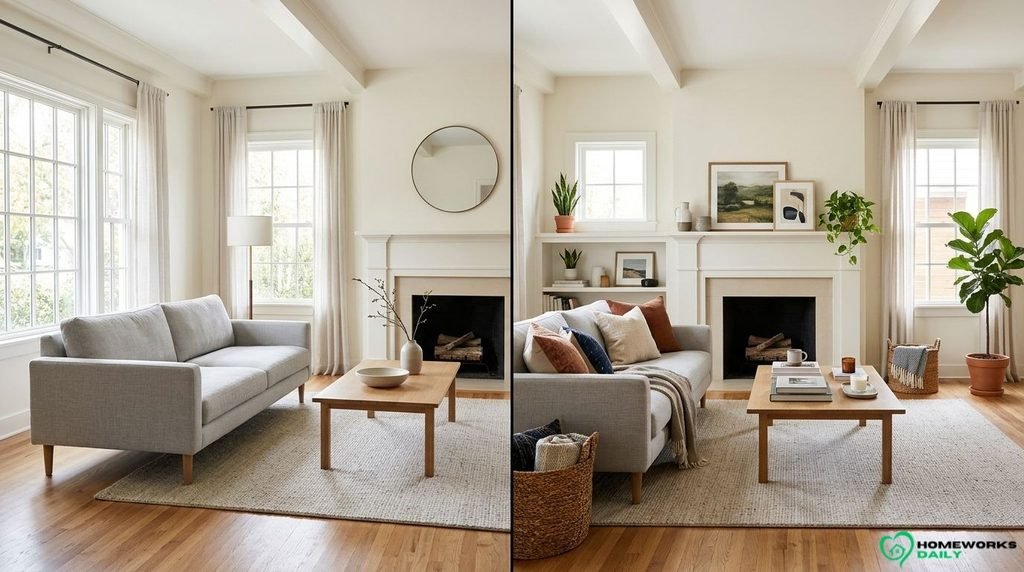
Minimalism is an established term in design and other creative fields. Merfez, as a lifestyle description, is not comparably established.
Merriam-Webster describes minimalism in terms of spareness and simplicity in areas such as art, design, and literature.
Everyday minimalist living is also commonly associated with simplifying possessions and making intentional choices.
Some descriptions of Merfez overlap with those ideas, particularly when discussing clutter, organization, and purposeful spaces.
The comparison below explains that overlap without treating Merfez as a formally recognized competing philosophy.
| Aspect | Merfez-Inspired Interpretation | Established Minimalist Approach |
| Basic idea | An informal emphasis on useful, meaningful, and organized surroundings | A recognized approach emphasizing simplicity and reduction |
| Number of possessions | No documented standard or required limit | Often encourages reducing unnecessary possessions |
| Home appearance | Can be interpreted as warm, personal, and functional | Often favors restrained arrangements, though personal styles vary |
| Decorating choices | Keep objects that support comfort or everyday use | Emphasize deliberate selection and avoiding excess |
| Personal expression | Can include sentimental objects, collections, and layered decor | Can also accommodate meaningful objects and personality |
| Formal definition | No verified universal lifestyle definition | Established meanings in dictionaries and design history |
This is a comparison of an informal interpretation with an established concept, not two officially documented design systems.
One misconception deserves particular attention: minimalism doesn’t automatically mean cold, colorless rooms.
A minimalist home can include family photographs, colorful artwork, comfortable furniture, and sentimental belongings.
Likewise, calling a room Merfez-inspired doesn’t make it fundamentally different from other thoughtfully organized spaces.
For most homeowners, the useful question isn’t which label sounds more appealing.
It’s whether a particular arrangement makes daily life easier.
Practical Ways to Apply Merfez-Inspired Ideas at Home
You don’t need a big budget, specialized equipment, or a complete weekend makeover to experiment with the practical ideas associated with Merfez.
Start with a problem you can identify.
Perhaps shoes collect near the front door. Your kitchen drawers are difficult to navigate. Or your bedroom has become a holding area for things that belong elsewhere.
Choose one issue and address it before moving on.
A Simple Checklist for a More Functional Home
Use this checklist as a flexible starting point:
- Choose one small area. Start with a drawer, shelf, counter, or corner rather than the entire house.
- Identify its purpose. Decide what the space needs to accommodate.
- Remove unrelated items. Return misplaced belongings to their appropriate locations.
- Keep useful things accessible. Frequently used items should be convenient, not buried behind decorative objects.
- Make room for personality. Comfort, photographs, books, and favorite belongings aren’t automatically clutter.
- Reuse what you own. Existing baskets, jars, trays, and containers may provide enough organization.
- Buy only when necessary. Measure the available space and identify a specific need before purchasing an accessory.
- Review the result. If the arrangement creates extra work, adjust it.
A successful setup doesn’t have to be photograph-worthy.
It only needs to work for your household.
Step-by-Step Example: A More Useful Entryway
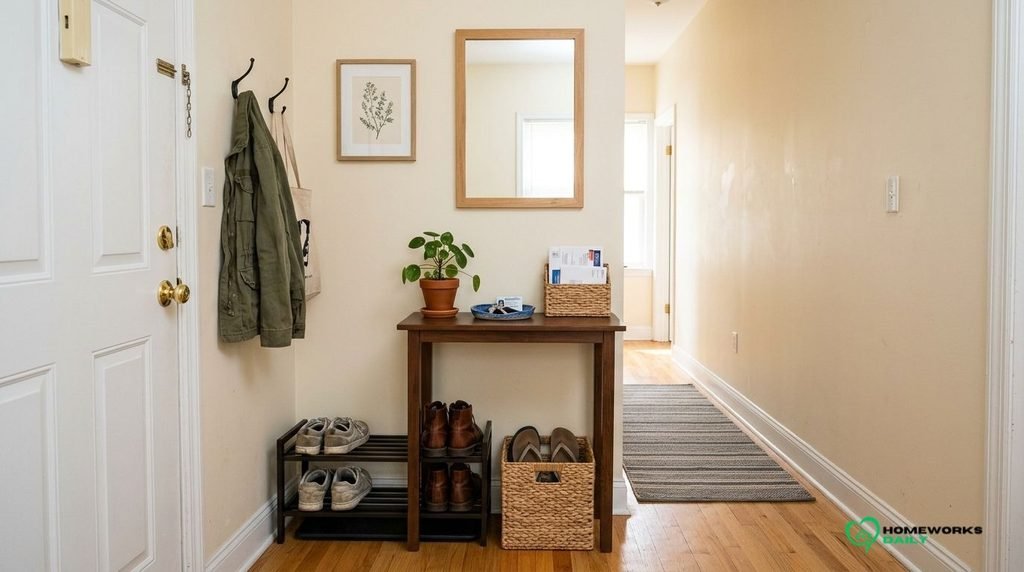
Consider a hypothetical apartment where keys disappear, shoes block the doorway, and incoming mail piles up on a narrow console table.
Here’s one practical way to improve it.
Step 1: Clear the immediate area.
Remove items that don’t belong near the entrance. Set aside anything that needs to be returned, recycled, or put in storage.
Step 2: Identify what happens there.
The residents put down keys, remove shoes, and bring in mail. Those are the entryway’s main everyday functions.
Step 3: Assign simple storage locations.
Place a small tray for keys on an existing surface, designate a shoe area, and choose a location for incoming paperwork.
Keep the doorway and walking route unobstructed.
Step 4: Add comfort only where useful.
If space allows, a washable mat or a small seat might make the entrance more convenient. But neither is necessary if it creates crowding.
Step 5: Test the arrangement.
After several days, check whether the setup supports actual habits.
If everyone continues leaving keys somewhere else, move the tray rather than insisting the entire household change its routine.
That’s a practical way to make a home work better: observe the problem, make a manageable adjustment, and refine it based on use.
There’s no need to call it a formal Merfez method.
Should You Buy Anything?
Not automatically.
Sometimes a new shelf, storage bin, or desk accessory solves a real problem. Other times, purchasing more containers simply gives you additional things to organize.
Before spending money, ask:
- What problem will this item solve?
- Do I already own something that can perform the same function?
- Will the item fit the available space?
- Will it be easy to use and maintain?
- Is it useful enough to justify the expense?
When decorating is genuinely part of the goal, HomeWorks Daily’s room decor ideas under $200 offer practical ways to think about affordable room improvements.
But remember: a freshly rearranged room can feel different even when you haven’t purchased a single thing.
Common Misunderstandings About Merfez
Because Merfez appears in different contexts, several assumptions are worth questioning.
Misunderstanding 1: Merfez has one official meaning.
No universally established definition was confirmed in the sources reviewed. Website uses and informal interpretations should be identified separately.
Misunderstanding 2: Merfez definitely comes from Turkish.
The resemblance to merkez is real, but the proposed etymological relationship remains unverified.
Misunderstanding 3: Merfez is an established design movement.
Some articles describe it through design-related ideas, but that doesn’t establish a recognized movement, founder, or historical tradition.
Misunderstanding 4: Merfez is necessarily a technology product.
The name appears in technology-related publishing. That alone doesn’t demonstrate the existence of a particular software application, proprietary platform, or paid service.
Misunderstanding 5: Merfez-inspired living requires buying certain products.
There are no verified universal product requirements. The practical examples discussed here can often be attempted with belongings already available at home.
Misunderstanding 6: Multiple similar online definitions prove they’re correct.
Writers can repeat interpretations without establishing their original source.
A useful explanation should distinguish what can be checked from what someone has merely suggested.
Frequently Asked Questions About Merfez
What does Merfez mean in simple terms?
Merfez is an online name used in different contexts, including informational publishing websites. Some independent articles also associate it with simplicity, organization, and intentional living. However, those lifestyle associations aren’t an established dictionary definition. The meaning depends on the specific source and how it uses the name.
Is Merfez a real word?
Merfez is real in the sense that it’s used as a name on websites and appears in online writing. However, current research hasn’t established it as a standard English word with a widely accepted dictionary meaning. A name can have practical significance without being a recognized word in ordinary English vocabulary.
Where did Merfez originate?
The precise origin of Merfez remains uncertain. Some writers suggest a connection to the Turkish word merkez, meaning center, but no verified historical or linguistic evidence establishes that derivation. There also isn’t enough documentation to identify a definitive creator or the first use of the name.
Is Merfez the same as minimalism?
Not exactly. Minimalism is an established concept associated with simplicity and reduction, especially in art and design. Merfez is sometimes given similar lifestyle meanings online, but it lacks an independently established set of principles. Any comparison is therefore between informal Merfez interpretations and existing minimalist practices.
How is Merfez used in home design?
Some lifestyle writers use Merfez to discuss organized, comfortable, and practical surroundings. A Merfez-inspired decorating idea might involve keeping furniture functional, making storage accessible, and preserving meaningful personal touches. These are suggested applications of familiar design principles, not requirements of a recognized Merfez decorating style.
Does Merfez refer to a website or brand?
Yes. Websites using the Merfez name publish informational content across various subjects. Merfez.org and Merfez.co.uk are observable examples. However, their use of similar names doesn’t establish common ownership or prove that every online description of Merfez refers to the same organization, service, or product.
Are there any official rules for Merfez?
No universal set of official Merfez lifestyle rules was verified. Suggestions about decluttering, focused work, or intentional choices come from informal interpretations. Readers can experiment with these ideas without treating them as obligations or assuming they belong to a formally established method.
Final Thoughts on Merfez
Merfez is a good example of how an unfamiliar online name can attract several different explanations.
What’s established is that the name appears in publishing contexts. What’s less certain is its origin and the broader lifestyle meaning that some writers attach to it.
There’s still something useful to take away.
You don’t need to subscribe to an unfamiliar philosophy to make thoughtful decisions about your home, belongings, or daily routines. A functional desk, an easier-to-use kitchen, or a more comfortable living room can be worthwhile improvements on their own.
Start with what needs attention, use what you already have, and make changes that suit your life rather than someone else’s ideal.
For more practical inspiration, explore HomeWorks Daily’s home improvement guides for decorating ideas, approachable projects, and everyday solutions.
The best improvement isn’t always the most impressive-looking one. Sometimes, it’s simply the change that makes tomorrow morning a little easier.