A cluttered desk drawer has a way of creating small frustrations throughout the day. You open it looking for a pen and find old receipts, tangled charging cables, dried-out markers, random paper clips, and items you forgot you even owned. Before you know it, five minutes have disappeared just searching for something simple.
Learning how to organize desk drawers is not just about making your workspace look better. A well-organized drawer helps you work faster, reduces distractions, and makes your desk feel calmer. Whether you have a large home office, a small apartment workspace, a student desk, or a remote work setup, the right organization system can help you get more from the space you already have.
The key is not buying dozens of storage products and hoping they solve the problem. Good desk drawer organization starts with understanding what you actually use, grouping similar items together, and creating a system that is easy to maintain.
In this guide, you’ll learn practical methods to organize desk drawers, storage ideas for different needs, common mistakes to avoid, and simple solutions for small spaces. These ideas are designed for real homes where drawers need to handle everyday items, not just look perfect in photos.
For more practical home improvement, organization, and lifestyle inspiration, Homework Daily shares useful ideas to help homeowners and renters create more functional spaces.
Quick Answer
How to organize desk drawers: Empty each drawer completely, remove items you no longer need, group similar items together, add dividers or small containers, and place frequently used items where they are easiest to reach. Keep daily essentials in the top drawer and store occasional-use items separately.
Why Organizing Desk Drawers Matters
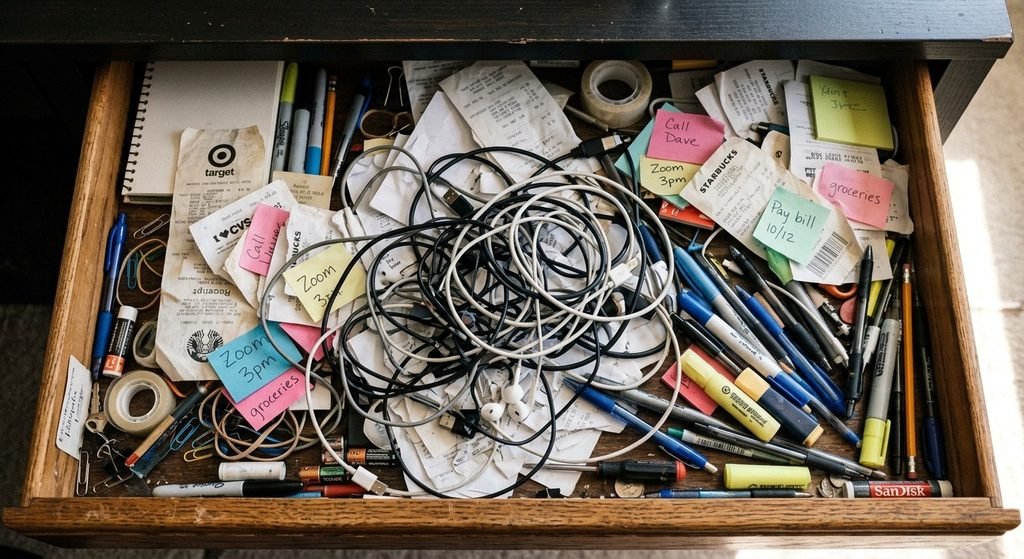
A desk drawer may seem like a small part of your home, but it plays an important role in how efficiently you use your workspace.
Whether you are answering emails, studying, managing household tasks, or working remotely, your environment affects how easily you can focus. A drawer filled with random objects creates unnecessary decision-making. A drawer with a clear purpose saves time.
1. Saves Time During Busy Days
Small interruptions add up.
Searching for a USB cable, notebook, or important document might only take a few minutes, but repeating that process every day creates frustration.
An organized drawer allows you to quickly answer:
- Where are my pens?
- Where do I keep charging cables?
- Where are my office supplies?
- Where can I find important paperwork?
Everything has a predictable place.
2. Creates a More Comfortable Workspace
A clean desk surface is helpful, but hidden clutter matters too.
Many people move items from their desk into drawers without actually organizing them. The result is a drawer that becomes a “temporary storage box” rather than a useful workspace tool.
A properly organized drawer supports a cleaner, more relaxing environment.
3. Helps You Use Your Space Better
Most desks have limited storage. Instead of needing a bigger desk, better organization can help you maximize the space you already have.
For example:
- A shallow drawer can hold stationery using small trays.
- A deep drawer can store notebooks, chargers, or technology accessories.
- A filing drawer can manage household paperwork.
The goal is not to fit more things inside. The goal is to make every item easier to find.
4. Reduces Unnecessary Purchases
Have you ever bought another pack of pens because you couldn’t find the ones you already had?
Disorganized drawers often make people purchase duplicate items.
When everything is visible and categorized, you know exactly what you own.
How to Organize Desk Drawers Step-by-Step
The easiest way to organize desk drawers is to treat the process like creating a small storage system. Don’t simply move items around. Decide what belongs where and why.
Step 1: Remove Everything From the Drawer

Start with a completely empty drawer.
Trying to organize items while they are still inside usually creates a temporary improvement that quickly becomes messy again.
Place everything on your desk or a clean surface.
Create a simple sorting area:
| Category | Examples |
| Keep | Items you use regularly |
| Move | Items that belong somewhere else |
| Donate | Useful items you no longer need |
| Trash | Broken or expired items |
This first step often reveals how many unnecessary items are taking up valuable space.
Step 2: Clean the Drawer Before Adding Items Back
Once empty, clean the drawer.
Use:
- A microfiber cloth
- A vacuum attachment for dust and crumbs
- Mild cleaning spray if needed
This is also a good opportunity to check the drawer condition.
Look for:
- Broken drawer rails
- Loose handles
- Damaged liners
- Dust buildup in corners
A clean foundation makes organization easier to maintain.
Step 3: Sort Items Into Practical Categories
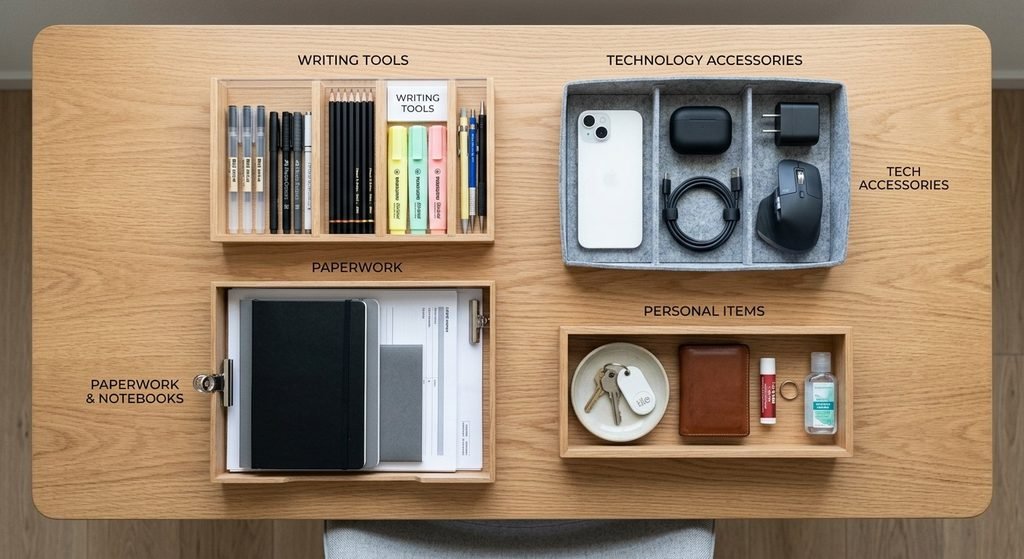
Avoid creating categories that are too specific.
For example, instead of separating every type of pen, create a practical stationery category.
Useful desk drawer categories include:
Everyday Office Supplies
Store items you reach for frequently:
- Pens
- Pencils
- Highlighters
- Sticky notes
- Paper clips
- Scissors
- Stapler
Technology Accessories
Create a dedicated area for:
- Charging cables
- USB drives
- Adapters
- Headphones
- Batteries
Personal Items
Depending on your workspace, this may include:
- Hand lotion
- Glasses
- Tissues
- Medication
- Personal notes
Paperwork
Keep important documents organized:
- Receipts
- Warranty papers
- Bills
- Forms
- Notebooks
Step 4: Decide What Belongs in Each Drawer
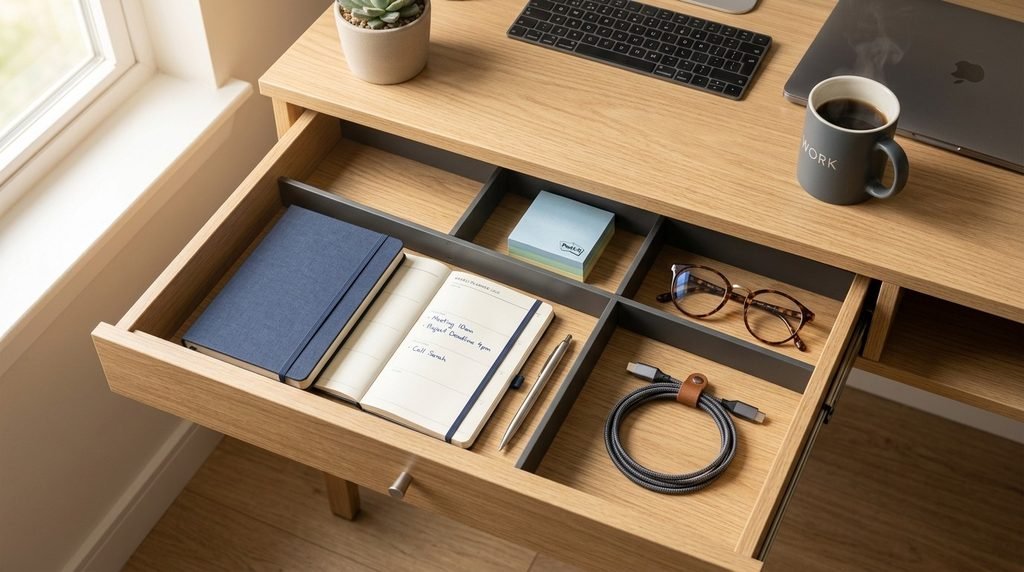
Not every drawer should have the same purpose.
A simple rule:
The closer the drawer is to you, the more frequently used the items should be.
A common setup:
| Drawer Location | Best Use |
| Top drawer | Daily essentials |
| Middle drawer | Regular office supplies |
| Bottom drawer | Files, notebooks, backup supplies |
This reduces unnecessary movement while working.
Step 5: Add Drawer Dividers and Containers
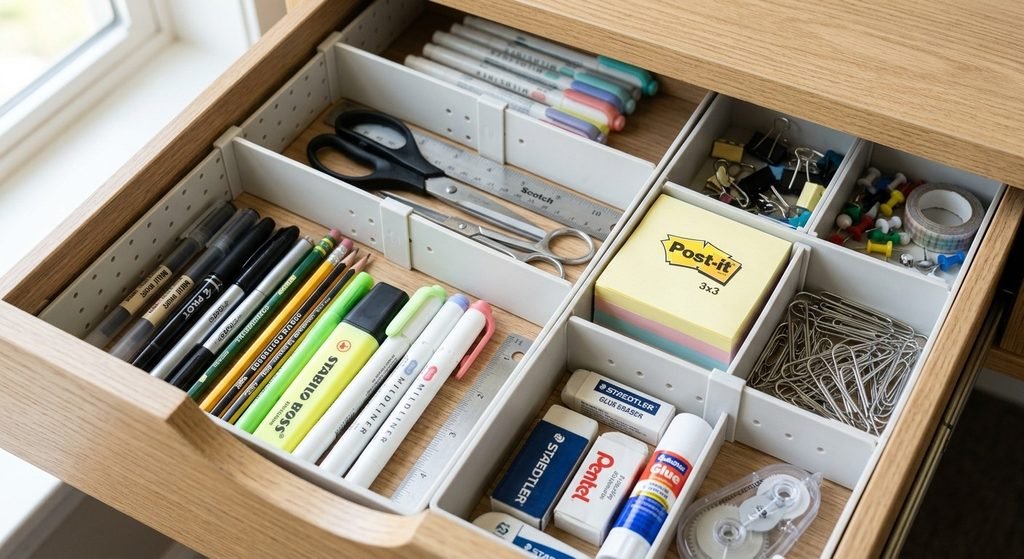
Drawer organizers are helpful because they create boundaries.
Without sections, items naturally mix together again.
Good organization tools include:
- Adjustable drawer dividers
- Small storage boxes
- Plastic trays
- Bamboo organizers
- Cable clips
- Label stickers
You don’t need expensive products. Even small recycled containers can work well for:
- Paper clips
- Erasers
- Memory cards
- Charging adapters
- Clips
The best organizer is one that matches your habits.
Step 6: Arrange Items Based on Frequency of Use
A common mistake is organizing by item type only.
Instead, organize by how often you use things.
A simple priority system:
Daily Use
Place at the front:
- Favorite pens
- Notebook
- Planner
- Computer accessories
Weekly Use
Place in the middle:
- Extra stationery
- Reference materials
- Backup chargers
Rare Use
Place at the back:
- Spare cables
- Old documents
- Replacement supplies
This makes your drawer practical instead of just visually neat.
Desk Drawer Organization Ideas for Different Needs
Everyone uses their desk differently. A student, remote worker, and business professional will not need the same setup.
Home Office Desk Drawer Setup
A home office drawer should support productivity.
Recommended layout:
Top drawer:
- Pens
- Notepad
- Sticky notes
- Headphones
Second drawer:
- Chargers
- External drives
- Computer accessories
Bottom drawer:
- Tax documents
- Business paperwork
- Manuals
Student Desk Drawer Setup
Students usually need quick access to study materials.
Useful items include:
- Highlighters
- Index cards
- USB drives
- Calculators
- Notebooks
- Study tools
Avoid storing old assignments unless they are still needed.
Remote Worker Desk Drawer Setup
Remote workers often have technology-related clutter.
Create a dedicated tech drawer:
| Item | Organization Idea |
| Charging cables | Use labeled cable ties |
| USB drives | Small container |
| Headphones | Dedicated section |
| Adapters | Small labeled box |
| Batteries | Separate battery holder |
Keeping technology organized prevents frustrating searches during meetings.
Common Desk Drawer Problems and Solutions
| Problem | Solution | Benefit |
| Too many pens and markers | Keep favorites and remove dried-out items | Saves space |
| Tangled cables | Use cable clips or small containers | Easier access |
| Important papers mixed together | Create a document section | Prevents lost paperwork |
| Small items everywhere | Add drawer trays | Creates clear categories |
| Drawer becomes messy quickly | Store items based on usage | Easier maintenance |
Best Drawer Setup for Different Drawer Types
| Drawer Type | Best Items to Store | Organization Tip |
| Shallow top drawer | Pens, notes, clips, small tools | Use slim trays |
| Medium drawer | Electronics and stationery | Create separate sections |
| Deep drawer | Files, notebooks, equipment | Use vertical organizers |
| File drawer | Documents and folders | Label categories clearly |
Space-Saving Techniques for Small Desk Drawers
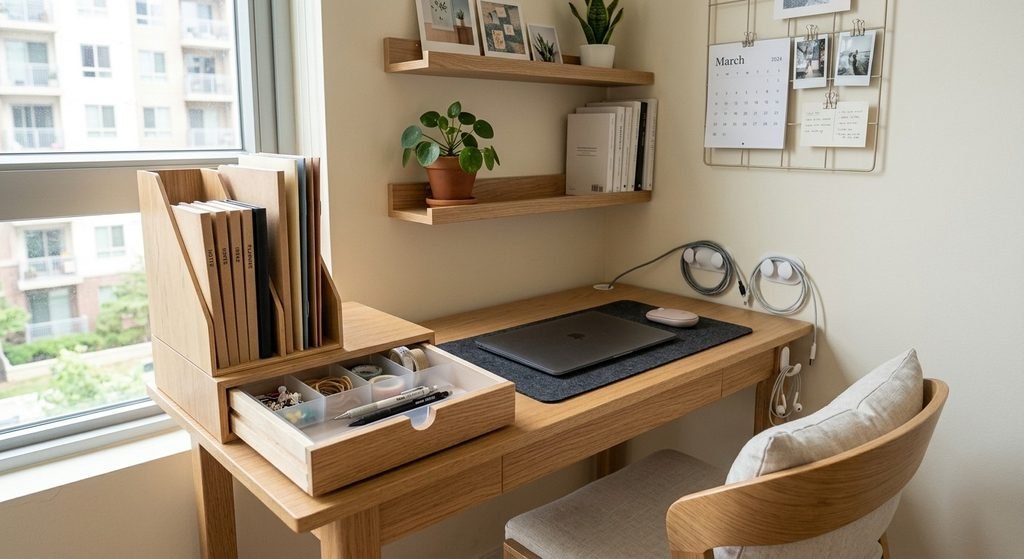
Small desks are common in apartments, dorm rooms, and compact home offices. Limited space does not mean you cannot create an organized system.
Try these ideas:
Use Vertical Space
Instead of stacking everything flat:
- Store notebooks upright
- Use standing file holders
- Place cables vertically in containers
Vertical storage makes items easier to see.
Remove Packaging
Boxes and bulky packaging take unnecessary space.
For example:
- Remove pens from large packages
- Store batteries in a small container
- Combine similar supplies
Create a “Daily Use Zone”
If your drawer is small, only store what you regularly need.
Ask yourself:
“Would I notice if this item disappeared for a month?”
If the answer is no, it probably does not need premium drawer space.
Common Mistakes People Make When Organizing Desk Drawers
Organizing a desk drawer sounds simple, but many people repeat the same mistakes that cause clutter to return within a few weeks. A drawer can look neat immediately after organizing and still fail as a system if it does not match your daily habits.
Here are the most common problems and how to avoid them.
1. Keeping Too Many Unused Items
One of the biggest mistakes is trying to organize everything instead of deciding what actually deserves space.
Many desk drawers contain:
- Pens that no longer work
- Old chargers for devices you no longer own
- Expired coupons
- Broken office supplies
- Duplicate items
- Random cables with unknown purposes
A useful rule is:
If you haven’t used something in the last 6–12 months and it has no clear purpose, it probably does not need prime drawer space.
This does not mean throwing everything away. Sentimental items or important documents can be stored elsewhere. The goal is simply to make your active workspace easier to use.
2. Buying Organizers Before Sorting Items
A common mistake is purchasing drawer trays first.
People often buy beautiful organizers, place them inside the drawer, and then discover:
- The compartments are too large
- The drawer does not close properly
- Items don’t fit
- Space is wasted
The better approach:
- Empty the drawer.
- Sort your items.
- Measure the available space.
- Choose organizers based on your actual needs.
Organization products should support your system, not create one.
3. Creating Too Many Categories
Over-organizing can become frustrating.
For example, separating:
- Blue pens
- Black pens
- Red pens
- Mechanical pencils
- Regular pencils
may look organized, but it creates unnecessary maintenance.
Most people need broader categories:
- Writing tools
- Technology accessories
- Paper supplies
- Personal items
A good system should be easy enough that you can maintain it even during busy weeks.
4. Ignoring How You Actually Work
Your drawer organization should follow your routine.
A graphic designer, student, accountant, and remote employee will all have different needs.
For example:
A remote worker may need:
- Webcam accessories
- Charging cables
- Headphones
- External storage
A student may need:
- Highlighters
- Index cards
- Calculator
- Study materials
The best organization method is not the most attractive one. It is the one that saves you time.
Best Desk Drawer Organization Ideas for Different Needs
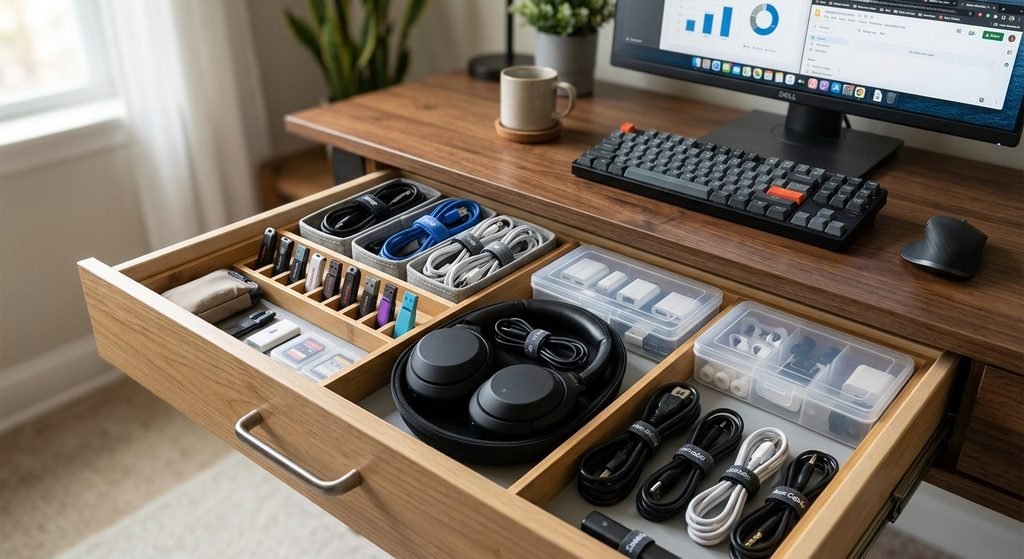
Desk Drawer Organization for Home Office Workers
A home office usually combines work, personal tasks, and household administration. This means drawers often become overloaded.
A practical setup:
Top Drawer: Daily Work Essentials
Store:
- Favorite pens
- Sticky notes
- Planner
- Notepad
- USB drives
- Glasses
Middle Drawer: Technology Items
Store:
- Charging cables
- Adapters
- Headphones
- External hard drives
- Computer accessories
Bottom Drawer: Documents and Backup Supplies
Store:
- Files
- Printer paper
- Office supplies
- Manuals
Keeping work essentials separate from backup supplies prevents daily clutter.
Desk Drawer Organization for Students
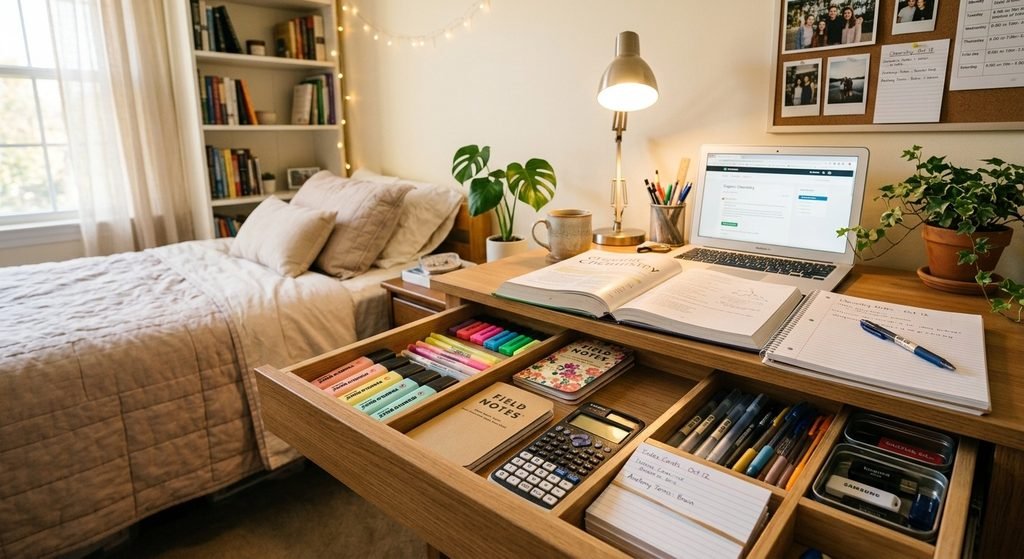
Students often have smaller desks and limited storage.
The focus should be accessibility.
Useful categories:
| Category | Items |
| Writing supplies | Pens, pencils, markers |
| Study tools | Flashcards, calculator, ruler |
| Technology | USB drives, chargers, headphones |
| Important papers | Notes, forms, assignments |
A small drawer can work surprisingly well when every item has a purpose.
Desk Drawer Organization for Small Apartments
Many people working from home don’t have a dedicated office. They may use:
- Bedroom desks
- Dining tables
- Corner workstations
- Small computer desks
For limited spaces:
Use Multi-Purpose Storage
Choose items that serve more than one purpose.
Examples:
- A notebook holder that stores documents
- A cable box that hides chargers
- Drawer dividers that can be adjusted
Keep Work Items Separate
When your desk shares space with your personal life, organization becomes even more important.
At the end of the workday:
- Return supplies to drawers
- Store cables neatly
- Clear the desk surface
This helps create a clear boundary between work and relaxation.
Desk Drawer Organization Tools and Accessories
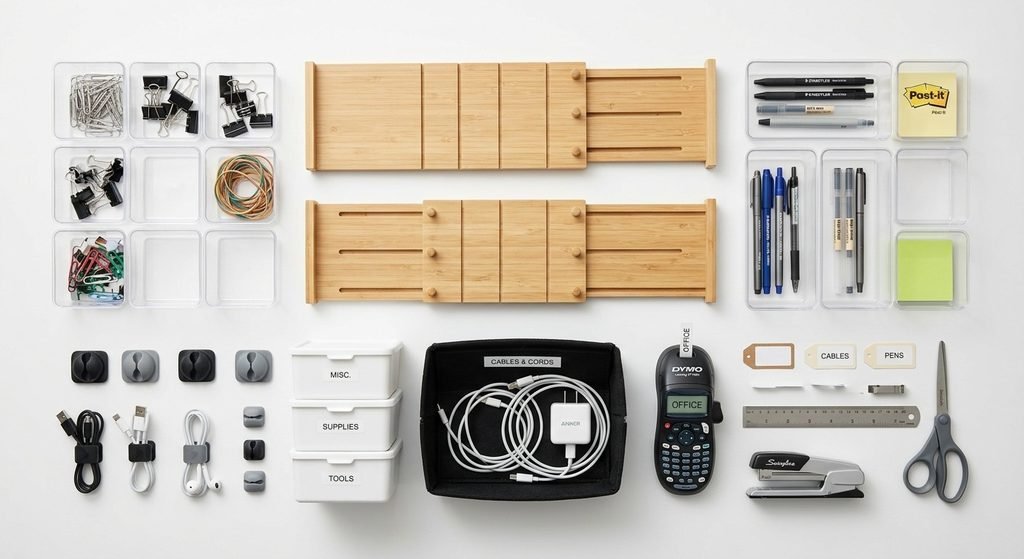
You don’t need expensive storage products, but the right tools can make organization easier.
Here are some useful categories:
| Tool | Best For | Why It Helps |
| Adjustable dividers | Mixed supplies | Creates flexible sections |
| Small trays | Pens and clips | Prevents small items spreading |
| Cable organizers | Electronics | Stops cable tangling |
| Label stickers | Documents | Makes items easier to find |
| Drawer liners | Slippery drawers | Keeps items stable |
| Small containers | Tiny accessories | Uses unused spaces |
Recommended Types of Drawer Organizers
Adjustable Drawer Dividers
Best for:
- Office supplies
- Kitchen-style desk drawers
- Changing storage needs
They allow you to resize sections as your requirements change.
Small Storage Boxes
Useful for:
- USB drives
- Memory cards
- Batteries
- Paper clips
Small boxes prevent tiny items from disappearing.
Cable Management Solutions
Technology clutter is one of the biggest desk drawer problems.
Helpful options include:
- Velcro cable ties
- Cable clips
- Small zipper pouches
- Charging stations
Labeling cables can also save time.
For example:
Instead of a drawer full of unknown cables, create labels such as:
- Laptop charger
- Phone charger
- Monitor cable
- Backup cable
Before and After Organization Approach
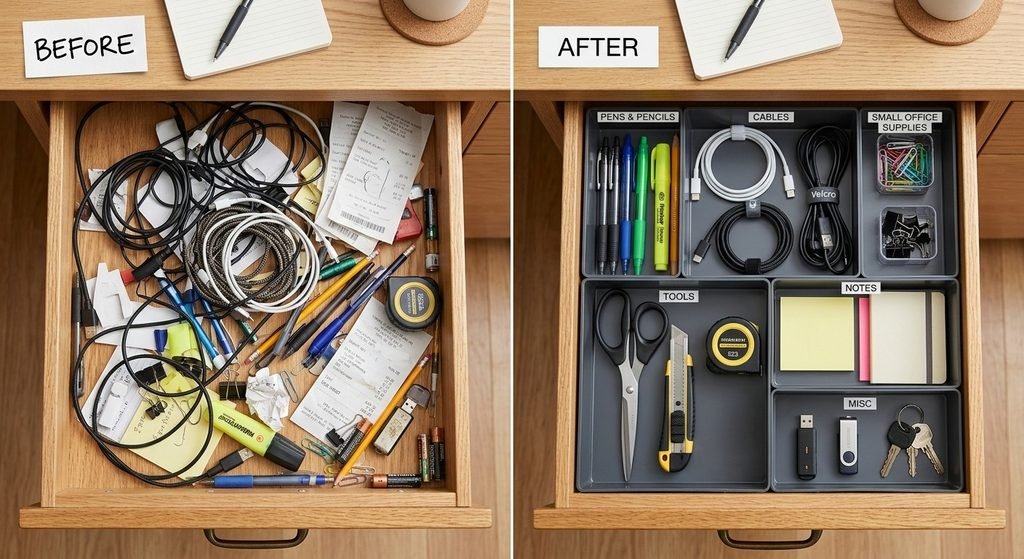
A successful desk drawer transformation is not about making it look perfect. It is about making it function better.
Before Organization
A typical messy drawer may contain:
- Mixed stationery
- Unused items
- Tangled wires
- Random paperwork
- Duplicate supplies
Problems:
- Difficult to find items
- Wasted space
- Increased frustration
After Organization
A functional drawer should have:
- Clear categories
- Easy access
- Defined spaces
- Only useful items
The goal is a drawer where you can open it and immediately know where everything belongs.
A Simple Before-and-After Method
Use this five-step reset:
Step 1: Take a Photo
Before organizing, take a picture.
This helps you notice how much clutter was actually present.
Step 2: Remove Everything
Do not organize around existing clutter.
Step 3: Reduce Items
Remove:
- Broken items
- Duplicates
- Unused supplies
Step 4: Create Zones
Divide the drawer into sections.
Example:
- Writing zone
- Technology zone
- Document zone
Step 5: Maintain the System
A good drawer should stay organized with minimal effort.
Professional Tips for Maintaining Organized Drawers
The hardest part is not organizing once. It is keeping the system working.
Here are practical habits that help.
Use the One-Minute Reset Rule
At the end of your workday, spend one minute returning items to their places.
Small daily actions prevent large cleaning sessions.
Review Your Drawers Every Few Months
Your needs change.
A drawer that works in January may not work in July.
Review:
- What you use regularly
- What has become unnecessary
- Whether categories still make sense
Follow the “One In, One Out” Rule
When you add something new, remove something old.
Example:
Buying new pens?
Check whether you already have enough.
This prevents gradual accumulation.
Label When Necessary
Labels are especially useful for shared workspaces.
Examples:
- Tax documents
- Printer supplies
- Backup cables
- Office stationery
Clear labels reduce searching time.
How to Keep Desk Drawers Organized Long-Term
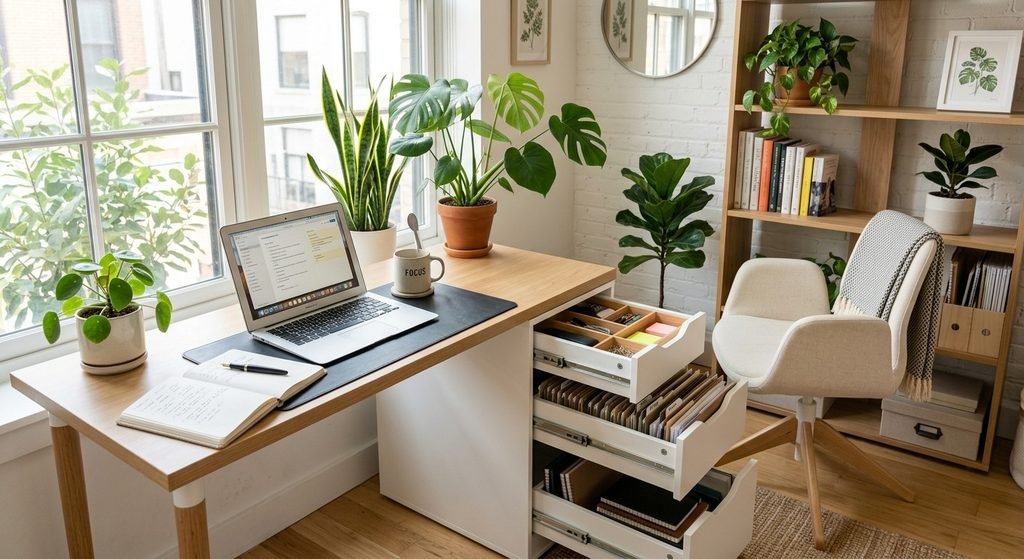
A sustainable system follows three principles:
1. Everything Has a Home
If an item has no designated place, it will eventually become clutter.
2. Frequently Used Items Stay Accessible
Do not store daily essentials in difficult-to-reach areas.
3. Organization Should Feel Natural
If maintaining your drawer requires too much effort, the system is too complicated.
The best organization method is one you can follow without thinking.
Frequently Asked Questions
How do I organize desk drawers without buying anything?
You can organize desk drawers without purchasing products by first removing unnecessary items, grouping similar supplies together, and using containers you already have. Small boxes, jars, recycled packaging, and unused trays can create sections for pens, cables, and accessories.
What should go in the top desk drawer?
The top desk drawer should usually contain items you use every day. Good choices include pens, notebooks, sticky notes, scissors, chargers, and other frequently accessed supplies. Keeping daily essentials nearby saves time and prevents desk clutter.
How often should I organize my desk drawers?
Most people benefit from reviewing desk drawers every three to six months. However, a quick one-minute cleanup at the end of each workday can prevent major clutter from developing.
What is the best way to organize cables in a desk drawer?
The best method is to group cables by purpose, remove unused ones, and use cable ties or small containers. Labeling cables makes it easier to identify them later and prevents the common problem of searching through a drawer full of tangled wires.
How do I organize a small desk drawer?
For small drawers, focus on essential items only. Use compact containers, vertical storage methods, and adjustable dividers. Keep frequently used items accessible and move rarely used supplies to another storage area.
Should I organize desk drawers by item type or frequency of use?
A combination works best. Group similar items together but place the most frequently used items in the easiest-to-reach locations. For example, keep daily writing tools at the front and backup supplies toward the back.
What are the most useful desk drawer organizers?
The most useful organizers depend on your needs, but adjustable dividers, small trays, cable holders, and labeled containers work well for most people. Flexible organizers are usually better because they can adapt as your storage needs change.
Final Thoughts
Learning how to organize desk drawers is a simple improvement that can make your entire workspace feel more efficient. A drawer does not need to look like a showroom to work well. It just needs a clear system that matches your daily routine.
Start small. Organize one drawer, remove what you no longer need, and create easy-to-follow categories. Over time, these small improvements create a workspace that feels calmer and easier to manage.
Whether you are setting up a home office, improving a student workspace, or simply trying to reduce everyday clutter, thoughtful organization can make a noticeable difference.
For more practical home improvement ideas, storage solutions, and organization inspiration, Homework Daily provides helpful guides designed to make everyday spaces more functional and comfortable.