
Decoradhouse garden tips by decoratoradvice are most useful when you treat them as a design-first framework rather than a rigid gardening formula. Start by understanding your sunlight, drainage, soil, climate, usable space, and maintenance limits; then choose plants and decorative features that fit those conditions. This guide turns the broad idea into practical decisions for US yards, patios, balconies, and garden beds.
Online, DecoratorAdvice uses the phrase around small and modern gardens, combining plant selection, layout, containers, furniture, lighting, and manageable upkeep. It isn’t a formal horticultural standard, so the smartest approach is to pair those design ideas with local, evidence-based gardening guidance.
Picture a homeowner standing at the garden center on Saturday morning with a cart containing a flowering shrub, two herbs, landscape lights, a bag of mulch, and a planter that looked irresistible by the entrance. Everything seems useful on its own. The problem appears once they get home: the shrub needs more sun than the chosen bed receives, the planter has poor drainage, and the lights are competing with a pathway that really needed fixing first.
A good garden plan prevents that cart from becoming a collection of unrelated purchases.
What do Decoradhouse garden tips by decoratoradvice mean in practice?
The practical idea is simple: design the garden around the site first and decorate it second. Plants, paths, furniture, irrigation, lighting, and ornaments should support how the outdoor space actually works.
That means making decisions in roughly this order:
- Decide what the space needs to do.
- Map sun, shade, drainage, traffic, and utilities.
- Understand the soil or container conditions.
- Choose plants for climate and mature size.
- Group plants with compatible water needs.
- Establish paths and functional zones.
- Add furniture, lighting, planters, and decorative details.
- Review how much maintenance the finished design will require.
This order isn’t as immediately satisfying as buying flowers first, but it usually produces a garden that’s easier to live with three years from now.
Start with the site, not the plant rack

Spend a few days watching the yard before changing it. Sunlight, standing water, reflected heat, wind, and foot traffic can vary dramatically within the same property.
Make a rough sketch and mark:
- Morning sun and afternoon sun
- Areas shaded by the house, trees, or fences
- Low spots where water collects after rain
- Dry zones under roof overhangs
- Hot areas beside south- or west-facing walls
- Existing trees and their root zones
- Hose connections and irrigation lines
- Doors, gates, utility covers, and commonly used routes
- Views you want to emphasize—or screen
- Places where children or pets regularly play
Don’t rely on a single observation at noon. A side yard that seems shady in spring may receive much stronger sun after the sun angle changes, while a bed under a deciduous tree can be bright before leaf-out and deeply shaded by summer.
USDA zones help, but they aren’t your entire climate
The USDA Plant Hardiness Zone Map is useful for judging whether perennial plants are likely to survive local winter lows. The current USDA map uses average annual extreme minimum winter temperature, with 10°F zones divided into 5°F half-zones.
Use the USDA Plant Hardiness Zone Map as one plant-selection filter—not the only one.
A Zone 8 garden in the Pacific Northwest doesn’t behave exactly like a Zone 8 garden in the Southeast. Summer heat, humidity, rainfall, drought, wind, soil, elevation, and length of the growing season still matter.
Decide what each part of the garden needs to do
A garden becomes easier to design once every major area has a purpose.
One section may need to provide shade for seating. Another might grow herbs. A strip beside the driveway may simply need to look tidy without demanding much attention.
| Situation | Practical approach | Why it works | Main watch-out |
| Small backyard | Fewer plant varieties, layered heights, compact seating | Reduces visual clutter | Don’t oversize shrubs |
| Sunny patio | Containers, herbs, movable shade | Flexible and renter-friendly | Pots can dry quickly |
| Shady side yard | Shade-adapted plants and a clear path | Works with existing conditions | Avoid forcing sun-loving flowers |
| Hot, dry yard | Climate-suited plants, mulch, grouped water zones | Reduces irrigation conflicts | New plants still need establishment water |
| Family yard | Durable paths plus an open activity area | Keeps circulation predictable | Avoid thorny plants beside play zones |
| Low-maintenance garden | Long-lived plants, simple bed shapes, efficient irrigation | Reduces repeated tasks | “Low maintenance” never means no maintenance |
| Rooftop space | Containers and lightweight, site-appropriate systems | Uses space without conventional beds | Structure, wind, drainage, and load require care |
For rooftop projects, structure isn’t something to guess about. HomeWorks Daily’s roof garden planning guide gives readers a useful next step before they begin treating the roof like an ordinary backyard.
Test the soil before trying to fix it
If you’re planting in the ground, a laboratory soil test can tell you more than a shelf full of generic fertilizer products.
A soil test can identify pH and available nutrients and provide recommendations based on what you plan to grow. Penn State Extension describes soil testing as a tool for determining soil fertility and appropriate lime and fertilizer needs.
The useful habit here is restraint: don’t automatically add lime, sulfur, phosphorus, or fertilizer because you’ve heard that gardens “need” them. Test first where practical, then follow your state or county Cooperative Extension recommendations.
Explore Penn State Extension’s soil-testing overview for an example of what a laboratory test can reveal.
Drainage deserves its own check
Soil fertility and drainage aren’t the same thing. Rich soil can still stay waterlogged.
After substantial rain, look for areas that remain saturated long after the rest of the yard has drained. Compaction, grade, downspout placement, clay soil, or larger drainage problems may be involved.
If you’re dealing with recurring water around the house rather than an occasionally wet flower bed, don’t treat thirsty plants as a drainage system. HomeWorks Daily’s guide to residential drain tile is a more relevant starting point for understanding dedicated drainage solutions.
Excavation near utilities or foundations deserves additional care. Call 811 before digging where underground utilities may be present, and use a qualified drainage, foundation, or landscape professional when the problem affects buildings, retaining walls, or neighboring property.
Choose plants by conditions before choosing them by color

A good-looking plant that dislikes your site will eventually become an expensive maintenance problem.
Before buying, check:
- USDA hardiness suitability for perennial plants
- Recommended light exposure
- Mature height and spread
- Soil and drainage preferences
- Typical moisture needs
- Heat and humidity tolerance
- Wind exposure
- Seasonal appearance
- Whether the plant spreads aggressively
- Local invasive-species guidance
- Pet or child considerations
- Pruning and cleanup requirements
Mature size is one of the easiest details to underestimate. That 18-inch nursery shrub might be headed toward 6 feet across. Planning for the mature spread leaves empty-looking gaps at first, but filling every gap with permanent plants creates pruning work later.
Annuals and movable containers are better ways to temporarily fill young beds.
Use native plants selectively, not mechanically
Regionally appropriate native plants can be excellent choices because they’re part of local ecological communities, but “native” doesn’t automatically mean “suitable for every spot” or “never needs water.”
Match native species to the specific light, soil, drainage, and space you have.
The same logic applies to drought-tolerant plants: drought tolerance after establishment doesn’t mean a newly planted specimen can be ignored during its first hot spell.
Group plants by water needs
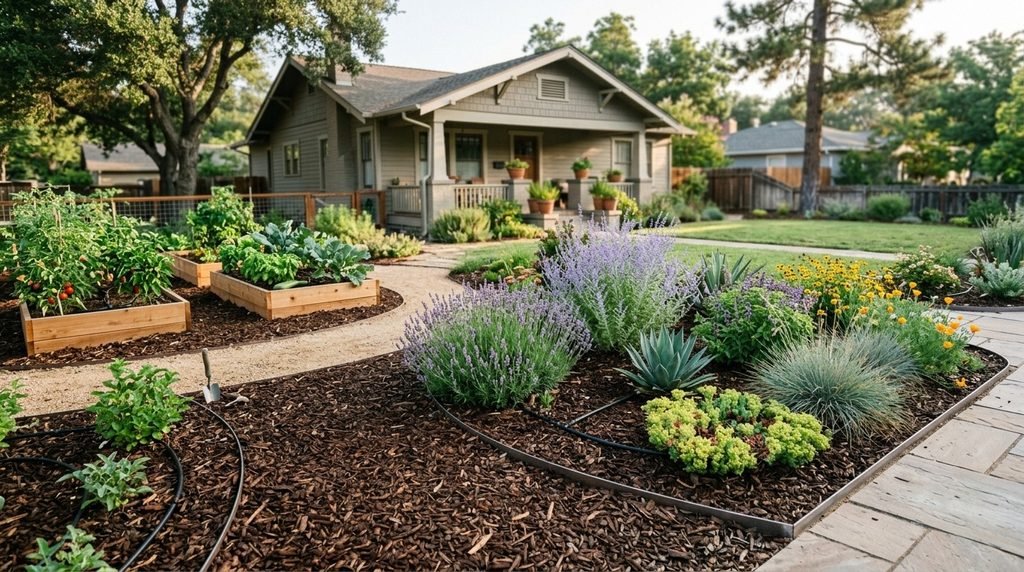
Don’t put a moisture-loving plant and a dry-soil plant on the same irrigation schedule.
EPA WaterSense recommends designing irrigation zones around factors such as plant type, sun or shade exposure, and watering requirements. EPA also notes that watering needs vary with local conditions, recent weather, and the plants in the landscape.
This practice is often called hydrozoning.
A simple home landscape might have:
- A lawn irrigation zone
- A moderate-water perennial bed
- A lower-water shrub bed
- Vegetable beds needing closer monitoring
- Containers checked separately
Microirrigation or drip can make sense for many beds, trees, and shrubs because it applies water slowly near the root area. See EPA’s WaterSense watering guidance for practical irrigation considerations.
At first glance, an automatic sprinkler controller sounds like the easiest option. It can also become an automatic overwatering system if nobody adjusts it when rainfall and seasons change.
Mulch where it solves an actual problem
Mulch is useful for moisture regulation, weed suppression, soil-temperature moderation, and protecting soil—but more isn’t better.
University of Minnesota Extension recommends roughly 2 to 4 inches for many garden situations and cautions against piling mulch against plant stems or tree trunks.
Its guide to mulching for soil and garden health also explains how organic and inorganic mulches behave differently.
A practical rule:
- Use wood chips or shredded bark around many shrubs and perennial beds.
- Consider straw in vegetable beds where appropriate.
- Keep mulch away from trunks and crowns.
- Don’t keep adding fresh layers without checking how much old mulch remains.
The classic mulch “volcano” around a tree trunk looks neat to some homeowners, but neatness isn’t a good reason to keep bark pressed against living trunk tissue.
Design the garden for maintenance access
One of the least glamorous garden-design questions is also one of the most useful:
Can you reach everything after it grows?
A 4-foot-deep border can be easy to plant when everything is small and surprisingly awkward to weed two summers later.
Leave access for:
- Pruning
- Weeding
- Hose movement
- Irrigation repairs
- Harvesting
- Cleaning around air-conditioning equipment
- Utility panels and meters
- Gutter or drain maintenance
- Replacing plants
If you’ll need to step into a deep bed regularly, include stepping stones rather than compacting the soil around plant roots every time.
How do you make a small garden feel bigger?
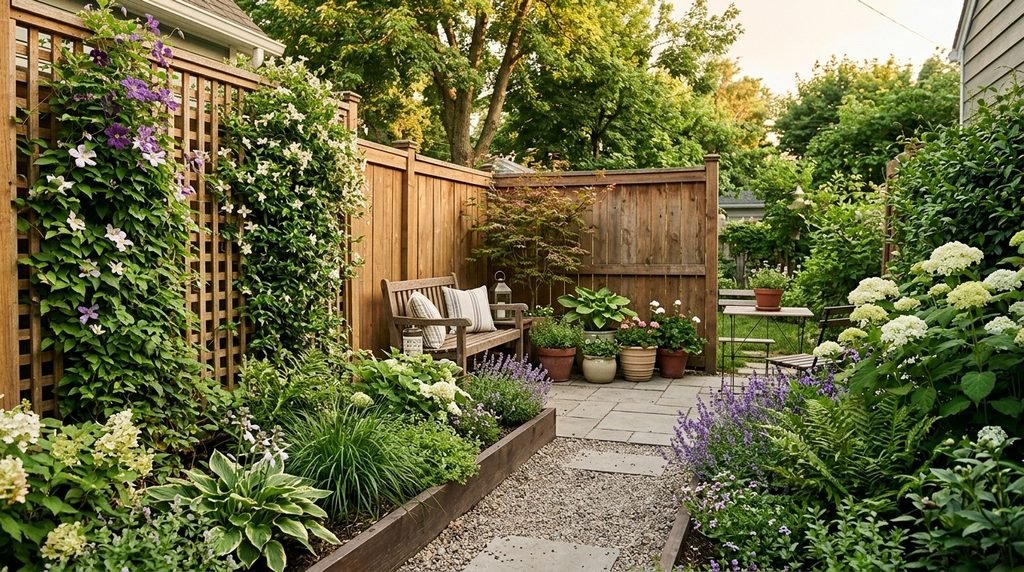
Reduce visual competition rather than trying to squeeze in more objects.
For small yards, balconies, and patios, repetition usually works better than collecting one of everything. Repeat a limited number of plant shapes or colors, keep paths obvious, and use vertical surfaces without covering every wall.
Useful small-space tactics include:
- Narrow upright shrubs where appropriate
- Trellises for suitable vines
- Wall or railing planters
- Folding or stackable seating
- Multi-purpose benches with storage
- Containers grouped in a few intentional clusters
- One focal element instead of five
- Herbs near the kitchen door
- A consistent planter material or color family
Renters can rely more heavily on containers, freestanding trellises, outdoor rugs, and movable lighting so the garden isn’t dependent on permanent construction.
Container gardeners should remember that pots can experience faster moisture and temperature swings than in-ground beds. Larger containers are often more forgiving than tiny decorative pots.
Match the plan to your US region
There isn’t one national planting calendar or watering formula.
Hot and humid Southeast
Prioritize heat and humidity tolerance, airflow, and drainage. Some plants that perform well in drier climates can struggle under prolonged humidity.
Warm-season lawns are also common in much of this region. Homeowners considering St. Augustine grass can use HomeWorks Daily’s St. Augustine grass sod buying and care guide to evaluate where that turf choice makes sense.
Arid Southwest
Sun exposure, reflected heat, water availability, and irrigation efficiency move to the top of the list. A west-facing masonry wall can produce conditions more severe than a hardiness-zone number suggests.
Prioritize plants suited to the local desert or dryland environment and separate higher-water plants into intentional zones rather than scattering them throughout the property.
Midwest and Northeast
Winter hardiness, freeze-thaw cycles, spring soil conditions, and shorter growing seasons can drive plant choices. Don’t let an unusually warm week push you into planting tender material before local frost risk has passed.
Pacific Northwest
Winter hardiness may look mild on a zone map, but drainage, winter moisture, summer-dry conditions in many areas, and local microclimates can matter just as much.
Coastal gardens
Salt exposure, wind, sandy soil, storms, and reflected light can narrow plant choices. Look for local Extension or municipal resources rather than assuming an inland recommendation will transfer directly to the coast.
Build beauty through structure, not just flowers
Flowers are seasonal. Structure is what keeps the garden readable after the bloom fades.
A balanced garden may combine:
- A tree or larger shrub as an anchor
- Mid-height shrubs or perennials
- Lower edging plants or groundcovers
- Seasonal flowers for temporary color
- A path or patio connecting the spaces
- Repeated materials tying the design together
This doesn’t mean everything needs to be symmetrical.
Repetition—a particular grass, foliage color, planter finish, or stone—can make varied planting look intentional without making the yard formal.
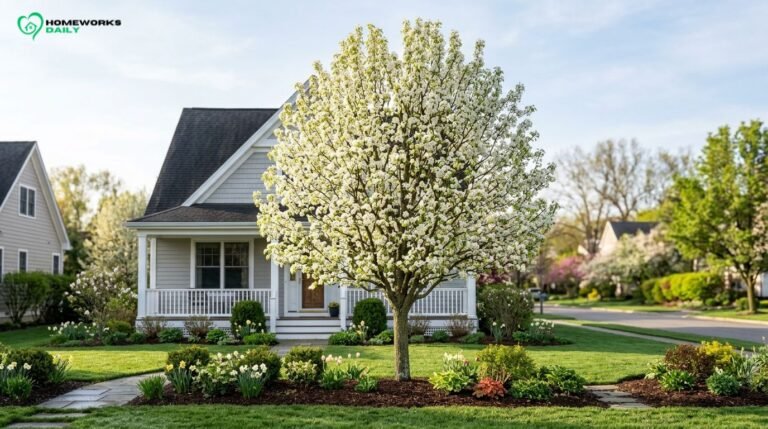
If you enjoy ornamental trees, consider their mature canopy, root space, pruning requirements, and seasonal debris before making one the focal point. HomeWorks Daily’s weeping cherry growing and care guide is one example of how plant-specific research should follow the broader design decision.
What are the best budget priorities?
Spend first on things that are difficult or expensive to correct later.
A sensible order is often:
- Drainage or grading problems
- Unsafe or damaged paths and steps
- Soil preparation
- Trees and long-lived structural plants
- Irrigation changes
- Beds and edging
- Smaller plants
- Furniture and decorative accessories
A low-cost planter won’t compensate for a patio that drains toward the foundation.
Likewise, it can be worth paying more for an appropriately sized, weather-suitable container or durable pathway material if the cheaper version will crack, tip, fade, or need replacement quickly.
Where can you save?
You don’t necessarily need premium pricing for every decorative element.
Reasonable savings include:
- Starting with smaller nursery plants where patience is acceptable
- Dividing suitable established perennials
- Using seasonal annuals while shrubs mature
- Repurposing sound containers after adding drainage holes where appropriate
- Improving one garden zone at a time
- Choosing simple bed shapes that require less edging
For edible beds, plant compatibility, spacing, light, and disease considerations matter more than making the bed look densely filled. HomeWorks Daily’s guide to watermelon companion crops provides a useful example for gardeners planning food-growing zones.
Pet- and child-conscious garden planning
Don’t assume an ornamental plant is safe because it’s common at garden centers.
For homes with dogs or cats that chew plants, check the exact botanical name against a reputable toxicity database before purchasing. The ASPCA maintains a searchable toxic and non-toxic plant database and notes that its list isn’t exhaustive.
Use the ASPCA plant-toxicity database as a screening resource and contact a veterinarian if an animal may have eaten a harmful plant.
For children, think beyond toxicity. Avoid sharp edging, unstable planters, thorny plants along running routes, unsecured water features, and cords stretched across paths.
Beginner mistakes that create more work later
Many garden problems begin with reasonable-looking decisions made too quickly.
Watch for these:
- Buying plants before checking sunlight
- Treating the USDA zone as the entire climate profile
- Filling beds according to nursery size rather than mature size
- Putting every plant on the same irrigation schedule
- Automatically fertilizing without understanding the soil
- Piling mulch against trunks
- Installing decorative gravel without considering heat and weeds
- Designing beds that can’t be reached
- Placing seating where afternoon sun makes it unusable
- Ignoring water that repeatedly collects beside the house
- Buying furniture before measuring walking space
- Assuming “drought tolerant” means “never water”
- Expecting a low-maintenance garden to be maintenance-free
A garden that suits your schedule is generally better than an ambitious design you don’t have time to maintain.
When this advice doesn’t apply
Broad garden-design advice has limits.
Call or consult a qualified professional when:
- Retaining walls are failing or being significantly altered.
- Grading could redirect water toward a house or neighboring property.
- Large-tree removal or hazardous limbs are involved.
- A roof garden may change structural loads.
- Irrigation work connects to regulated plumbing or backflow equipment.
- Landscape lighting involves line-voltage electrical work.
- Major excavation is required.
- Pesticide use involves a pest you can’t confidently identify.
For pesticide products, the label is the legal use direction in the United States. Don’t improvise concentrations, application rates, or off-label uses.
A practical weekend planning exercise
Before buying anything, spend one weekend gathering information.
Saturday morning: Measure the area and photograph it from several angles.
Saturday afternoon: Mark sun and shade, foot traffic, water access, and problem drainage.
Sunday morning: Decide on one main function for each zone—seating, play, herbs, flowers, screening, or simply a tidy view.
Sunday afternoon: Build a plant shortlist based on mature size, climate, light, and moisture. Then price materials.
That modest pause between inspiration and purchasing can prevent a surprising amount of rework.
HomeWorks Daily focuses on practical ideas homeowners can actually use, so the goal isn’t to produce a perfectly styled garden in one weekend. It’s to make the next decision more informed than the last.
FAQ
What is the first thing I should do before redesigning my garden?
Observe and measure the site before buying plants. Map sunlight, drainage, pathways, water access, existing plants, and the areas people actually use. Those conditions will narrow your choices more effectively than starting with a shopping list.
How do I know which plants will survive in my yard?
Check several factors, not just USDA hardiness zone. Look at winter hardiness, sunlight, mature size, drainage, soil, heat, humidity, rainfall, and local Extension recommendations. Hardiness zones primarily describe extreme winter lows, not the full growing environment.
Is drip irrigation always better than sprinklers?
No. The right system depends on what you’re watering. Microirrigation can work very well for many garden beds, shrubs, and trees, while turf is typically handled differently. The key is applying water according to plant, soil, climate, and weather conditions rather than using one schedule everywhere.
How can I make my garden lower maintenance?
Reduce unnecessary variety and recurring tasks. Choose site-suitable plants, allow for mature size, mulch appropriately, group plants by water needs, simplify bed shapes, and keep maintenance access clear. Start with fewer areas and expand only after you know how much care they require.
Are container gardens a good option for renters?
Yes. Containers are one of the most flexible renter-friendly approaches. They let you move plants, experiment with layouts, and avoid permanent landscaping changes. Just remember that containers often need closer moisture monitoring than in-ground beds.
Should I fertilize my garden every year?
Not automatically. Nutrient needs depend on existing soil conditions and what you’re growing. A laboratory soil test can help identify pH and nutrient needs so you aren’t applying amendments blindly.
How much should I spend before I know whether the garden plan works?
Phase the project rather than committing the entire budget at once. Fix drainage and structural problems first, establish one or two priority zones, and watch how plants respond through the season. You can repeat what works instead of paying to redo what doesn’t.
Conclusion
The most useful lesson behind Decoradhouse garden tips by decoratoradvice is that appearance should follow conditions. Learn the site’s sunlight, soil, water behavior, climate, mature plant sizes, and maintenance demands first; then use furniture, color, lighting, containers, and decorative details to pull the space together.
Pick one problem area this week and map it before buying anything. From there, explore another relevant HomeWorks Daily Gardening or Home Improvement guide that addresses the specific project—lawn care, drainage, edible planting, or rooftop gardening—you’re ready to tackle next.






2 Responses