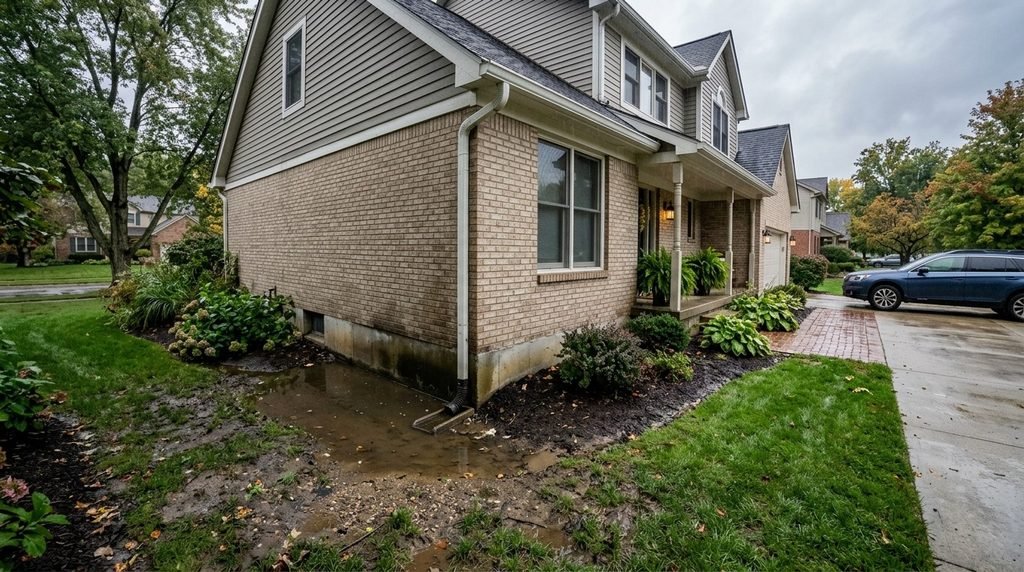
A little water near the basement wall doesn’t always look like a major problem.
Maybe it showed up after a heavy storm. Maybe the lawn stays soggy in one particular spot. Or perhaps there’s a faint musty smell downstairs that seems to disappear when the weather dries out.
Then the next storm arrives.
The water comes back.
That’s when drainage stops being a minor annoyance and starts becoming a question worth answering.
Drain tile is one of the drainage systems used to collect and redirect water away from foundations and other areas where excess water can cause problems. Depending on the property and design, it can be installed around a foundation, beneath a basement floor, or as part of another subsurface drainage arrangement.
But here’s the part that’s easy to miss: drain tile isn’t a universal cure for every water problem. The right drainage solution depends on where the water is coming from, how the site is graded, the soil, the foundation, the available discharge point, and local requirements.
Let’s break it down without turning it into a construction textbook
What Is Drain Tile?
Drain tile is a drainage system designed to collect excess subsurface water and move it toward an approved discharge point. Modern systems commonly use perforated pipe surrounded by drainage aggregate and, where appropriate, filter material.
Despite the name, modern drain tile isn’t necessarily made from tile. The term comes from older drainage systems that used sections of clay tile. Today, perforated plastic pipe and other approved drainage products are commonly used.
A typical foundation drainage arrangement may include:
- Perforated drainage pipe
- Washed gravel or crushed stone
- Filter fabric or another approved filter material
- A properly planned outlet
- A sump or mechanical pump where gravity discharge isn’t possible
The exact configuration matters.
For example, the 2024 International Residential Code describes foundation drainage using drainage tile, gravel or crushed-stone drains, perforated pipe, or other approved systems and materials. It also specifies conditions for their placement and discharge.
Bottom Line Up Front
If water is collecting around a foundation, drain tile may help intercept and redirect that water before it creates a bigger moisture problem. But the system needs to be designed around the actual source and path of the water.
That distinction can save a homeowner from spending money on the wrong fix.
How Does Drain Tile Work?
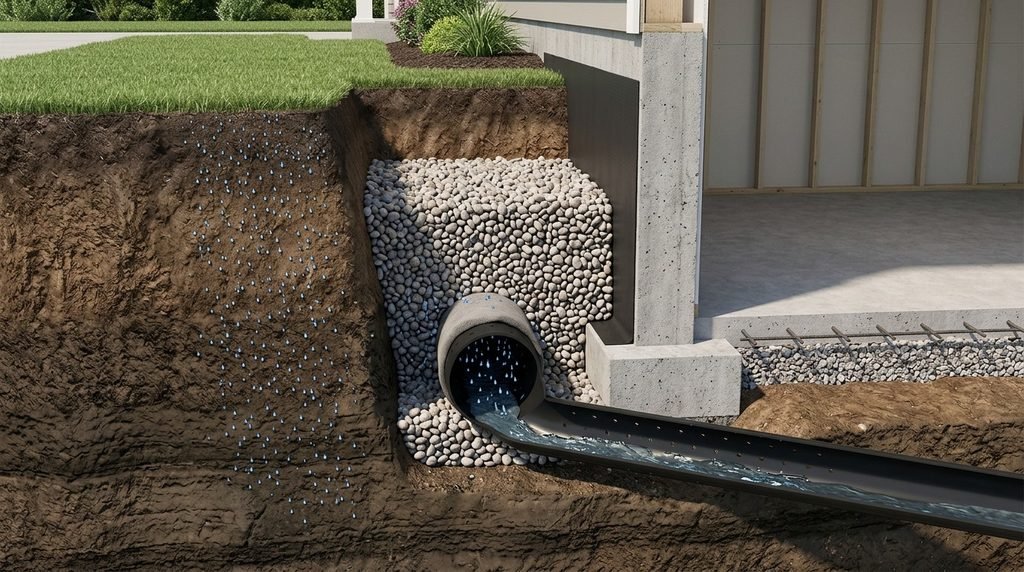
The basic idea is surprisingly simple.
Water moves through soil. If the soil around a foundation becomes saturated, water can create pressure against foundation walls and find paths into cracks, joints, penetrations, or other vulnerable areas.
A properly designed drainage system gives some of that water a controlled route to follow.
A simplified process looks like this:
- Water enters the drainage zone.
- Water moves through gravel or another free-draining material.
- Perforations in the pipe allow collected water to enter.
- The pipe carries the water toward a planned discharge point.
- Water leaves through gravity drainage, a sump system, or another approved method.
The pipe doesn’t magically make water disappear.
It gives water somewhere to go.
That final part is crucial. A drainage pipe with nowhere useful to discharge isn’t a complete drainage strategy.
For foundation systems, the International Residential Code calls for drainage systems to discharge by gravity or mechanical means into an approved drainage system.
Where Is Drain Tile Used?
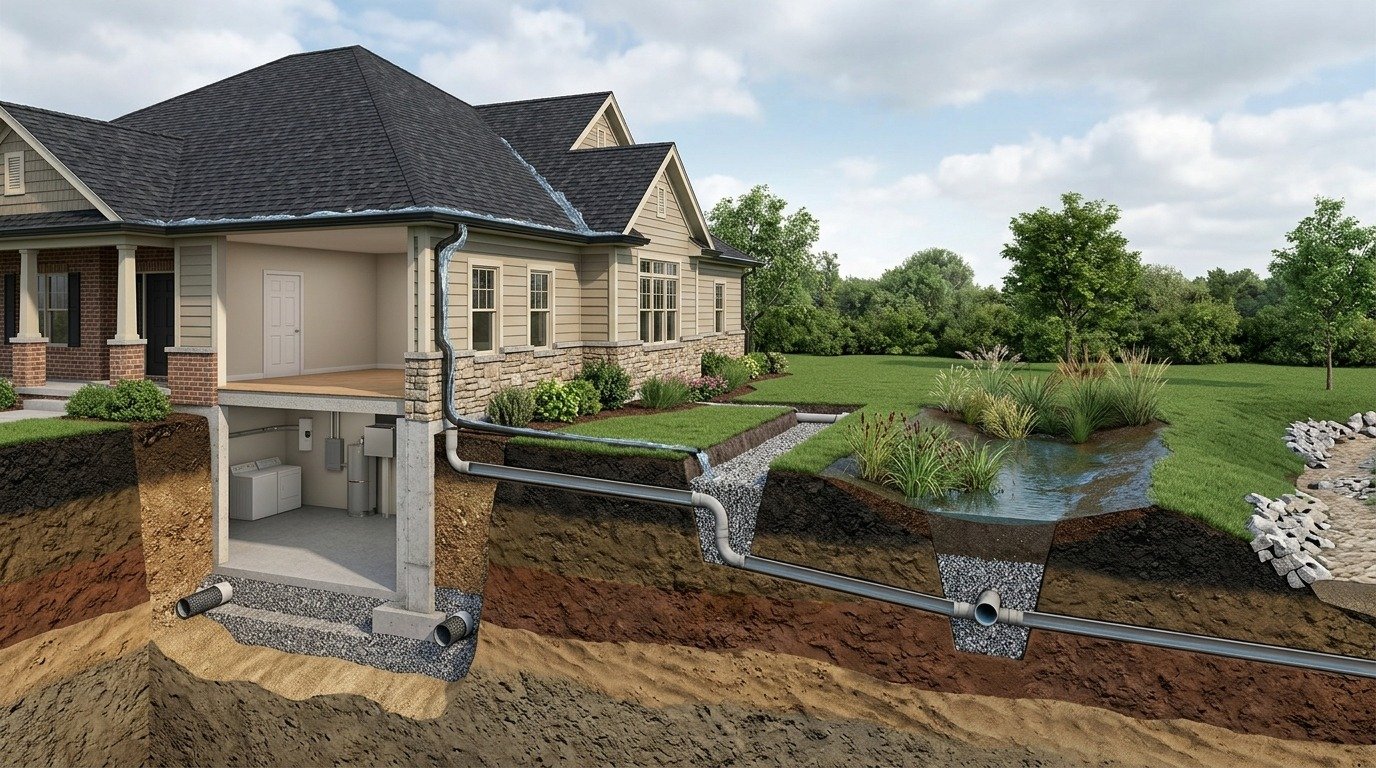
Drain tile is most closely associated with foundation and subsurface drainage, but drainage systems can be designed for several different situations.
Foundation Drainage
Foundation drainage helps manage water around below-grade foundation walls.
For concrete or masonry foundations enclosing usable or habitable space below grade, the 2024 IRC includes requirements for foundation drainage, with exceptions for certain well-drained soil conditions.
A foundation drainage system may be particularly relevant when a property has:
- Persistent groundwater
- Poorly draining soil
- Water collecting around foundation walls
- A basement or crawl space below grade
- Site grading that concentrates water near the structure
Basement Drainage
Basement drainage can involve an exterior foundation drain, an interior perimeter drainage system, a sump system, or a combination of approaches.
The key question isn’t simply:
“Should I install drain tile?”
A better question is:
“Where is the water entering, and what path can safely move it away?”
That difference matters because basement moisture can come from several sources.
Yard and Landscape Drainage
Some drainage problems occur away from the house.
A low area in a yard may collect water because of:
- Natural topography
- Compacted soil
- Poor grading
- Heavy clay soil
- Runoff from nearby surfaces
- Downspout discharge
- An inadequate existing drainage route
In those situations, the best solution may not be foundation drain tile at all.
A surface drain, swale, grading correction, or another landscape drainage method could make more sense.
Drain Tile vs. French Drain: What’s the Difference?
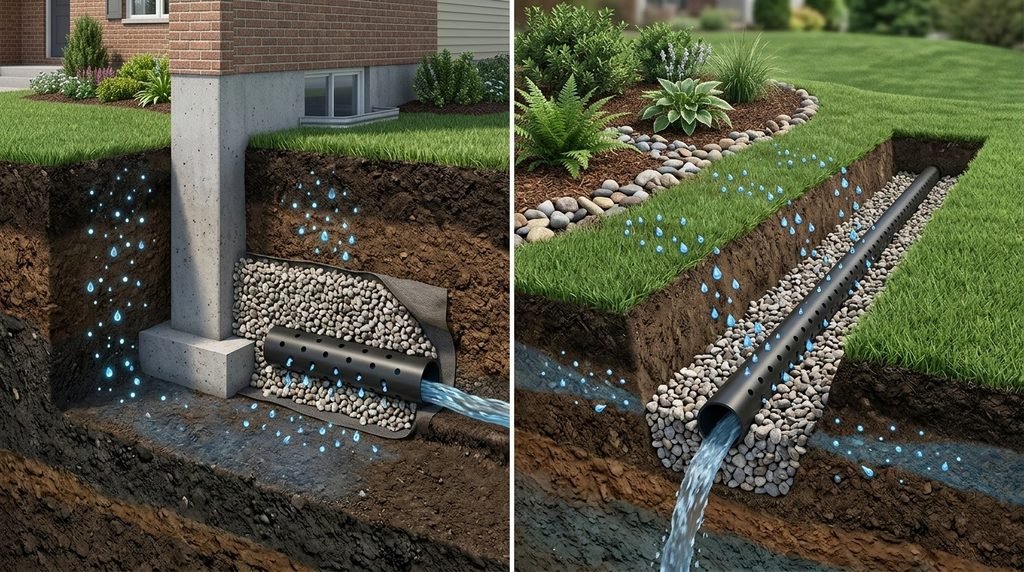
These terms are sometimes used interchangeably in everyday conversation, which can make drainage discussions confusing.
A French drain is generally a drainage trench designed to collect and redirect water, often using perforated pipe and drainage aggregate. Drain tile is commonly used to describe a subsurface drainage pipe or foundation drainage system.
The exact terminology can vary by region and application.
| Feature | Drain Tile | French Drain |
| Typical purpose | Subsurface/foundation drainage | Collecting and redirecting water |
| Common location | Around foundations or below grade | Yards, slopes, foundations, landscapes |
| Pipe | Often perforated | Often perforated |
| Gravel | Commonly used | Commonly used |
| Main concern | Proper collection and discharge | Proper collection, slope, and outlet |
| Best solution | Depends on water source | Depends on water source |
The important takeaway is not which label wins.
It’s whether the system is correctly matched to the water problem.
What Does a Drain Tile System Usually Contain?
A drainage system isn’t just a pipe buried underground.
Several components work together.
Perforated Pipe
The pipe provides a route for collected water to travel.
Perforations allow water from the surrounding drainage zone to enter the pipe.
Drainage Aggregate
Clean gravel or crushed stone creates space for water to move around the pipe.
Foundation drainage requirements in the 2024 IRC specify minimum aggregate arrangements around certain foundation drain systems.
Filter Material
Filter fabric or another approved material can help limit soil migration into the drainage system.
Without appropriate filtration, fine soil particles can gradually enter areas where they’re not wanted.
Discharge Point
Collected water needs a destination.
Depending on the site, that could involve:
- Gravity discharge
- Daylight drainage
- A sump pump
- An approved stormwater system
- Another locally permitted drainage arrangement
The discharge method is one of the details homeowners should discuss before approving a project.
Signs Your Property May Need Better Drainage
Water problems don’t always announce themselves with a flooded basement.
Sometimes the clues are much smaller.
Watch for:
- Water appearing near basement walls after storms
- A persistent musty smell
- Damp areas along a basement floor
- Efflorescence or mineral deposits on masonry
- Soil that stays unusually wet beside the foundation
- Repeated puddling near the house
- Downspouts releasing water directly beside the foundation
- Yard areas that remain saturated long after rain
- Water entering through cracks or wall-floor joints
- A sump pump that runs unusually often
- Evidence of an older drainage system that may be blocked or damaged
One sign doesn’t automatically mean you need drain tile.
For example, a downspout dumping several gallons of roof runoff beside the foundation can create a surprisingly persistent moisture problem. Fixing the discharge location may be a much simpler first step than excavating around the entire house.
Don’t Ignore Grading
Drainage doesn’t start underground.
It starts at the surface.
If the ground around a house directs rainwater toward the foundation, even a well-designed subsurface drainage system may have more water to deal with than necessary.
The 2024 IRC calls for surface drainage to be directed away from foundation walls and provides a general grading requirement of at least a 6-inch fall within the first 10 feet, subject to stated exceptions and local requirements.
EPA moisture-control guidance similarly emphasizes shaping the surrounding grade so surface water moves away from the building.
That’s why a good drainage evaluation should look at the entire water path.
Think:
roof → gutters → downspouts → soil surface → foundation → subsurface drainage → discharge
Not just the pipe underground.
How Is Drain Tile Installed?
Every site is different, but a typical exterior foundation drainage project may involve several stages.
1. Planning
First, identify where the water is coming from and where it needs to go.
This can involve looking at:
- Site grading
- Soil
- Foundation depth
- Existing drainage
- Downspouts
- Groundwater conditions
- Available discharge points
2. Excavation
For exterior foundation drainage, soil is excavated to expose the relevant portion of the foundation.
This isn’t a trivial step.
Excavation around an existing structure can involve utilities, structural considerations, access limitations, and soil stability.
3. Preparing the Drainage Area
The drainage area is prepared to provide a suitable path for water and the drainage pipe.
4. Installing the Pipe
Perforated pipe or another approved drainage component is positioned according to the system design.
For foundation drainage, code requirements address the elevation and placement of drainage systems relative to footings and floors.
5. Adding Drainage Material
Clean gravel or crushed stone is commonly placed around the drainage pipe.
6. Providing Filtration
Filter material may be used to help prevent soil from migrating into the drainage zone.
7. Connecting the Discharge
The collected water needs a safe, approved route away from the structure.
8. Backfilling and Final Grading
After the drainage system is completed, the excavation is backfilled and the surface is graded so water isn’t immediately directed back toward the foundation.
This last step is easy to underestimate.
A drainage system buried beneath poor grading is being asked to solve a problem that could have been reduced at the surface.
Common Drain Tile Mistakes
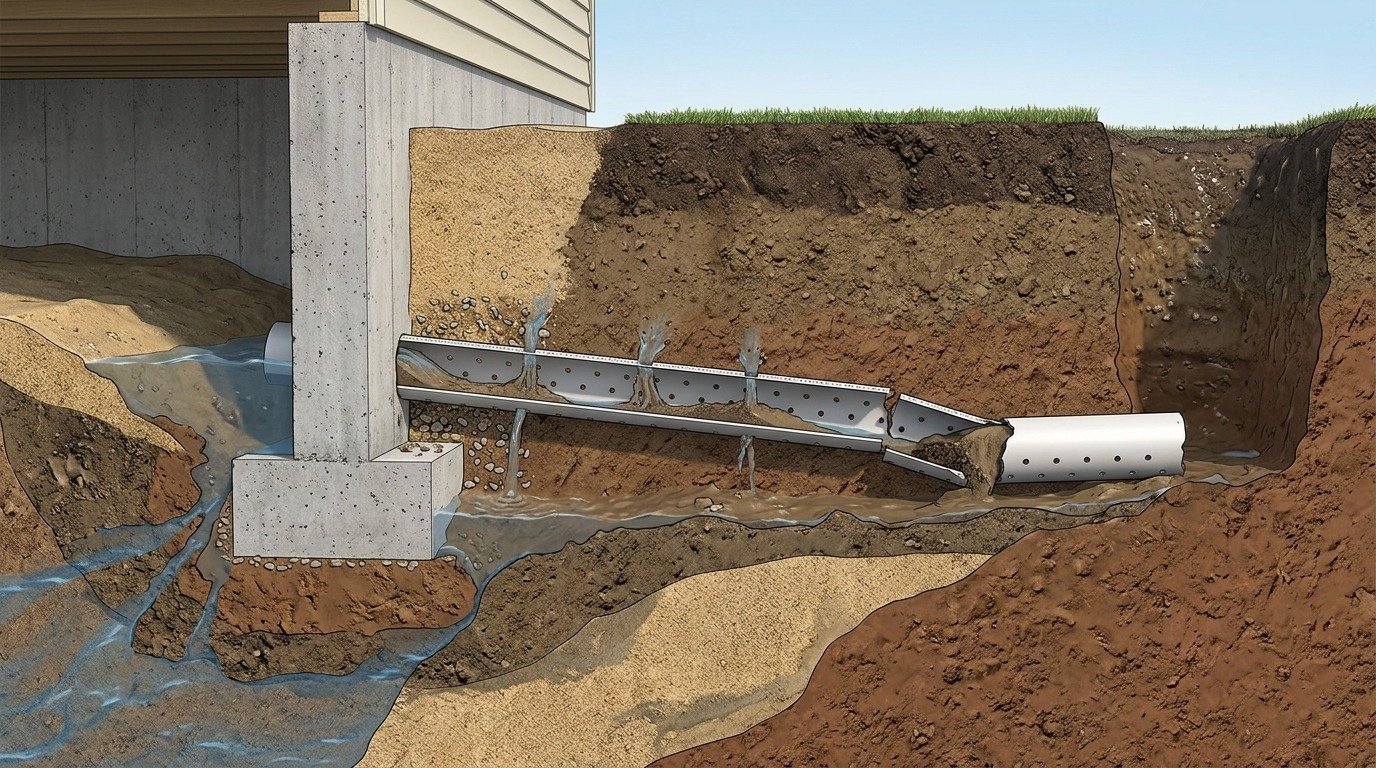
A drainage project can contain good materials and still perform poorly if the design is wrong.
Poor Water Diagnosis
The first mistake is choosing the system before identifying the source of the water.
Groundwater, surface runoff, plumbing leaks, condensation, and foundation leaks can require very different responses.
No Practical Outlet
Collected water needs somewhere to go.
A pipe that collects water but doesn’t have a properly planned discharge path isn’t solving the entire problem.
Ignoring Downspouts
Roof runoff can put a large amount of water near a foundation.
Before assuming an underground foundation problem, check where the gutters and downspouts send water.
Poor Grading
If rain repeatedly flows toward the house, the drainage system may be fighting an uphill battle.
Inadequate Filtration
Fine soil entering a drainage system can create clogging or reduce performance over time.
Treating Every Water Problem the Same
This is perhaps the biggest mistake.
A soggy lawn isn’t automatically a foundation problem.
A damp basement isn’t automatically a drain-tile problem.
The water source comes first.
Is Drain Tile a DIY Project?
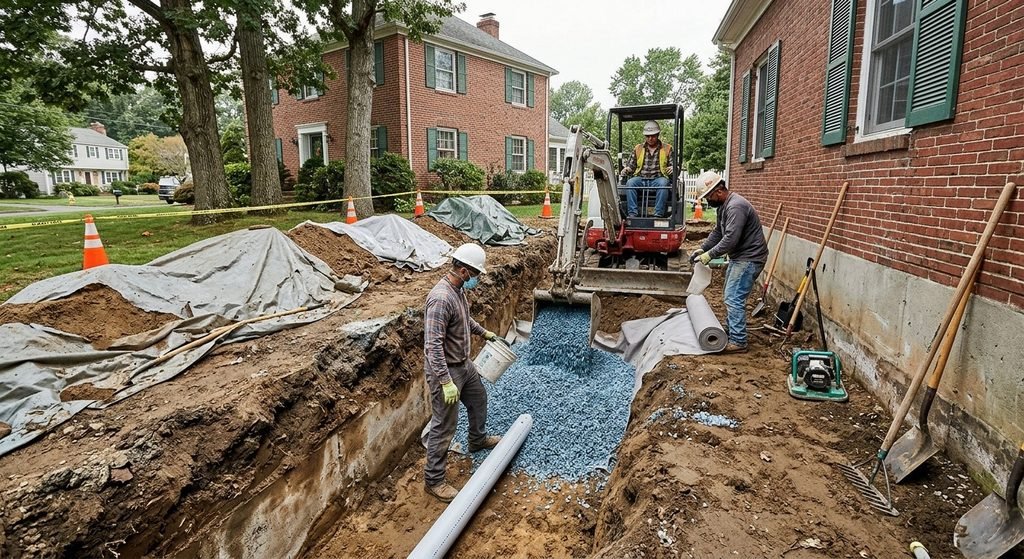
Sometimes homeowners can handle relatively straightforward drainage improvements.
But foundation drainage is a different category from digging a shallow garden drainage trench.
DIY May Be Reasonable When:
- The drainage problem is clearly understood
- The project is small
- Excavation is shallow and safe
- No structural work is involved
- Utilities have been properly considered
- The discharge arrangement is straightforward and permitted
- Local requirements are understood
Professional Help Makes More Sense When:
- Water is entering a finished basement
- Excavation will expose a foundation
- The project involves substantial digging
- The foundation may be compromised
- Groundwater is significant
- Structural cracks are involved
- A sump system is needed
- The discharge route is complicated
- Local building or drainage requirements apply
- You aren’t sure where the water is coming from
When in doubt, getting the water problem diagnosed before buying materials can save money.
Drain Tile Cost Considerations
There isn’t one meaningful price for “drain tile.”
The cost of a drainage project depends heavily on what you’re actually building.
Important cost factors include:
| Cost Factor | Why It Matters |
| Project size | More pipe and excavation increase material and labor needs |
| Excavation | Deep or difficult digging can add substantial labor |
| Access | Tight spaces can make equipment and material handling harder |
| Soil | Dense, rocky, or difficult soil can complicate excavation |
| Foundation depth | Deeper foundations may require more extensive work |
| Interior vs. exterior | The two approaches involve very different construction work |
| Pipe and aggregate | Material choices affect the overall project |
| Waterproofing | May be needed alongside drainage in some situations |
| Sump system | Pump, basin, discharge piping, and backup considerations add cost |
| Existing drainage | Damaged or clogged systems may require additional investigation |
| Local labor | Installation costs vary significantly by location |
Be cautious of any estimate that gives you one universal number without asking about the property.
A contractor who hasn’t seen the site can’t reasonably know all of these variables.
How to Choose the Right Drainage Approach
Instead of starting with a product, start with the problem.
If Surface Water Is the Main Issue
Look first at:
- Grading
- Gutters
- Downspouts
- Swales
- Surface drainage
- Landscape design
If Water Is Collecting Around the Foundation
Investigate:
- Soil drainage
- Foundation drainage
- Existing drain tile
- Exterior waterproofing
- Surface runoff
- Groundwater
If Water Is Entering the Basement
Determine exactly where and when it appears.
Does it happen:
- Only during heavy rain?
- After snowmelt?
- Throughout the year?
- At the wall-floor joint?
- Through cracks?
- Around plumbing penetrations?
- From a floor drain?
Those details can point toward very different causes.
The smartest drainage project isn’t necessarily the biggest one. It’s the one that addresses the actual source of water.
Questions to Ask a Drainage Contractor
Before hiring someone, ask questions that reveal how they arrived at their recommendation.
Consider asking:
- Where do you believe the water is coming from?
- What evidence supports that diagnosis?
- Why are you recommending this drainage system?
- Could grading or downspout improvements solve part of the problem first?
- Where will collected water discharge?
- What happens if gravity drainage isn’t possible?
- Will waterproofing be part of the project?
- What happens to the system if it becomes clogged?
- Are permits or inspections required locally?
- What parts of the existing drainage system can be reused?
- What maintenance will the homeowner need to perform?
- What isn’t included in the quoted price?
That final question can prevent some unpleasant surprises.
Drain Tile Maintenance
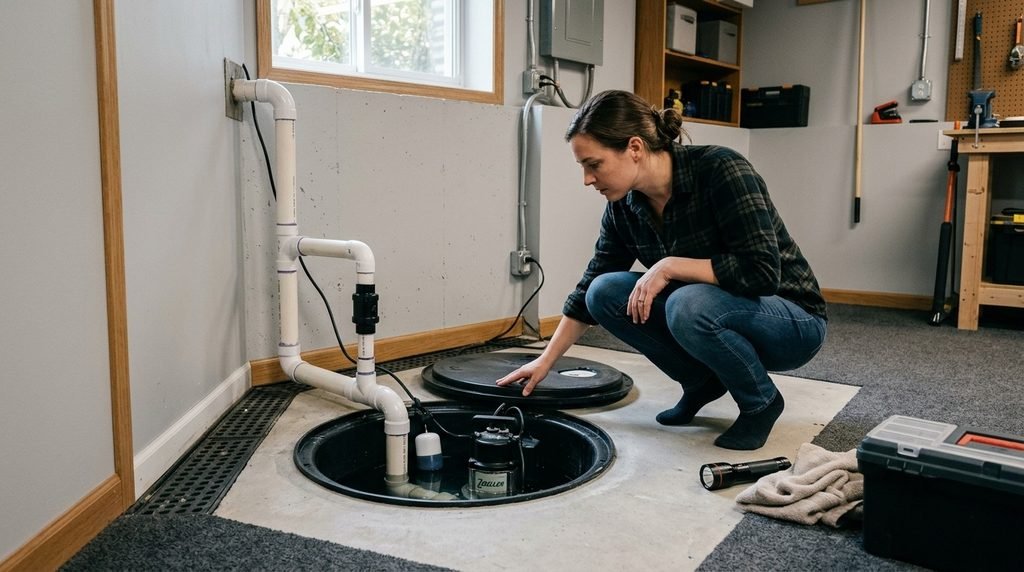
A properly installed drainage system shouldn’t require constant attention, but homeowners shouldn’t completely forget about it.
Keep an eye on:
- Sump pump operation
- Discharge piping
- Drainage outlets
- Yard grading
- Downspout connections
- Areas where water repeatedly pools
- New basement moisture
- Unusual changes in groundwater conditions
If a sump pump handles your drainage water, test it periodically according to the manufacturer’s guidance.
Also inspect the area around the house after major storms.
Heavy rain can reveal drainage problems that aren’t obvious during dry weather.
How Long Does Drain Tile Last?
There isn’t one guaranteed lifespan for every drain tile system.
Service life depends on:
- Pipe material
- Installation quality
- Soil conditions
- Filtration
- Drainage aggregate
- Maintenance
- Ground movement
- Tree roots and other site conditions
- Whether the discharge system remains functional
A drainage system can last for many years, but longevity isn’t just about the pipe.
The surrounding system matters too.
A good pipe buried in a poorly designed drainage arrangement won’t necessarily perform well.
Does Every House Need Drain Tile?
No. Not every property needs the same foundation drainage system.
Soil conditions, foundation design, groundwater, site grading, local requirements, and the presence of below-grade living space all influence drainage needs.
The 2024 IRC includes exceptions to certain foundation drainage requirements for foundations located in qualifying well-drained soils.
That’s another reason not to treat drain tile as a mandatory upgrade for every home.
Is Drain Tile Installed Inside or Outside?
It can be installed in either location, depending on the problem and system design.
Exterior systems can collect water outside the foundation before it reaches the structure.
Interior drainage systems can collect water that has already reached the interior perimeter and direct it toward a sump or other discharge arrangement.
The better choice depends on:
- Where water is entering
- Foundation access
- Existing construction
- Excavation limitations
- Groundwater conditions
- The desired scope of work
There isn’t a universal “best” location.
Can Drain Tile Become Clogged?
Yes, drainage systems can experience reduced performance or blockage.
That’s why filtration, appropriate drainage aggregate, correct installation, and maintenance matter.
Soil particles, sediment, root intrusion, damaged pipe, or problems elsewhere in the drainage system can affect performance.
If an older system suddenly stops working, don’t immediately assume the pipe itself is the problem.
The outlet, sump, grading, and surrounding drainage conditions may deserve inspection too.
What Should You Fix Before Installing Drain Tile?
Before committing to a major drainage project, look at the simple water-management details first.
Check:
- Gutters
- Downspouts
- Downspout extensions
- Surface grading
- Low spots
- Foundation cracks
- Existing drains
- Sump discharge
- Irrigation overspray
- Nearby hard surfaces
Sometimes a relatively simple change can reduce the amount of water reaching the foundation.
That doesn’t mean major drainage work is never necessary. It means you should understand the whole system before spending thousands on one component.
Frequently Asked Questions
What is drain tile used for?
Drain tile is used to collect and redirect excess subsurface water, commonly around foundations and below-grade spaces. Modern systems often use perforated pipe with drainage aggregate and appropriate filtration.
Is drain tile the same as a French drain?
Not exactly. The terms are sometimes used loosely, and both systems can use perforated pipe and gravel. In practice, “drain tile” often refers to subsurface or foundation drainage, while a French drain commonly describes a trench drainage system used for redirecting water in yards, landscapes, slopes, and around structures.
Does drain tile keep water out of a basement?
It can help manage water around or beneath a foundation, but it isn’t a guarantee against every type of basement moisture. Water can enter through cracks, joints, penetrations, plumbing problems, condensation, or other paths.
Does drain tile need gravel?
Many foundation drainage designs use washed gravel or crushed stone around the drainage pipe. Specific material requirements depend on the system, applicable code, manufacturer instructions, and site conditions.
Can drain tile be installed around an existing house?
Yes, exterior drainage systems can sometimes be installed around existing foundations, but excavation can be extensive and may involve structural, utility, access, and safety considerations.
Does every basement need drain tile?
No. Drainage requirements depend on site conditions, soil, foundation construction, groundwater, local requirements, and other factors.
How do I know if my drainage problem is surface water or groundwater?
Timing and location provide clues. Water appearing after rain and following surface-flow paths may point toward runoff, while persistent moisture can indicate groundwater or another source. A proper site evaluation is more reliable than guessing from one symptom.
When should I call a professional?
Consider professional help when water repeatedly enters a basement, substantial excavation is required, structural concerns are present, groundwater is significant, or you’re unsure what is causing the problem.
Can a clogged drain tile be repaired?
Sometimes. The appropriate repair depends on the cause and condition of the system. Inspection may reveal whether the problem involves sediment, roots, damaged pipe, an obstructed outlet, or another part of the drainage system.
Final Takeaway: Start With the Water, Not the Pipe
Drain tile can be an important part of a home’s drainage strategy, particularly when subsurface water is putting pressure on a foundation or creating problems below grade.
But the pipe itself isn’t the whole story.
Good drainage starts with understanding where water comes from, where it travels, and where it can safely go.
That means looking at grading, gutters, downspouts, soil, foundation conditions, existing drainage, and the final discharge point before deciding which system makes sense.
If you’re dealing with a recurring moisture problem, don’t rush straight to the biggest project. Start by identifying the source.
Then choose the drainage solution that actually fits the property.
For more practical home-improvement and gardening guidance, continue exploring the related resources on HomeworkDaily.