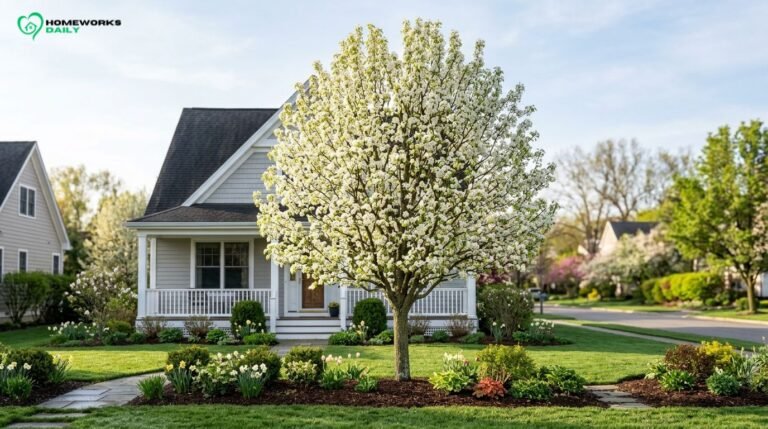
You want a flowering tree that makes your front yard look beautiful every spring. But there’s a catch: your lawn isn’t enormous, your driveway takes up valuable space, and you don’t want branches crowding your windows ten years from now.
That’s where Navigator Pear might catch your attention.
With its upright shape, clusters of white spring flowers, and warm autumn foliage, this ornamental pear has several qualities homeowners look for in a decorative landscape tree. It’s also promoted for its ability to handle cold climates.
But before you picture one beside your front porch, there’s something worth knowing: nurseries don’t entirely agree on how large Navigator Pear becomes. And because it’s an ornamental pear, questions about fruit, environmental impacts, and local planting regulations deserve attention.
Here’s what the available horticultural evidence tells us—and how to decide whether this tree belongs in your yard.
The bottom line: Navigator Pear (Pyrus × ‘DurPSN303’) is a deciduous ornamental pear grown for its white spring blossoms, upright crown, and yellow-orange fall color. It’s worth considering for a sunny, well-drained landscape with adequate growing room, particularly in colder regions. However, reported mature dimensions vary considerably, U.S. availability requires confirmation, and its botanical identity and local regulatory status should be checked before planting.
What Is Navigator Pear?
Navigator Pear is an ornamental tree sold under the botanical designation Pyrus × ‘DurPSN303’. It is associated with Prairie Shade Nursery in Canada and was developed for landscape appeal rather than commercial fruit production.
The Pyrus portion of its name identifies the pear genus. The multiplication symbol (×) indicates a hybrid designation, while ‘DurPSN303’ identifies the cultivated selection.
That matters because different ornamental pear trees can look similar without sharing the same documented ancestry or horticultural characteristics.
Navigator Pear stands out for three seasonal features.
In spring, clusters of bright white flowers appear along its branches. During summer, glossy, dark green leaves create a dense canopy. In fall, the foliage develops shades of yellow and orange, with some nursery descriptions also mentioning reddish tones.
Its natural form is upright to pyramidal, meaning its crown generally grows taller than it is wide.
According to Bron & Sons Nursery’s cultivar description, the tree favors moist, well-drained soil and offers a relatively narrow ornamental form.
Still, relatively narrow doesn’t mean tiny. As we’ll see, that distinction can make or break a landscaping plan.
Navigator Pear at a Glance
| Feature | Information |
| Botanical designation | Pyrus × ‘DurPSN303’ |
| Common name | Navigator Pear, Navigator ornamental pear |
| Tree type | Deciduous ornamental pear |
| Mature height | Approximately 23–35 feet across published descriptions |
| Mature spread | Approximately 10–25 feet across published descriptions |
| Growth habit | Upright, pyramidal to upright-oval |
| Flower color | White |
| Flowering season | Early to mid-spring, depending on climate |
| Summer foliage | Glossy, dark green |
| Fall color | Primarily yellow to orange; some sources mention red |
| Sun requirements | Full sun |
| Soil preference | Moist, well-drained soil; higher pH favored in one nursery description |
| Hardiness | Cold-hardy; nursery ratings differ, and Canadian zones should not automatically be read as USDA zones |
| Fruit | Small ornamental fruit reported; production appears variable |
| Landscape uses | Vertical accent, lawn specimen, ornamental focal point, and suitable-sized residential landscapes |
| Primary concerns | Conflicting mature-size estimates, uncertain U.S. distribution, and pear-related ecological questions |
Important: These measurements are not a guaranteed minimum-to-maximum growth range. They represent differences among published sources, growing conditions, and potentially the way mature specimens were evaluated.
Why Are Gardeners Interested in Navigator Pear?
A beautiful display of spring flowers
After a long winter, few things change the appearance of a yard as quickly as a tree covered in white blossoms.
Navigator Pear produces its flowers in spring, offering a bright contrast against brown lawns, bare branches, and early emerging perennials.
Bloom timing depends on local weather. A tree in a relatively mild spring climate may flower earlier than one growing where snow lingers into April.
And although those flowers are the main attraction, don’t assume Navigator Pear has the same fragrance characteristics as every other ornamental pear. Reliable cultivar-specific fragrance descriptions are limited.
An upright shape with landscaping potential
Some flowering trees develop broad, spreading crowns that gradually take over neighboring planting beds.
Navigator Pear is generally described as upright or pyramidal. This could make it useful as a vertical accent in a front lawn or a focal point in a generously sized side yard.
Picture a suburban property with an open planting area between the house and the street. A tree with an upright crown can add height without immediately dominating the entire landscape.
However, an upright growth habit shouldn’t be mistaken for a columnar form. Navigator Pear still needs room for its mature canopy and root system.
More than one attractive season
A tree that looks wonderful for two weeks but ordinary for the remainder of the year isn’t necessarily a poor choice. Still, having several seasons of visual interest is a bonus.
Navigator Pear offers white blossoms in spring, green foliage during summer, and yellow-orange leaves in autumn.
Once the leaves fall, its branching structure remains visible, although it doesn’t provide the same year-round screening as an evergreen.
Potential for cold-climate landscapes
Much of the available nursery information originates in Canada, where cold-tolerant ornamental trees are especially valuable.
That makes Navigator Pear interesting for homeowners in northern U.S. regions. But winter survival isn’t the only consideration.
Late spring frosts may damage flowers, heavy snow can affect branches, and summer heat or inadequate irrigation may create stress even when a tree survives winter.
A locally proven tree is usually a safer investment than one selected solely because an online description calls it hardy.
How Big Does Navigator Pear Grow?
Mature height and spread: Why the numbers differ
Here’s where the research becomes especially important.
Not every reputable source gives Navigator Pear the same mature dimensions.
| Source | Reported height | Reported spread |
| Bron & Sons Nursery | 23–26 feet | 10–13 feet |
| Jeffries Nurseries | 35 feet | 18 feet |
| University of Minnesota forestry tree guide | 35 feet | 25 feet |
Jeffries Nurseries describes a medium-sized tree with an upright crown, while the University of Minnesota’s forestry guide includes ‘Navigator’ in a broader Ussurian pear entry with a larger estimated footprint.
These are meaningful differences.
A tree that’s 13 feet wide might fit comfortably in a space where a 25-foot canopy would eventually cause problems.
Differences may reflect growing conditions, age, pruning, regional observations, or the source’s method of estimating mature size. The available descriptions don’t establish one definitive explanation.
For planning purposes, it’s wiser to allow for the larger documented dimensions unless a knowledgeable local grower has reliable evidence that the cultivar stays smaller in your region.
How much planting space does it need?
Start by looking upward.
If mature height could approach 35 feet, planting beneath electrical lines or immediately beside a low roofline is difficult to justify.
Then look sideways.
Measure the available space between your house, driveway, property line, neighboring trees, and any structures that could interfere with future crown development.
For example, if you have only a 12-foot-wide planting strip, a tree with a possible 18- to 25-foot canopy is a questionable choice.
The same applies to narrow spaces beside a garage or along a fence where regular pruning would be required to keep branches out of the way.
Remember that roots will extend beyond the trunk, often beyond the visible canopy. Leave room for healthy soil, water infiltration, and root development.
Navigator Pear growth rate: What should you expect?
Navigator Pear is described as a relatively vigorous, upright ornamental tree, but the references reviewed don’t establish a consistent annual growth rate.
That means a promise such as “grows three feet every year” would be misleading.
Actual growth depends on nursery stock size, soil conditions, sunlight, watering, climate, and how quickly the roots establish after planting.
A newly installed tree might spend much of its early growing period developing roots instead of adding impressive height.
Rather than choosing it based on an advertised growth rate, evaluate its eventual dimensions and the maintenance your site can support.
How far apart should you plant Navigator Pear trees?
Spacing depends on whether you want individual specimens or a more continuous visual grouping.
If you’re planting two trees and want their crowns to remain substantially separate, use their expected mature spread as your starting point. Given the larger published estimates, that may mean approximately 18–25 feet between trunks.
Closer spacing can result in overlapping canopies and greater competition for light and resources.
Before installing a row, have a local arborist or nursery professional review your intended spacing against the actual stock and regional growth expectations.
How to Plant Navigator Pear Successfully
Once you’ve confirmed the tree is appropriate and permitted for your location, proper planting gives it the best possible start.
These recommendations follow established tree-planting principles rather than claiming that Navigator Pear needs an unusual planting technique.
Step 1: Choose a sunny location
Navigator Pear is listed as a full-sun tree.
Aim for at least six hours of direct sunlight daily, preferably with sufficient exposure for the crown to develop evenly.
Avoid squeezing it between buildings where the tree would receive limited light or encounter strong competition from established roots.
Step 2: Check drainage and soil conditions
The tree is described as preferring moist, well-drained soil, with Bron & Sons noting a preference for higher soil pH.
Well-drained doesn’t mean bone-dry. It means excess water can move through the soil rather than remaining around the roots for extended periods.
If water regularly stands in the planting area after rain, investigate drainage before buying the tree.
A soil test is also useful. Don’t add lime simply because the nursery description mentions higher pH; first determine what your soil actually needs.
For broader help evaluating climate and growing conditions, HomeWorks Daily’s practical guide to planting by zone explains why sunlight, drainage, and local microclimates matter alongside the hardiness-zone number.
Step 3: Dig a wide, shallow planting hole
The planting hole should generally be at least twice the width of the root ball, but no deeper than necessary to position the tree correctly.
A wide planting hole loosens the surrounding soil and helps new roots extend outward.
Avoid digging an unnecessarily deep hole, which may allow the tree to settle below its proper planting level.
Step 4: Position the tree correctly
Find the root flare—the slightly widened area where the trunk meets the main roots.
It should be visible at or just above the surrounding finished soil grade, according to appropriate tree-planting practice.
Container-grown trees may have circling roots that need correction. Balled-and-burlapped trees may contain extra soil above the root flare.
Handle these issues before backfilling, and seek professional help when dealing with a large specimen.
Step 5: Backfill and water
Use the excavated native soil for backfilling unless a site-specific assessment recommends otherwise.
Gently settle the soil around the roots, removing substantial air pockets without compacting it excessively.
Water thoroughly after planting so moisture reaches the root ball and surrounding soil.
Avoid automatically adding fertilizer to the planting hole.
Step 6: Apply mulch properly
Spread approximately 2–3 inches of organic mulch over a broad area surrounding the tree.
Keep mulch away from the trunk and leave the root flare exposed.
A mulch ring can help conserve moisture, discourage weeds, and reduce damage from lawn equipment.
Don’t create a mound of mulch against the bark. These so-called mulch volcanoes can contribute to moisture and root problems.
How to Care for Navigator Pear
Watering
Consistent watering is especially important while a newly planted tree develops roots.
The University of Minnesota Extension’s watering guidance recommends frequent watering immediately after planting, gradually reducing the frequency as establishment progresses.
As a general starting schedule, its guidance suggests:
- Weeks 1–2: Water daily.
- Weeks 3–12: Water every two to three days.
- After 12 weeks: Water weekly until roots are established.
These intervals should be adjusted for rainfall, soil drainage, weather, and tree size.
Check moisture in the root zone instead of assuming the surface appearance tells the whole story. Deeply saturated soil doesn’t need additional water simply because the calendar says it’s watering day.
Established trees may require supplemental irrigation during extended dry periods.
Soil and nutrients
Navigator Pear isn’t documented as needing heavy annual fertilization.
If growth appears disappointing, first investigate watering, soil compaction, drainage, root establishment, and sunlight.
A soil test can identify actual nutrient deficiencies.
Excessive fertilizer isn’t a substitute for suitable growing conditions and may encourage undesirable soft growth.
Pruning
A naturally upright tree shouldn’t need constant shaping just to maintain a recognizable form.
For routine maintenance:
- Remove dead, broken, or damaged branches.
- Correct rubbing or crossing branches when appropriate.
- Inspect branch attachments while the tree is young.
- Avoid topping or aggressively shearing the crown.
- Use a qualified arborist for large or structurally significant cuts.
Late winter or the dormant season is often suitable for routine structural pruning, while hazardous or diseased branches may require prompt attention.
Because Navigator Pear is not well documented for cultivar-specific branch-strength performance, don’t assume it shares either the weaknesses or claimed improvements of other ornamental pears.
Seasonal maintenance
Spring: Inspect flowers, emerging foliage, and any winter damage. Check mulch and begin appropriate watering.
Summer: Monitor soil moisture, especially during hot or dry periods. Look for unusual leaf discoloration or branch dieback.
Fall: Observe foliage color and any fruit production. Clear excessive accumulations of fallen fruit from paved areas if needed.
Winter: Check for snow damage, protect young trunks where rodents or deer are a local concern, and avoid piling snow mixed with deicing salt against the planting area.
Common problems to watch for
There isn’t enough reliable cultivar-specific evidence to declare Navigator Pear immune to common pear diseases or unusually susceptible to them.
As a practical precaution, watch for symptoms sometimes encountered on pear trees, including blackened shoot tips associated with fire blight, abnormal leaf spotting, cankers, and sudden branch dieback.
Root problems can also result from excessive moisture or planting too deeply.
The best response depends on the actual cause. If symptoms appear, consult your local cooperative extension office rather than immediately applying a general-purpose spray.
Navigator Pear Pros and Cons
| Advantages | Limitations |
| Attractive white spring flowers | Flowers are seasonal rather than long-lasting |
| Upright, relatively narrow growth habit | Some sources report a substantially wider mature crown |
| Glossy summer foliage | Deciduous; no evergreen screening |
| Yellow-orange autumn color | Color intensity can vary with conditions |
| Promoted for cold-climate performance | USDA suitability across the U.S. isn’t fully established |
| Useful ornamental specimen potential | Not ideal for very narrow sites or under overhead wires |
| Distinct named cultivar | U.S. retail distribution is difficult to confirm |
| Ornamental fruit may add seasonal interest | Fruit production and cleanup needs are uncertain |
| Strong visual landscaping appeal | Ecological identity, rootstock, and local regulations deserve investigation |
The biggest advantage is its combination of spring flowers and upright form.
The biggest drawback isn’t necessarily a problem with the tree itself. It’s the uncertainty a homeowner faces when trying to predict its size, climate performance, and long-term behavior from limited published information.
Is Navigator Pear Invasive?
Navigator Pear has not been established as invasive by the cultivar-specific evidence reviewed here. However, that does not prove it is sterile, unable to spread, or environmentally harmless.
This distinction is important because ornamental pears have a complicated history in the United States.
Navigator Pear vs. Bradford Pear
Bradford pear is a cultivar of Callery pear (Pyrus calleryana), a species with documented invasive behavior in parts of the United States.
Callery pears can produce viable seeds through cross-pollination, and birds disperse their fruit into natural areas.
The resulting trees can form dense, thorny thickets that compete with native vegetation.
The University of Maryland Extension’s Callery pear guidance describes these ecological problems and recommends regionally appropriate alternatives.
Navigator Pear, by contrast, is marketed as Pyrus × ‘DurPSN303’. The available cultivar descriptions do not identify it as the Bradford cultivar.
That means you shouldn’t automatically assign every documented Callery pear problem to Navigator Pear.
It also means you shouldn’t assume that its different cultivar name establishes a completely unrelated genetic background.
Notably, a University of Minnesota forestry publication groups ‘Navigator’ among Ussurian pear selections, while commercial nursery descriptions use the hybrid Pyrus × designation. This provides context but doesn’t conclusively establish the cultivar’s parentage.
What about seeds and fruit?
Fruit production is another uncertainty worth discussing.
Jeffries Nurseries describes small fruit around one inch in diameter, while some other nursery descriptions characterize fruit production as minimal or uncommon.
A cultivar capable of producing fruit shouldn’t automatically be described as seedless.
For homeowners near natural areas, it’s reasonable to ask the nursery whether the cultivar produces viable seeds locally and whether any documented naturalization concerns exist.
Check local regulations before buying
Several states regulate Callery pear because of its invasive impact. Ohio, for example, prohibits the sale and planting of Pyrus calleryana, while South Carolina’s restrictions also address pears grown on Callery pear rootstock.
These rules should not automatically be interpreted as cultivar-specific legal determinations about Navigator Pear.
Instead, confirm:
- The plant’s exact botanical identity.
- Whether the specimen is grafted and, if so, onto which rootstock.
- Whether state or municipal planting restrictions apply.
- Whether the local extension service recommends the tree for your area.
If the answers remain uncertain, selecting a locally recommended native flowering tree may be the more responsible choice.
Navigator Pear vs. Other Ornamental Trees
Sometimes the best way to evaluate a tree is to compare it with what you could plant instead.
These alternatives offer spring flowers, but their forms, growing conditions, and wildlife benefits differ.
| Tree | Appearance | Space considerations | Climate suitability and trade-offs |
| Navigator Pear | White spring flowers, upright form, yellow-orange fall foliage | Published spreads range from 10–25 feet | Cold-climate appeal, but uncertain U.S. availability and cultivar-specific ecological data |
| Serviceberry (Amelanchier spp.) | White spring flowers, colorful fall leaves, edible berries | Smaller tree or large shrub; dimensions depend on species | Several species suit cold climates; native options support birds and pollinators |
| Eastern redbud (Cercis canadensis) | Pink to purple spring flowers, heart-shaped leaves | Often develops a broader, rounded or irregular crown | Attractive native choice in suitable regions; cold tolerance varies with provenance and cultivar |
| Flowering dogwood (Cornus florida) | Showy white or pink spring bracts, red fall fruits | Spreading, layered branch structure | Suitable in parts of the eastern U.S.; prefers an appropriate woodland-like site and can be sensitive to environmental stress |
Which tree makes the most sense?
Choose serviceberry if you’re looking for white flowers, seasonal color, and useful wildlife value. Be sure to select a species or cultivar suited to your local climate.
Consider eastern redbud if you prefer a more colorful spring display and have room for a less upright crown.
Look at flowering dogwood if your landscape has suitable soil, adequate moisture, and an appropriate amount of light.
Continue researching Navigator Pear if a taller upright form is your priority and a local nursery can confidently address its size, climate suitability, and ecological questions.
For many U.S. properties, a locally adapted native tree offers the additional advantage of a longer track record in regional landscapes.
Where Can You Buy Navigator Pear?
Finding Navigator Pear in the United States may take more effort than locating familiar flowering trees.
The clearest cultivar-specific nursery listings reviewed are primarily Canadian. Those listings demonstrate that the tree is cultivated and marketed, but they don’t establish availability from a U.S. seller or prove that plants can legally be shipped across the border.
A Canadian price or online purchase button should not be treated as a confirmed U.S. purchasing opportunity.
How to search for the correct tree
Start with established independent garden centers, regional wholesale tree growers, or nurseries specializing in cold-hardy ornamental plants.
Ask specifically for:
Navigator Pear — Pyrus × ‘DurPSN303’.
Don’t accept an unidentified “ornamental pear” or a similar-looking Bradford pear as an automatic substitute.
Before placing an order, ask:
- Is this the exact cultivar, with a traceable plant label?
- Was the tree grown locally or imported?
- What mature dimensions have you observed in this region?
- What USDA hardiness range do you recommend based on actual local performance?
- Is the tree grafted, and what rootstock was used?
- Is it permitted for sale and planting here?
- Can you inspect the roots and branch structure before purchase?
- What delivery, establishment, and warranty terms apply?
What size tree should you buy?
Larger nursery trees offer an immediate landscape presence, but they also cost more to transport, install, and establish.
Smaller container-grown specimens are often easier for homeowners to handle and may be less expensive to purchase, although they require time to reach a substantial size.
For larger balled-and-burlapped trees, professional planting may be worthwhile.
Regardless of stock size, inspect for a healthy root system, visible root flare, sound trunk, and well-spaced branches.
Don’t buy solely because the tree looks impressive in a nursery container. A correctly identified, healthy specimen suited to your yard is the better long-term investment.
Frequently Asked Questions About Navigator Pear
How tall does Navigator Pear grow?
Navigator Pear is reported to reach approximately 23–35 feet tall. Bron & Sons lists 23–26 feet, while Jeffries Nurseries reports 35 feet. A University of Minnesota tree guide also includes a 35-foot estimate. These are published estimates rather than guarantees of the tree’s final size.
Is Navigator Pear suitable for a small yard?
Navigator Pear may suit some smaller landscapes, but not extremely confined planting spaces. Published crown widths range from about 10 to 25 feet. If your yard has nearby structures, narrow side setbacks, or overhead utilities, use the larger estimates when determining whether the tree will fit comfortably.
Does Navigator Pear produce edible fruit?
Navigator Pear is grown as an ornamental, not an established dessert pear variety. Jeffries Nurseries reports small fruit approximately one inch across, although other sources describe minimal fruiting. There’s insufficient cultivar-specific information to recommend its fruit for eating. If edible pears are your goal, choose a proven fruiting variety instead.
How much sunlight does Navigator Pear need?
Navigator Pear is listed as requiring full sun. Plan for at least six hours of direct sunlight per day, ideally in an open location with sufficient space for balanced crown development. Good drainage and dependable water during establishment are also important.
What hardiness zones can grow Navigator Pear?
Canadian nurseries report cold-hardiness ratings of Zone 2 or Zone 3, while a University of Minnesota forestry guide includes Navigator in a Zone 3 pear entry. Canadian and USDA hardiness systems aren’t automatically interchangeable. U.S. buyers should confirm locally supported USDA ratings rather than assuming a nationwide growing range.
Is Navigator Pear the same as Bradford Pear?
No. Bradford pear is a named cultivar of Pyrus calleryana. Navigator Pear is marketed as Pyrus × ‘DurPSN303’. The available evidence doesn’t establish them as the same cultivar. However, Navigator Pear’s exact parentage and rootstock should be confirmed before making assumptions about invasive potential or local legal restrictions.
Where can I find Navigator Pear in the USA?
Start by contacting regional specialty nurseries and independent garden centers using the exact cultivar designation Pyrus × ‘DurPSN303’. Verified nationwide U.S. retail availability was not established in the sources reviewed. Ask about special orders, state regulations, shipping restrictions, and locally appropriate alternatives before paying a deposit.
Final Verdict: Is Navigator Pear Right for Your Yard?
Navigator Pear has plenty of visual appeal. White spring flowers, glossy summer foliage, autumn color, and an upright crown are an attractive combination—particularly when you’re trying to give a residential landscape more height and seasonal personality.
But the planting decision deserves more than a beautiful nursery photograph.
The available information supports its identity as Pyrus × ‘DurPSN303’ and its ornamental value. What isn’t equally clear is its dependable mature width, its performance across different U.S. climates, and its environmental behavior under American growing conditions.
Navigator Pear is worth further consideration if you have a sunny, well-drained planting site, plenty of canopy space, and a reputable local source that can verify the cultivar.
Choose a proven regional alternative if space is tight, ecological benefits are a top priority, or local regulations and nursery information leave important questions unanswered.
The right flowering tree isn’t simply the one that looks best in April. It’s the one you’ll still be happy to have growing beside your home twenty years from now.
For more help planning an attractive, practical outdoor space, explore the gardening guides at HomeWorks Daily.