You walk past a flower bed filled with the usual pinks, yellows, and whites, then one bloom stops you. From several feet away, it looks almost black. Up close, sunlight reveals a wash of burgundy or purple hidden in the petals.
That single flower changes the mood of the whole planting.
That visual effect is at the heart of the Gothic Flower idea: flowers and garden plants chosen for their dark, mysterious color and their ability to create striking contrast.
Bottom line: Goth Flower isn’t the scientific or official name of one plant. It’s a gardening and design term generally used for black-looking, near-black, burgundy, dark purple, or similarly dramatic flowers. Gardeners use these plants to create gothic-inspired beds, unusual containers, dramatic focal points, or simply a darker twist on a traditional flower garden.
What Is a Gothic Flower?
A Goth Flower is best understood as an aesthetic category rather than a botanical species.
There isn’t one plant scientifically named “Goth Flower.” Instead, the phrase commonly describes flowers that fit a gothic garden palette: black-looking petals, deep burgundy, wine red, plum, dark violet, and other colors that appear nearly black under certain lighting.
That distinction matters because flower names online can become confusing quickly. A seller may describe a bloom as “black,” while horticultural information identifies the actual color as very dark purple, maroon, or red.
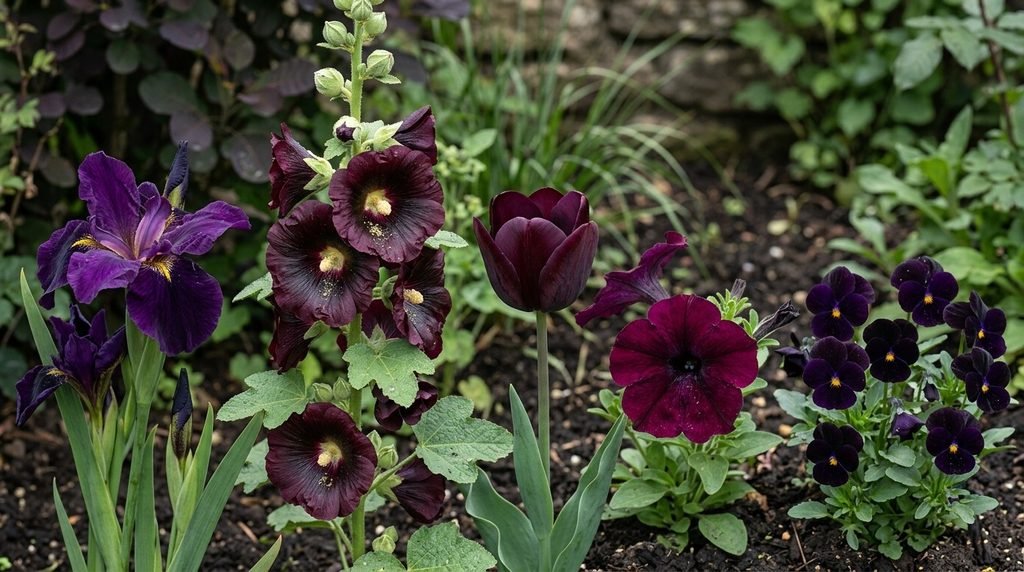
For example, University of Wisconsin Extension notes that the well-known Black Velvet petunia appears black but is actually an exceptionally dark purple. UConn’s Home & Garden Education Center similarly explains that many so-called black flowers get their appearance from extremely dark burgundy, maroon, blue, red, or purple pigmentation rather than a truly black pigment.
So if you’re shopping for gothic flowers, don’t judge a plant by the word black alone. Look at the exact cultivar, botanical name, growing requirements, and photographs taken in ordinary garden light.
Why Gothic Flowers Stand Out in a Garden
Dark flowers work differently from bright flowers visually.
A bed filled entirely with dark plants can lose definition, particularly from a distance or in heavy shade. Penn State Extension notes that dark foliage tends to recede visually and that too much darkness can merge into what looks like one large dark mass. The same design principle is useful when arranging near-black blooms.
That’s why contrast is usually more effective than simply planting as many black-looking flowers as possible.
Dark flowers can look especially dramatic beside:
- Silver or gray foliage
- Lime-green foliage
- White flowers
- Pale pink flowers
- Cream-colored plants
- Light gravel or stone
- Weathered wood
- Terracotta
- Dark metal used selectively
Light also changes the effect.
A flower that seems almost black on an overcast morning may reveal wine-red or purple undertones in bright afternoon sun. Instead of treating that as a flaw, use it as part of the design. A planting that shifts character as the light changes often looks more interesting than one flat block of color.
Best Gothic Flowers for U.S. Gardens
The best choice depends on your climate, soil, sunlight, available space, and the season you want flowers.
Here are several well-documented options that create the dark look without relying on questionable plant names or heavily edited nursery photographs.
Black Velvet Petunia
Black Velvet petunia is one of the most recognizable dark-flowering container plants.
Its velvety flowers appear black at first glance but are actually an extremely dark purple. University of Wisconsin Extension identifies Black Velvet and Black Cat as marketing names associated with the cultivar developed as ‘Balpevec’.
Petunias are tender perennials in USDA Zones 10–11 but are usually grown as annual bedding and container plants elsewhere in the United States. The broader petunia group flowers from roughly May until frost and performs in full sun to light shade.
This makes dark petunias especially practical for gardeners who want the gothic effect without committing permanent bed space.
Try them in:
- Patio pots
- Window boxes
- Hanging baskets
- Border edges
- Seasonal displays
Pairing them with silver foliage or pale flowers keeps the dark blooms from disappearing visually.
‘Queen of Night’ Tulip
For spring drama, Tulipa ‘Queen of Night’ is one of the classic near-black choices.
Missouri Botanical Garden describes its flowers as dark maroon-purple and notes that their nearly black appearance works particularly well beside lighter tulips. It is listed for USDA Zones 3–8, prefers full sun, and generally blooms in April and May.
‘Queen of Night’ works particularly well when planted in groups rather than as isolated bulbs. The dark flowers become much easier to read against pale companions such as white, blush, cream, or soft lavender tulips.
Tulips can sometimes return in later years, but hybrid tulip performance may decline. Gardeners who want a very precise annual display often treat them more like seasonal bulbs than permanent perennials.
‘Nigra’ Hollyhock
If your gothic garden needs height, Alcea rosea ‘Nigra’ offers a completely different silhouette.
Missouri Botanical Garden describes ‘Nigra’ as producing deep maroon flowers that look almost black. Plants can reach roughly 5 to 8 feet tall and are listed for USDA Zones 2–9. Bloom is concentrated in summer, with the cultivar listing July through August.
That height makes it particularly useful:
- Against fences
- Beside garden walls
- Behind lower perennials
- In cottage-style borders
- As an architectural backdrop
Hollyhocks are often short-lived perennials or behave somewhat like biennials, but they can self-seed when conditions suit them. Rust and other foliage problems can also make the leaves look less polished later in the season, so consider placing shorter plants in front of them.
‘Blackout’ Viola
For something much smaller, consider Viola cornuta ‘Blackout’.
Missouri Botanical Garden lists ‘Blackout’ for USDA Zones 6–10 and describes the cultivar as having deep black flowers. Plants stay roughly 6 to 9 inches tall and flower primarily from April through June. They can grow in full sun or partial shade.
Its compact size makes it particularly useful in:
- Container edges
- Path borders
- Rock gardens
- Small beds
- Window boxes
In climates where hot summer weather slows flowering, cutting the plants back may encourage another period of growth and possible fall flowering.
‘Black Gamecock’ Louisiana Iris
Not every gothic garden has dry, ordinary flower-bed soil.
For a damp location, Iris ‘Black Gamecock’ is an interesting alternative. Missouri Botanical Garden describes its blooms as dark purple to black and lists the cultivar for USDA Zones 4–9. It flowers mainly in May and June and grows in full sun to partial shade.
Here’s the important difference: this iris likes moisture.
It can grow in moist to wet soil and is suited to rain gardens, pond margins, bog gardens, and other locations where many ordinary flowering plants would struggle.
That makes it useful for homeowners who want a dramatic flower without forcing a dry-border plant into the wrong conditions.
Gothic Flower Comparison Table
USDA Plant Hardiness Zones describe average annual extreme minimum winter temperatures. They’re useful for estimating winter survival of perennial plants, but they don’t replace information about summer heat, rainfall, soil, light, or local microclimates.
| Flower | Actual Color | USDA Zones | Sun Needs | Main Bloom Season | Best Use |
| Black Velvet petunia | Extremely dark purple; appears black | Petunia group 10–11 as perennial; usually grown as an annual elsewhere | Full sun to light shade | Late spring to frost | Containers, hanging baskets, seasonal beds |
| ‘Queen of Night’ tulip | Dark maroon-purple, nearly black | 3–8 | Full sun | April–May | Spring beds, mass planting, cut flowers |
| ‘Nigra’ hollyhock | Dark maroon, almost black | 2–9 | Full sun | July–August | Tall borders, fences, cottage gardens |
| ‘Blackout’ viola | Black | 6–10 | Full sun to part shade | April–June; possible later rebloom | Edging, pots, small gardens |
| ‘Black Gamecock’ Louisiana iris | Dark purple to black | 4–9 | Full sun to part shade | May–June | Rain gardens, pond edges, wet sites |
The table also shows why there isn’t one universal Goth Flower growing guide. A moisture-loving Louisiana iris and a container petunia may fit the same color palette while needing very different garden conditions.
How to Design a Gothic Flower Garden
A gothic garden doesn’t have to resemble a Halloween display.
The most convincing designs usually borrow from ordinary landscape principles—contrast, repetition, structure, scale, and focal points—and then use a darker plant palette.
If you’re planning a new bed from scratch, HomeWorks Daily’s broader guide to garden design and structural planting can help you think beyond flower color alone.
Pair Dark Flowers With Light Foliage

One of the easiest ways to make dark flowers visible is to place something pale behind or beside them.
Consider:
- Silver foliage
- Gray-green leaves
- White variegation
- Chartreuse foliage
- Cream flowers
- Pale gravel
A black-looking flower against another dark plant can disappear from several feet away. The same flower beside silver foliage suddenly has an outline.
Use Contrast Instead of Only Black Plants
You don’t need a completely black garden to create a gothic mood.
In fact, the dark flowers usually become stronger when the surrounding palette includes restraint and contrast.
A simple three-color scheme might be:
Near-black + white + silver
For something warmer:
Burgundy + dusty pink + charcoal
Or for a more modern look:
Near-black + chartreuse + green
Penn State specifically notes that dark plants can create dramatic contrast with lighter colors while warning that too many dark plants can visually merge together.
Create One Strong Focal Point
If every plant is trying to be dramatic, none of them feels especially dramatic.
Instead, choose one feature to carry the darkest color.
That might be:
- A group of ‘Queen of Night’ tulips
- One large container of black petunias
- A row of ‘Nigra’ hollyhocks against a wall
- A patch of ‘Black Gamecock’ iris around water
- A small mass of ‘Blackout’ violas near an entrance
Then repeat smaller amounts of the same color elsewhere.
Add Containers and Garden Accessories
Containers make experimentation easier because you can change the display from season to season.
Dark flowers also work naturally with:
- Aged terracotta
- Matte or weathered metal
- Dark glazed pots
- Stone urns
- Simple trellises
- Wrought-iron-style garden features
Avoid turning every accessory into a theme prop. One or two strong materials usually create a more convincing atmosphere than a collection of unrelated decorations.
Growing and Caring for Dark Flowers
Color doesn’t determine care requirements.
A black-looking flower isn’t automatically more difficult to grow than a pink, orange, or white flower. What matters is the species and cultivar.
Soil
Start with the plant rather than a universal “goth garden soil.”
‘Queen of Night’ tulips prefer fertile, well-drained soil. ‘Nigra’ hollyhock also needs drainage and doesn’t tolerate persistently wet winter soil. ‘Black Gamecock’ iris, on the other hand, actively prefers moist to wet conditions.
Putting all three into identical soil conditions would make little sense.
Water
Water according to the plant and weather.
Petunias generally want moderate moisture with good drainage, while Louisiana iris can tolerate substantially wetter soil. Containers also dry more quickly than equivalent plants in the ground.
Check the soil rather than watering purely by calendar.
Sunlight
Most dark-flowering choices still need meaningful light to bloom well.
‘Queen of Night’ tulip and ‘Nigra’ hollyhock favor full sun. ‘Blackout’ viola and ‘Black Gamecock’ iris can handle some partial shade.
There’s also a design issue: a nearly black flower planted in deep shade may be physically healthy yet difficult to see.
Fertilizing
Don’t assume dark flowers need extra fertilizer because of their color.
Use fertilizer according to the needs of the species and your soil conditions. Excessive feeding can produce weak or overly leafy growth in some ornamentals rather than better flowers.
For containers, nutrients also leach from potting media more quickly than from many garden soils, so container plants may need a different routine than plants growing in the ground.
Pruning and Deadheading
Deadheading can extend the display of some plants, but the correct approach varies.
For perennial tulips, Missouri Botanical Garden recommends removing spent flower stems while leaving foliage in place until it yellows. For ‘Blackout’ viola, cutting plants back when flowering declines in summer can encourage fresh growth and potentially another bloom period.
With hollyhocks, leaving some spent flowers can allow self-seeding if that’s part of your garden plan.
Winter Care
Check the cultivar’s hardiness zone before assuming a plant can stay outdoors year-round.
A petunia that thrives through summer in Minnesota isn’t therefore winter hardy in Minnesota. It is commonly treated as an annual there.
Likewise, USDA hardiness zones are based on average annual extreme minimum temperatures—not summer heat, humidity, rainfall, or soil conditions. Use the zone as one part of the decision rather than the entire decision.
Gothic Flowers for Containers and Small Spaces

You don’t need an expansive Victorian garden to use dark flowers.
A patio, balcony, townhouse entrance, or small backyard may actually make the dark palette easier to control.
Black petunias are among the most practical choices because they produce substantial summer color without requiring permanent garden space. ‘Blackout’ viola works well closer to the container edge, while bulbs such as ‘Queen of Night’ can create a spring display before summer annuals take over.
A simple container might include:
- One dark-flowering plant as the main feature
- One silver or lime-green foliage plant for contrast
- One softer trailing plant around the edge
Make sure all plants in the same container have compatible sunlight and watering requirements. A visually perfect combination won’t stay perfect if one plant wants wet soil and its neighbor needs the mix to dry quickly.
For rooftop or highly space-limited gardening, the HomeWorks Daily guide to roof garden ideas and container planning covers additional considerations such as drainage, wind, container choice, and available space.
Common Goth Flower Gardening Mistakes
A few mistakes can turn a dramatic planting into a disappointing one:
- Buying by color name alone. “Black” may mean dark purple, maroon, burgundy, or another near-black shade. Verify the cultivar before purchasing.
- Putting dark flowers in the darkest part of the yard. They may disappear visually even if the plant tolerates the light level.
- Using nothing but dark plants. Contrast usually creates a stronger effect than an uninterrupted mass of black-looking foliage and flowers.
- Ignoring mature height. An 8-foot hollyhock and an 8-inch viola shouldn’t occupy the same design role.
- Ignoring soil moisture. ‘Black Gamecock’ iris enjoys moisture that would be unsuitable for many other ornamentals.
- Assuming USDA zone equals total climate suitability. Hardiness zones address winter minimum temperature, not every environmental factor.
- Choosing only by edited online photographs. Flower color can look dramatically different under studio lighting, filters, and different exposure settings.
- Crowding containers. A moody container still needs adequate root space, airflow, drainage, and access for maintenance.
- Buying vaguely labeled seeds for named cultivars. If an exact flower color matters, buy from a reputable source and confirm the cultivar name and botanical identity.
How to Choose the Right Gothic Flower
Start with your garden conditions and narrow the list from there.
Check Your USDA Zone
For a perennial or bulb you hope will return, compare its documented hardiness with your local USDA zone.
The current USDA Plant Hardiness Zone Map lets U.S. gardeners look up their location by ZIP code.
Measure Available Sunlight
Don’t describe a location as simply “sunny” or “shady.”
Observe it.
A spot receiving strong afternoon sun behaves differently from a space receiving a few hours of gentle morning sun.
Consider Garden Size
For a small patio, a compact viola or petunia can provide plenty of dark color.
For the back of a large flower border, a 6-foot hollyhock has much more presence.
Decide How Much Maintenance You Want
Annual displays are easy to redesign each year but require replacement.
Longer-lived perennials may reduce annual planting but can introduce pruning, division, disease management, or winter-care considerations.
Think About Bloom Season
A gothic garden doesn’t need to look identical all year.
‘Queen of Night’ tulip provides spring color.
‘Black Gamecock’ iris follows in late spring.
‘Nigra’ hollyhock adds midsummer height.
Dark petunias can carry the palette through warmer months and toward frost.
Using different bloom periods creates a sequence rather than one short burst.
Decide Between Containers and Ground Planting
Containers are useful when:
- Space is limited
- Soil conditions are poor
- You like changing designs seasonally
- You want dark flowers near a doorway or patio
- A plant isn’t reliably winter hardy in your location
Ground planting makes more sense when you want a larger recurring border or a species needs conditions easier to provide in the landscape.
Consider Household Safety
If children or pets regularly use the garden, include plant safety in your buying process.
Don’t rely on common names or assumptions. Check the exact botanical plant identification against an appropriate poison-control or veterinary source before purchasing a plant that may be eaten or handled.
Gothic Flower Ideas for Different Garden Styles

Dark flowers don’t have to belong to one design style.
Victorian-Inspired Garden
Use tall plants and strong vertical structure.
A backdrop of ‘Nigra’ hollyhocks can work with pale roses, silver foliage, clipped shrubs, traditional containers, and restrained metal accents.
The goal is romance and structure rather than turning the garden into a permanent Halloween set.
Modern Dark Garden
Keep the planting simpler.
Use repeated groups of one or two dark flowers against strong foliage shapes, pale hardscaping, and uncluttered containers.
Dark flowers become much more graphic in a modern layout.
Cottage Garden With Gothic Accents
A cottage garden naturally accommodates unusual color combinations.
Mix a few near-black flowers among soft pink, white, mauve, and blue blooms rather than separating them into their own bed.
For another example of using a bold flower as part of a larger garden planting, see HomeWorks Daily’s guide to growing tiger lilies.
Halloween-Inspired Seasonal Display
For a temporary autumn display, lean into the theme more strongly.
Combine dark annuals or foliage with pumpkins, ornamental grasses, weathered containers, and a restrained amount of seasonal décor.
Keeping the plants central prevents the arrangement from feeling like decorations happened to land in a flower bed.
Frequently Asked Questions About Gothic Flowers
What is a Gothic Flower?
A Goth Flower is not one recognized botanical species. The term usually describes black-looking, near-black, burgundy, deep-red, or dark-purple flowers used for gothic, moody, or dramatic garden designs.
The exact plant could be anything from a petunia to a tulip, viola, hollyhock, or iris.
Are there naturally black flowers?
Flowers described as black are often extremely dark shades of purple, red, maroon, or burgundy rather than botanically pure black. Some cultivars become dark enough that they appear black under normal garden conditions.
Lighting also changes how the color appears.
What flowers work best in a gothic garden?
Useful options include Black Velvet-type petunias, ‘Queen of Night’ tulips, ‘Nigra’ hollyhocks, ‘Blackout’ violas, and ‘Black Gamecock’ Louisiana iris. The best choice is the one suited to your climate, sunlight, soil, moisture, space, and desired flowering season.
Can Gothic Flowers grow in full sun?
Many can. ‘Queen of Night’ tulips and ‘Nigra’ hollyhocks prefer full sun, while ‘Blackout’ viola and ‘Black Gamecock’ iris can grow in full sun or partial shade.
Always check the specific plant rather than using flower color as a care guide.
What colors look best with black flowers?
White, silver, gray, chartreuse, pale pink, and other lighter colors can provide enough contrast to define dark flowers clearly.
There’s no single correct combination. The important point is creating enough difference in color or texture for the near-black blooms to remain visible.
Are dark flowers harder to grow?
Not inherently.
Their care depends on the species. A dark petunia generally follows petunia care, while a dark Louisiana iris follows Louisiana iris care. The pigmentation doesn’t create one universal set of growing requirements.
Can Goth Flowers grow in containers?
Yes. Compact plants such as dark petunias and ‘Blackout’ viola are particularly useful in containers, and ‘Queen of Night’ tulips can also be used for seasonal spring pots.
Choose a container with drainage and match all plants in the pot to similar moisture and light requirements.
Final Thoughts
A Gothic Flower isn’t one mysterious species waiting to be discovered. It’s a useful name for a much broader group of black-looking, burgundy, maroon, wine-red, and dark-purple flowers that can give an ordinary garden a completely different personality.
The strongest designs don’t depend on darkness alone.
Choose flowers that suit your climate. Give them the soil and sunlight they actually need. Use pale foliage or flowers for contrast. Consider height and bloom season. And buy named cultivars from sources that provide credible plant information rather than relying on dramatic photographs.
Start with one dark focal point if you’re unsure. A container of near-black petunias or a small group of ‘Queen of Night’ tulips can tell you quickly whether you enjoy the look before you redesign an entire bed.
For more flower inspiration and practical growing guidance, explore HomeWorks Daily’s October birth flower growing guide and other gardening resources.