
A hardwood floor can look perfectly clean from across the room, then sunlight hits it and suddenly you see the footprints, pet hair, fine dust, and faint kitchen film.
The safest answer to how to clean hardwood floors is straightforward: remove loose dirt first, then clean the surface with as little moisture as practical and a cleaner approved for your flooring or finish. Use a soft microfiber mop or suitable hard-floor vacuum, never leave puddles behind, and deal with spills promptly.
There is one important catch. Not every wood floor should be cleaned the same way. A modern factory-finished floor, an old waxed floor, a natural-oil finish, and unfinished wood can require very different products. The National Wood Flooring Association (NWFA) recommends following the flooring or finish manufacturer’s instructions and avoiding wet mops and steam mops.
How Do You Clean Hardwood Floors Safely?
For most surface-sealed hardwood floors, the practical routine is:
- Remove dust, hair, sand, and grit with a microfiber dust mop, soft broom, or vacuum set up for bare floors.
- Spot-clean spills and stuck-on messes rather than flooding the entire floor.
- Use a cleaner made for the floor’s finish, preferably one specifically recommended by the flooring or finish manufacturer.
- Apply very little liquid. A spray mop or lightly damp microfiber pad gives you much better moisture control than a bucket and traditional string mop.
- Work in manageable sections, changing the pad when it gets dirty.
- Don’t leave standing moisture behind. If an area looks noticeably wet, wipe it dry.
That’s the basic method. What changes from one home to another is the type of cleaner and the amount of damp cleaning the particular floor permits.
The NWFA’s wood-floor maintenance guidance recommends routine sweeping, dust mopping, or vacuuming on a bare-floor setting, prompt spill cleanup, and a cleaner appropriate to the floor’s finish.
Before You Start, Know What You’re Actually Cleaning
Here’s where people often go wrong: you’re usually cleaning the finish protecting the wood, not scrubbing bare wood itself.
Modern hardwood may have a factory-applied finish or a site-applied surface coating. Older flooring may be waxed. Other floors use penetrating oils or hard-wax oils. Each system has its own maintenance requirements. The NWFA specifically notes that waxed floors shouldn’t be cleaned with water-based cleaners and that oiled floors can require finish-specific soaps or oils rather than conventional wood-floor cleaners. NWFA
| Floor or finish | Safest starting approach | Important caution |
| Surface-sealed or factory-finished hardwood | Dry-clean first; use the manufacturer’s approved wood-floor cleaner with tightly controlled moisture | Don’t assume every generic hardwood cleaner is compatible |
| Waxed hardwood | Dry-clean and use wax-compatible maintenance products | NWFA advises against water-based cleaners on waxed floors |
| Natural-oil or hard-wax-oil finish | Follow the finish manufacturer’s specific cleaning and maintenance system | Conventional wood-floor cleaner may damage or interfere with the oil finish |
| Unfinished or badly worn wood | Prioritize dry cleaning and professional guidance | Water and stains can reach the wood more readily |
| Unknown finish | Dry-clean first and identify the finish before experimenting | Skip vinegar, polish, wax, steam, and generic wet cleaning |
| Engineered hardwood | Follow the individual product’s care instructions | More dimensional stability doesn’t mean every engineered floor is waterproof |
What if you don’t know what finish is on your floor?
Don’t turn identification into a chemistry experiment.
Check installation paperwork, old cans of finish, purchase records, or the flooring manufacturer’s information if you have it. If the floor is older and you genuinely can’t determine what’s on it, the NWFA recommends asking a wood-flooring professional to identify the finish and suggest a compatible product.
Until then, dry dusting and careful vacuuming are safer than introducing an unfamiliar cleaner.
What Should You Use to Clean Hardwood Floors?
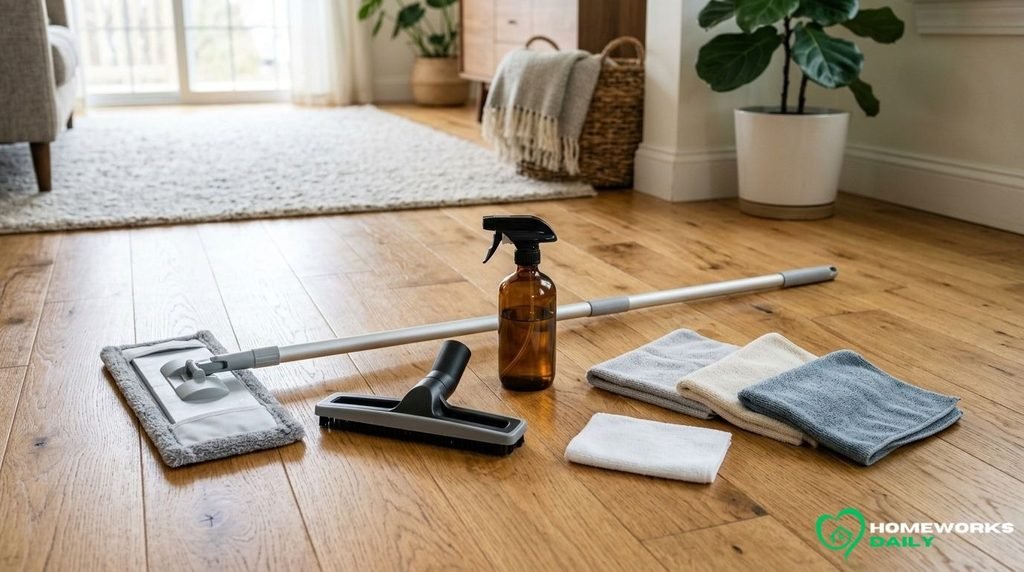
You don’t need an overflowing cleaning cabinet. A simple setup is usually more useful:
- A soft microfiber dust mop
- A flat microfiber cleaning mop or controlled spray mop
- Clean replacement mop pads
- A vacuum with a bare-floor setting or soft brush/felt attachment
- Clean microfiber cloths for spills and spot cleaning
- A hardwood-floor cleaner approved for your flooring or finish
- A dry towel for accidental excess moisture
A flat mop is particularly practical because it gives you more control than a saturated string mop. Fresh pads also matter. Once a cleaning pad is loaded with grit and dirty solution, continuing to push it around the room can simply redistribute the mess.
Bona, for example, advises removing grit before wet cleaning and changing dirty cleaning pads rather than continuing to spread soil across the floor.
What should you look for in a hardwood floor cleaner?
Start with compatibility, not marketing language.
Look for a product that:
- Explicitly states that it is intended for wood flooring
- Is compatible with your floor’s particular finish
- Can be used according to the flooring manufacturer’s care instructions
- Doesn’t require flooding or heavy rinsing
- Is designed to dry without leaving excessive film or residue
Many modern hardwood cleaners are pH-neutral or pH-balanced, but “pH-neutral” alone doesn’t make a product suitable for every wood finish. Finish compatibility is still the deciding factor.
What should you look for in a mop?
The most useful features are usually:
- A washable microfiber pad
- Good liquid absorption
- A flat head that reaches beneath furniture
- A spray system that allows controlled application, if your floor permits spray cleaning
- Replacement pads so you don’t have to finish a room with one dirty pad
More liquid isn’t better. Good cleaning comes from combining the right chemistry with a clean pad and enough mechanical action to lift soil—not from soaking the boards.
What vacuum works well on hardwood?
Use a vacuum that lets you disengage the rotating beater bar or has a dedicated hard-floor head. A soft brush or felt-covered attachment can remove grit from seams and edges without aggressively striking the finish.
Bruce and Shaw both recommend regular vacuuming or sweeping while avoiding floor-contacting brush systems that can scratch the surface.
Step by Step: How to Clean Hardwood Floors Properly
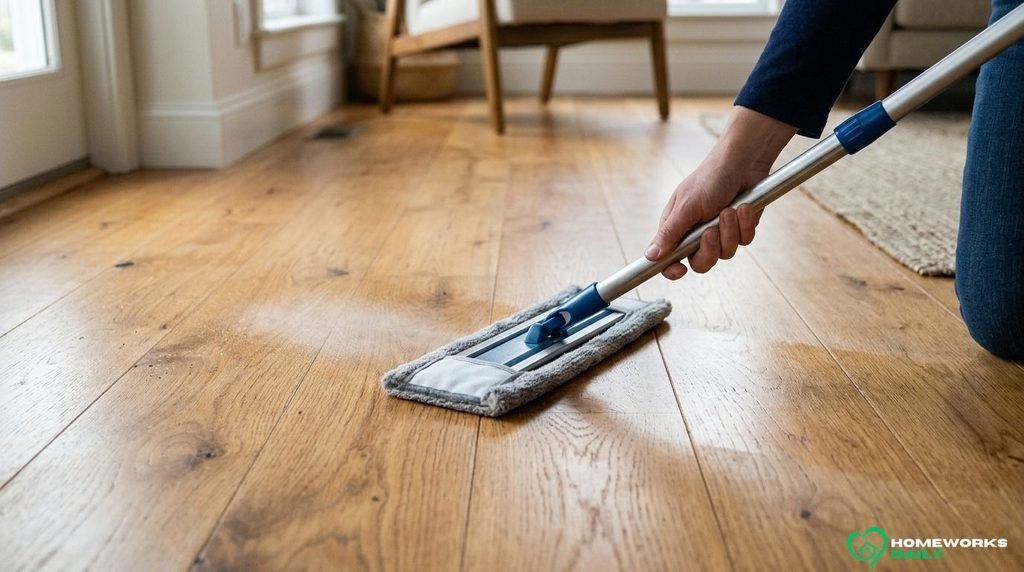
1. Check the floor before getting it wet
Look for:
- Open seams or unusually large gaps
- Loose boards
- Peeling or missing finish
- Cupping or swelling
- Gray or raw-looking wood
- Dark stains that appear to be below the finish
- Areas damaged by a previous leak
A floor with an intact finish is a different cleaning job from a floor with exposed or damaged wood.
If you see widespread bare wood, moisture damage, or a failing coating, more aggressive cleaning isn’t necessarily the solution. The floor may need repair, recoating, or refinishing.
2. Remove furniture and floor-level obstacles
You don’t need to empty the entire house, but move lightweight furniture, pet bowls, baskets, and anything else that prevents you from reaching the actual floor.
If you’re moving heavier furniture, lift rather than drag it whenever possible.
3. Dry-clean the floor thoroughly
This step is easy to underestimate.
Dust, sand, tiny stones, and outdoor grit can behave like abrasive particles when trapped beneath a mop pad. Vacuum or dust-mop the entire area before introducing cleaner.
Pay extra attention to:
- Exterior doors
- Under dining chairs
- Kitchen work areas
- Pet feeding stations
- Hallway transitions
- Along baseboards
- Under movable rugs
This matters even more in homes with pets, children, or shoes routinely worn indoors.
4. Spot-clean obvious messes first
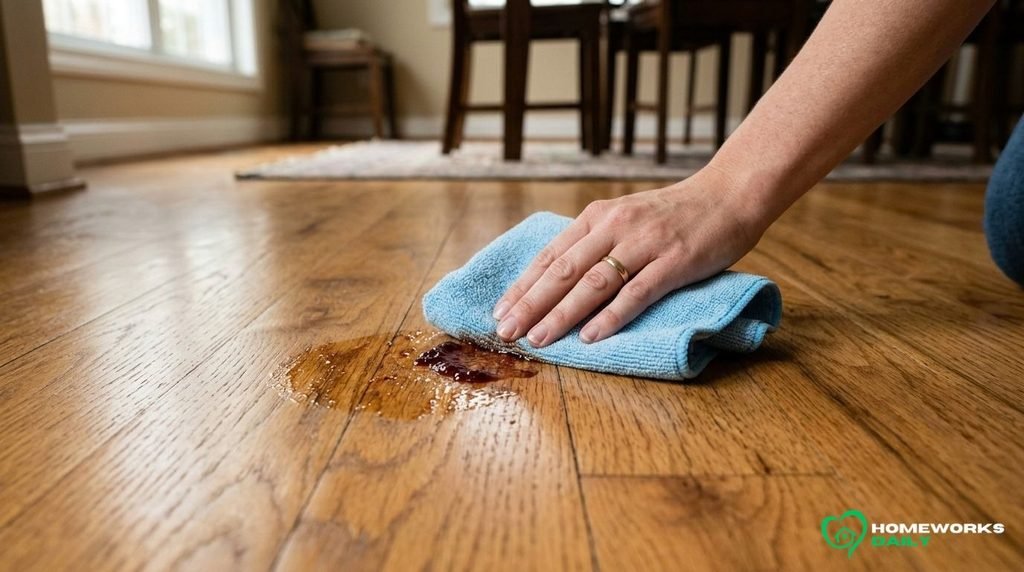
A dried splash of juice doesn’t require the entire room to receive more cleaner.
Apply the appropriate wood-safe cleaner to the affected area according to its label, give it the recommended contact time if applicable, and wipe gently with a microfiber cloth.
Avoid aggressive scrubbing pads, scouring powders, and improvised abrasives.
5. Prepare the mop with minimal moisture
If your manufacturer’s instructions permit damp cleaning, the pad should be lightly damp—not dripping or saturated.
For ready-to-use spray cleaners, follow the label rather than pouring extra product into a bucket.
For manufacturers that specify spray-and-wipe cleaning, follow that approach instead of conventional mopping.
There isn’t a universal “safe number of cups of water” for hardwood. A Bruce floor, a site-finished polyurethane floor, a waxed oak floor, and an oiled floor aren’t necessarily governed by the same care instructions. Bruce, for example, tells owners of many of its hardwood products to avoid mopping with water and instead use its spray-and-wipe cleaner system.
6. Clean a small area at a time
Work in manageable sections so you can see what the cleaner and moisture are doing.
Move the mop smoothly across the boards rather than repeatedly grinding the same dirty pad into one spot. Cleaning in the direction of the boards can also make it easier to work along seams and spot remaining dirt.
If the pad becomes visibly dirty, replace or rinse it according to the product instructions.
One clean pad for an entire dirty first floor isn’t necessarily efficient. Sometimes the simplest fix for streaking is another clean pad.
7. Watch the floor as you work
A little water goes a long way here.
You shouldn’t be seeing puddles or liquid sitting in seams. If that happens, stop and absorb the excess immediately with a clean towel.
Wood movement is influenced by moisture, and flooring manufacturers consistently warn against leaving excess water on hardwood.
8. Let the floor dry before replacing rugs
Allow the surface to dry according to the cleaner manufacturer’s instructions.
Don’t immediately trap residual moisture beneath an area rug or mat.
If you’re choosing a rug for a larger hardwood living area, HomeWorks Daily’s guide to choosing and positioning a 9 x 12 living-room rug also covers rug pads, maintenance, and flooring considerations.
Can You Mop Hardwood Floors With Water?
Don’t wet-mop hardwood floors with a traditional soaked mop and bucket. Whether a carefully dampened microfiber pad is acceptable depends on your floor and finish.
The NWFA advises against wet mops because excessive water can damage wood and finishes. Its technical guidance also recognizes controlled spray-mop or near-dry cleaning methods where appropriate and emphasizes manufacturer instructions. That’s an important distinction.
“Never flood a wood floor” is excellent general advice.
“Every wood floor can safely be damp-mopped” is not.
For some products, the manufacturer explicitly allows a lightly damp microfiber mop. Others specify their own spray cleaner and discourage mopping with water entirely.
Can You Use Vinegar on Hardwood Floors?
Vinegar isn’t a good default hardwood-floor cleaner.
The 2025 NWFA technical guidance specifically says not to use vinegar on wood-floor finishes because its acidity can degrade the finish. Bruce likewise lists acidic substances such as vinegar among products it recommends avoiding on its hardwood flooring.
You may still see old recipes calling for vinegar and water. That’s precisely why knowing the finish matters. A DIY recipe that’s been repeated for years isn’t automatically compatible with the finish protecting your particular floor.
The simplest option is usually a cleaner approved by the flooring or finish manufacturer.
Can You Use Dish Soap on Hardwood?
Don’t treat dish soap as a universal hardwood cleaner.
Manufacturer advice can even vary by product line. Bruce’s engineered-hardwood guidance says a few drops of mild dish soap may be used with warm water on certain floors, while broader Bruce hardwood-care instructions tell users to avoid detergents and use its approved hardwood cleaner instead.
That isn’t a contradiction so much as a reminder that the product-specific care guide wins.
If your manufacturer doesn’t specifically authorize dish soap, a purpose-made, finish-compatible hardwood cleaner is the safer starting point.
Can You Use a Steam Mop on Hardwood Floors?
For ordinary hardwood care, skip the steam mop.
Steam combines heat with moisture and can drive water vapor into seams and wood fibers. The NWFA advises against steam cleaners, and major manufacturers including Shaw and Bruce also tell homeowners not to steam-clean their hardwood flooring.
Shaw’s hardwood care and maintenance guidance explicitly lists both wet mops and steam mops among the methods to avoid.
If you own a multi-surface steam cleaner, don’t assume its “floor” capability means it is approved for wood. HomeWorks Daily also has broader guidance on steam-cleaning equipment, but the individual flooring manufacturer’s restrictions should control whether a particular surface is suitable.
What Should You Never Use on Hardwood Floors?
Unless your flooring or finish manufacturer specifically instructs otherwise, avoid:
- Steam mops
- Saturated wet mops
- Vinegar
- Bleach
- Ammonia-based cleaners
- Abrasive powders
- Steel wool or aggressive scrub pads
- Tile or vinyl-floor cleaning chemicals
- Oil soaps on finishes that don’t call for them
- Wax on a no-wax or urethane-finished floor
- “Rejuvenator,” polish, or shine-building coatings used without confirming compatibility
- Large quantities of all-purpose cleaner
- Any product that leaves the floor persistently sticky, greasy, or slippery
One overlooked concern with shine-restoring products is future maintenance. The NWFA warns that inappropriate waxes, oils, and film-forming products can interfere with later recoating or otherwise change the intended finish.
A dull floor doesn’t always need polish. Sometimes it simply needs cleaner residue removed. Sometimes the finish itself is worn.
Those are different problems.
How to Clean Heavily Soiled Hardwood Floors
If the floor hasn’t been cleaned properly in months—or you’ve just moved into a house where it looks gray and grimy—resist the urge to use more water and stronger chemicals.
Instead:
- Inspect for bare wood, loose boards, moisture damage, and finish failure.
- Vacuum exceptionally well, including edges and between accessible seams.
- Test the approved cleaner in an inconspicuous area.
- Treat sticky or greasy spots individually.
- Use a manufacturer-approved hardwood deep cleaner if one is available for your finish.
- Work in small areas with clean microfiber pads.
- Replace pads frequently instead of redistributing soil.
- Repeat a gentle cleaning cycle if necessary rather than making the first pass dramatically wetter.
- Stop if the surface remains dull because the finish appears worn rather than dirty.
Bona’s deep-cleaning instructions follow a similar principle: remove loose particles first, concentrate appropriate cleaner on problem areas, and replace a cleaning pad once it becomes dirty.
Know when “dirty” is actually “worn”
This distinction can save a great deal of unnecessary scrubbing.
If traffic lanes remain gray, bare-looking, deeply scratched, or discolored after appropriate cleaning, the problem may be finish wear or wood damage.
The NWFA notes that a maintenance coat can renew some dull floors, while floors with exposed wood, deep scratches, or significant damage may require sanding and refinishing.
Cleaner can’t replace missing finish.
How to Handle Common Hardwood Floor Messes
| Situation | Recommended approach | Avoid | Why |
| Dust, hair, and grit | Microfiber dust mop or bare-floor vacuum | Wetting the dirt first | Dry removal prevents grit from being dragged across the finish |
| Mud | Let heavy mud become easier to lift if appropriate, remove loose soil, then spot-clean with approved cleaner | Spreading muddy water around with a wet mop | Sand and grit in mud can be abrasive |
| Sticky food or drink | Blot/remove excess, then use a finish-compatible cleaner on a microfiber cloth | Soaking the area | Localized mess doesn’t require flooding the floor |
| Grease | Use an approved hardwood cleaner and repeat gently if necessary | Strong kitchen degreaser unless specifically approved | Degreasers may attack or haze some finishes |
| Pet accident | Blot promptly, remove solids, then clean with an approved product | Saturating seams with enzyme cleaner unless the floor maker approves it | Liquid can reach seams or damaged finish |
| Shoe scuff | Try the approved cleaner and a soft microfiber cloth | Abrasive erasers or scouring pads without manufacturer approval | Aggressive rubbing can alter the sheen |
| Gum or wax | Check the floor maker’s stain-removal instructions; some manufacturers recommend hardening it before gentle removal | Metal blades and aggressive scraping | Scraping can gouge the finish |
| Dark or black stain | Dry the area and determine whether the discoloration is beneath the finish | Repeatedly soaking or bleaching it | Deep staining may require repair or refinishing |
| Unknown finish | Vacuum/dust-mop and seek finish identification | DIY chemical experiments | The wrong cleaner can permanently alter the finish |
Sticky floors after mopping
A sticky hardwood floor isn’t necessarily still dirty.
Common causes include:
- Using too much cleaner
- Using the wrong cleaner
- Cleaning with a dirty pad
- Applying a product that leaves a film
- Layering multiple incompatible cleaning or polishing products
Bona notes that excessive product or a dirty pad can contribute to streaking and residue.
Don’t automatically add another product on top. Find the floor manufacturer’s recommended residue-removal or cleaning method first.
Pet urine and other pet messes
Blot liquid promptly before it spreads into seams. Then use a cleaner approved for the flooring.
Be especially cautious with enzyme pet products. A cleaner may be excellent for carpet yet unsuitable for a hardwood finish or for prolonged contact with wood.
If you also have rugs or carpet in the same room, treat those surfaces separately. HomeWorks Daily’s guide to choosing carpet-cleaning solutions for different messes can help with the soft flooring, but don’t assume a carpet formula is safe on exposed hardwood.
Persistent dark pet stains can extend below the finish. At that point, repeated surface cleaning may accomplish very little.
Water spots and dark water stains
First determine whether you’re looking at residue on the finish or discoloration inside or below it.
A surface mark from cleaner may respond to the approved cleaning process. A blackened board following a leak may indicate moisture reached the wood itself.
If the area is swollen, cupped, persistently damp, or smells musty, stop treating it as a normal cleaning problem and investigate the moisture source.
Where water damage has also resulted in visible or suspected mold, HomeWorks Daily’s mold remediation guide for homeowners explains why controlling the moisture source matters as much as surface cleanup.
How Do You Clean Engineered Hardwood Floors?
Use the same low-moisture principles, but follow the engineered-floor manufacturer’s instructions.
Engineered hardwood uses a real-wood surface over a layered core, which generally makes it more dimensionally stable than solid hardwood. But “more stable” doesn’t mean “safe to soak.”
Bruce recommends regular dry removal of dirt, microfiber cleaning, pH-balanced hardwood cleaner, and avoiding excess moisture, steam, harsh chemicals, and abrasive tools on its engineered floors.
Some newer engineered products are marketed as water-resistant or waterproof, and their care instructions may permit methods that would be inappropriate for another floor. Follow the documentation for the exact product rather than assuming all engineered hardwood behaves alike.
How Often Should Hardwood Floors Be Cleaned?
There isn’t one schedule that fits every household.
The NWFA says maintenance frequency varies with lifestyle, use, and wear. Shaw, for example, recommends routine dry cleaning and weekly use of its approved cleaner on its hardwood products.
A practical way to think about it is:
Spills: clean immediately.
Visible grit and pet hair: remove as needed. In an entryway or pet household, that may mean daily. A lightly used guest room may need far less attention.
Routine floor cleaning: use your manufacturer’s approved cleaner when soil or film requires it rather than wet-cleaning automatically every day.
Under rugs and furniture: inspect periodically because dirt can accumulate where normal passes miss it.
High-traffic homes need more frequent dirt removal, but that doesn’t mean they need more water.
How to Keep Hardwood Floors Cleaner for Longer
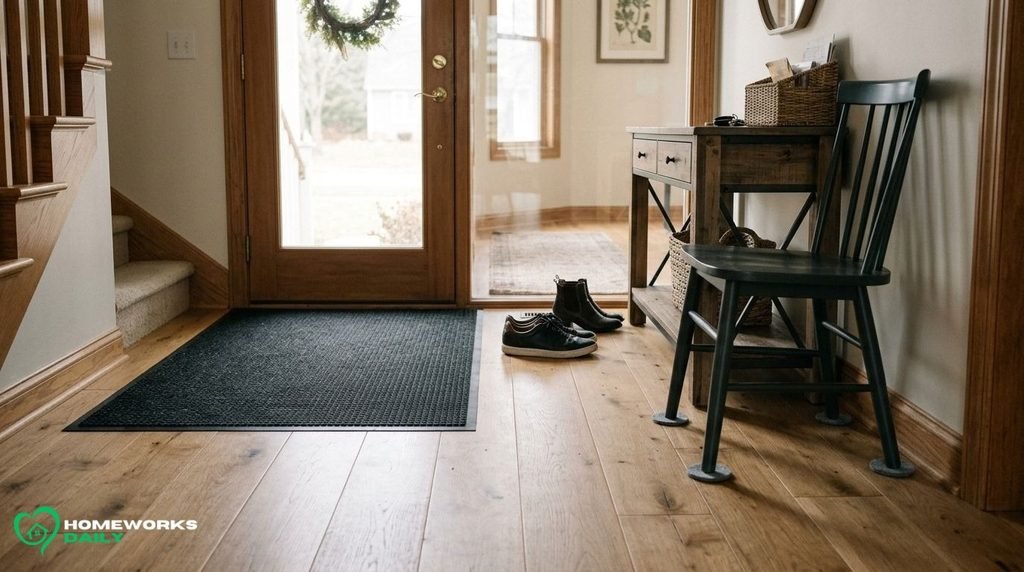
Prevention does much of the hard work.
Stop grit near the door
Use suitable walk-off mats at exterior entrances. Dirt caught before it reaches the hardwood can’t scratch the floor later.
Check that the mat and backing are compatible with your flooring. Some manufacturers warn against certain solid rubber, latex, vinyl, or non-breathable backings because they can interact with the floor or trap moisture.
Use felt protectors beneath furniture
Chair legs are repeat offenders because they move constantly. Felt pads reduce direct abrasion, but they need occasional inspection because grit can become embedded in the pad itself.
Keep pet nails maintained
Pets and hardwood can live together perfectly well, but longer nails can increase surface scratching. The NWFA recommends nail maintenance along with doorway rugs and regular dirt removal in pet households.
Deal with wet shoes quickly
Rain, snow, mud, and deicing residue can create a combination of moisture and abrasive grit.
An entrance mat plus a place to leave wet footwear is more useful than trying to repair the finish later.
Don’t drag heavy objects
Lift furniture when possible or use flooring-appropriate moving protection.
Don’t mistake gloss for cleanliness
A clean satin floor shouldn’t necessarily look like a glossy showroom surface.
Adding polish simply because the finish isn’t highly reflective can create buildup or future recoating problems. The desired sheen comes from the finish itself.
Common Hardwood Floor Cleaning Mistakes
Using more cleaner because the floor is dirty
More product can mean more residue.
Follow the cleaner’s dosage instructions. If the floor is genuinely dirty, clean pads and a second controlled pass are often preferable to one heavily saturated pass.
Mopping before vacuuming
This turns fine grit into something you’re pushing across the finish.
Dry first. Damp second.
Treating every wood-looking floor as hardwood
Laminate, luxury vinyl plank, wood-look tile, bamboo, engineered hardwood, and solid wood may resemble one another from across the room but can have different care requirements.
Confirm the flooring material before choosing the cleaner.
Leaving a wet mop sitting on the floor
A wet mop parked face-down can keep one area wet far longer than intended. Bona specifically cautions against leaving a wet pad standing on a floor surface after cleaning.
Assuming a “natural” cleaner is automatically safer
Vinegar is natural. So are plenty of substances you wouldn’t apply to a wood finish.
Compatibility matters more than whether a cleaner sounds homemade or eco-friendly.
Trying to clean away finish damage
If the finish has worn through, stronger cleaning can make matters worse.
That’s the point to ask whether the floor needs recoating or refinishing rather than another round of scrubbing.
What Products Are Actually Worth Buying?
You don’t need a complicated floor-care system, but a few features can make cleaning easier.
Microfiber mop
Prioritize moisture control, washable pads, replacement-pad availability, and a head that moves easily around furniture.
A built-in sprayer can be useful if your flooring manufacturer allows spray cleaning.
Hardwood-safe cleaner
Look for finish compatibility first. If you know your flooring brand, start with the care guide for that exact product.
A general “safe for hardwood” claim on the bottle doesn’t overrule the flooring warranty.
Vacuum attachment
A hard-floor tool with soft contact surfaces and no aggressive rotating brush is usually a more important feature than raw suction power.
Entry mats and area rugs
Choose materials and backings that are compatible with your floor. Use them where they actually intercept grit—entrances, heavily traveled paths, and other wear zones.
That kind of purchase can prevent more damage than a cabinet full of restorative cleaners.
Common Questions About Cleaning Hardwood Floors
What is the best thing to clean hardwood floors with?
For most finished floors, use a microfiber mop or cloth and a wood-floor cleaner approved for the specific finish or flooring product. Remove grit with a dust mop or bare-floor vacuum first.
Can I mop hardwood floors with plain water?
Don’t use a saturated wet mop. Some manufacturers permit a very lightly damp microfiber mop, while others prefer spray-and-wipe cleaning without conventional water mopping. Follow the care instructions for your floor.
Is vinegar and water safe for hardwood floors?
It’s not a good default. Current NWFA technical guidance advises against vinegar on wood-floor finishes, and major manufacturers also warn that acidic cleaners can damage or dull certain finishes.
Can I use Dawn or another dish soap?
Only if the care instructions for your particular flooring allow it. Some engineered-hardwood guidance permits a tiny amount of mild dish soap, while other hardwood warranties discourage detergents. Don’t assume one DIY formula fits every finish.
Can I use a steam mop if my hardwood is sealed?
The NWFA and major hardwood manufacturers generally advise against steam cleaning wood flooring. “Sealed” doesn’t mean steam-proof. Heat and vapor can reach seams and affect wood or finish systems.
Why does my hardwood floor feel sticky after I clean it?
Too much cleaner, an incompatible product, dirty mop pads, or residue from polishes and soaps are common possibilities. Stop layering additional products and return to the flooring manufacturer’s recommended cleaning system.
How do I make dull hardwood floors shine again?
First determine whether the problem is dirt, cleaner residue, or actual finish wear. Clean with the approved product before adding polish. If the finish itself is worn, the proper solution may be a professional maintenance coat or refinishing—not a shine-restoring liquid.
What if my hardwood floor is very old?
Use more caution, particularly if you don’t know whether it is waxed, oiled, surface-finished, or partially worn through. Dry-clean first. If the finish can’t be identified confidently, a wood-flooring professional can help determine the appropriate maintenance system.
A Simple Hardwood Floor Care Routine
The central lesson in how to clean hardwood floors is to use the least aggressive method that gets the job done.
Remove abrasive grit before it gets ground into the finish. Clean spills promptly. Match the cleaner to the finish. Control moisture rather than flooding the floor. Skip steam and improvised chemical recipes unless your flooring manufacturer specifically approves them.
For most households, the useful routine is simple: dry-clean when grit appears, spot-clean spills immediately, use the approved cleaner when needed, and pay extra attention to entrances and high-traffic areas.
At HomeWorks Daily, our goal is to turn everyday home-care questions into practical steps you can actually use. With hardwood, that often means knowing what not to do is just as valuable as knowing which mop to pick up.






One Response