
A Peace Lily can look perfectly composed one day, then suddenly sag so dramatically that it seems something has gone seriously wrong. That reaction is one reason new plant owners often reach for the watering can too quickly.
Sometimes the plant really is thirsty. Sometimes the roots are already sitting in wet soil.
That distinction matters.
Peace lilies (Spathiphyllum spp.) are tropical members of the Araceae family rather than true lilies. Their glossy leaves and white spathes make them popular indoor plants, and they adapt well to home conditions when light, moisture, drainage, and temperature stay reasonably balanced.
Peace Lily Care at a Glance
For a healthy Peace Lily, provide bright, indirect light, keep the potting mix lightly moist but never waterlogged, and use a container with dependable drainage. Warm indoor temperatures suit the plant best. Protect it from cold drafts, heating vents, and harsh direct sun. Feed lightly during active growth rather than fertilizing heavily. Peace Lily is toxic to cats and dogs because its tissues contain insoluble calcium oxalate crystals, so keep it where pets cannot chew it.
1. Give Your Peace Lily Bright, Indirect Light
Peace Lily can tolerate lower indoor light, but that doesn’t mean a dark room is ideal. For stronger growth and better flowering, bright, indirect light is the better target.
UF/IFAS recommends bright indirect light and no direct sun for indoor Spathiphyllum. North Carolina Extension likewise advises keeping the plant out of direct sunlight.
In practical terms, a spot near a bright window with filtered light usually works better than either extreme: a dim interior corner or a hot windowsill receiving hours of strong direct sun.
Can Peace Lily grow in low light?
Yes, it can tolerate relatively low light, which is one reason Peace Lily is common in offices and apartments. But there is a difference between surviving in low light and performing at its best.
A plant in a darker location may grow more slowly and flower less often. If your Peace Lily looks healthy but rarely blooms, increasing the amount of indirect light is one of the first changes worth considering. Illinois Extension includes Peace Lily among houseplants that tolerate low-light conditions, while UF/IFAS recommends brighter indirect light for home cultivation.
Move a plant gradually when increasing light. A sudden jump from a dim room into intense sun can scorch foliage.
2. Check the Soil Before Watering

Don’t water a Peace Lily just because seven days have passed.
Water use changes with light, room temperature, pot size, airflow, season, root density, and the type of potting mix. The better habit is to check the soil first.
Peace lilies prefer moisture, but UF/IFAS specifically warns against allowing the plant to sit in water. North Carolina Extension similarly recommends moist rather than soggy soil, with some drying between waterings.
Feel the upper portion of the potting mix. If it is beginning to feel dry, water thoroughly enough to moisten the root ball and allow excess water to drain.
Then empty the saucer or decorative outer pot.
How often should you water a Peace Lily?
There isn’t one correct number of days.
A plant growing in brighter summer light may use water noticeably faster than the same plant during a cool, dim winter. Large plants in relatively small pots may also dry faster than newly repotted plants surrounded by a greater volume of mix.
Use the calendar as a reminder to check, not an instruction to automatically water.
3. Learn What Peace Lily Drooping Is Actually Telling You
A dramatically drooping Peace Lily is often thirsty, but drooping does not automatically mean “add water.”
This is where problems usually start.
UF/IFAS describes severe wilting from lack of water as a common issue, and a dry plant may recover after thorough watering. But saturated growing media can also damage roots and produce wilting because unhealthy roots can no longer function normally.
Use this quick diagnostic:
- Drooping + dry potting mix: Water thoroughly and allow excess water to drain.
- Drooping + wet or soggy mix: Don’t add more water. Check drainage, recent watering frequency, and root condition.
- Drooping during a particularly hot, bright part of the day: Recheck later and inspect the soil before assuming the plant needs another drink.
A Peace Lily that repeatedly collapses from severe drought may recover each time, but repeated stress can contribute to damaged leaf edges and a less attractive plant.
4. Don’t Let the Roots Sit in Water
Peace Lily likes moisture around its roots, but roots still need oxygen.
A potting mix that remains saturated for long periods can reduce root aeration and increase the risk of root decline. That’s why a drainage hole is more than a convenience.
Choose a container that allows excess water to escape. If the nursery pot sits inside a decorative cachepot, remove it for watering or check the outer container afterward and pour away accumulated runoff.
Illinois Extension warns that over-potting can create a similar problem: placing a small houseplant in a very large container leaves a large volume of wet mix that the root system cannot use quickly, increasing the risk of root problems.
Moist soil is the goal.
A permanently saturated root zone isn’t.
5. Use a Moisture-Retentive but Well-Drained Potting Mix
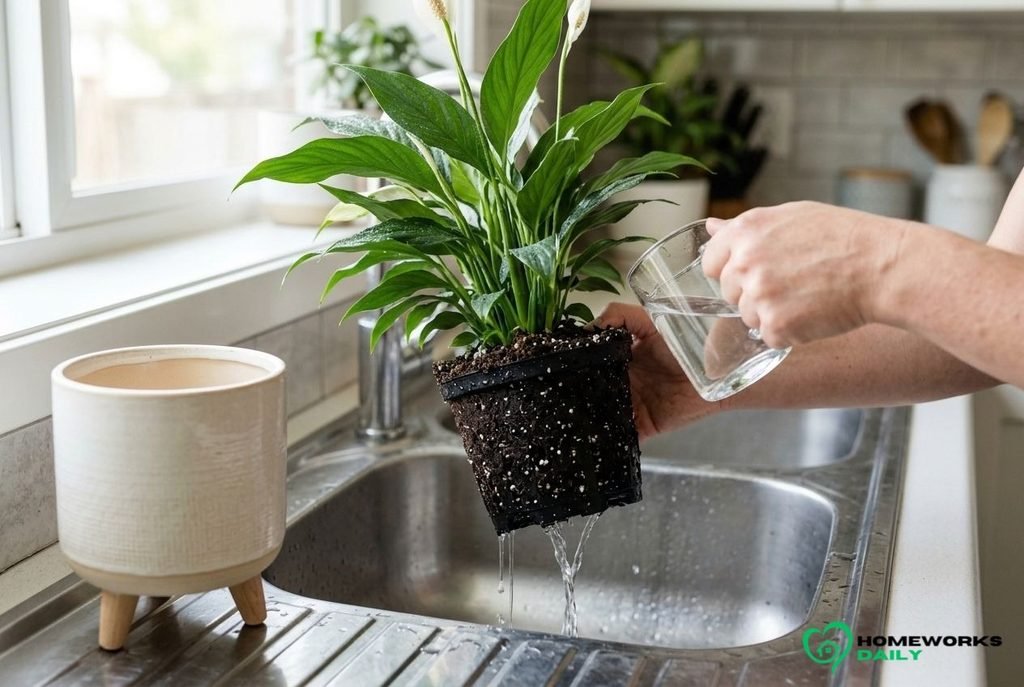
Peace Lily does well in a rich indoor potting medium that can hold useful moisture while still allowing air and excess water to move through the container.
UF/IFAS recommends rich, organic peat- or bark-based packaged potting soil for indoor Spathiphyllum.
Avoid using dense garden soil in an indoor container. A quality houseplant mix is generally easier to manage because it is designed for container drainage and aeration.
One detail matters more than it may seem: don’t try to compensate for poor drainage by simply watering less each time.
Tiny sips can leave parts of the root ball dry while other sections stay wet. When watering is needed, moisten the root zone properly and let the container drain.
6. Keep Temperatures Warm and Stable
Peace Lily is a tropical plant and performs best in warm indoor conditions.
North Carolina Extension gives a daytime preference of roughly 68°F to 85°F, while UF/IFAS lists 75°F to 85°F as its preferred warm range and notes that active growth slows at or below about 50°F.
Most normally heated U.S. homes therefore fall into a workable range.
The bigger concern is often location rather than thermostat setting.
Avoid placing the plant:
- Against a very cold winter window
- Beside a frequently opened exterior door
- Directly under an air-conditioning vent
- In the blast of a forced-air heating vent
Cold and drafts can damage Spathiphyllum, while heating and air conditioning can also change how quickly its potting mix dries.
7. Manage Humidity Without Turning the Pot Into a Swamp
Peace Lily comes from tropical environments and generally appreciates humidity, but humidity and soil moisture are separate issues.
Adding extra water to the pot isn’t a substitute for increasing moisture in dry indoor air.
This distinction becomes especially useful in U.S. homes during winter, when central heating can push indoor humidity down. Penn State Extension notes that heated winter homes may fall below 30% relative humidity and that a portable or whole-house humidifier can be more useful than commonly suggested tricks such as misting. Misting raises local humidity only briefly.
If your home becomes extremely dry in winter, a room humidifier may help.
Don’t, however, keep the potting mix constantly saturated because the leaf tips look dry. Brown tips have several possible causes.
8. Feed Lightly During Active Growth
Peace Lily isn’t a plant that needs aggressive fertilizing.
UF/IFAS recommends a low dose of liquid fertilizer for indoor plants and gives three applications per year as its home-care guideline. Commercial production guidance also warns that excessive soluble salts can burn leaf tips and margins.
Follow the fertilizer label and err toward a conservative approach rather than assuming more fertilizer will produce more flowers.
If the plant is severely wilted, root-stressed, newly repotted, or barely growing in low winter light, fertilizer is unlikely to solve the underlying problem.
If you’re also experimenting with household gardening amendments, treat each plant as its own case rather than assuming one material benefits everything. HomeWorks Daily’s guide to plants that may benefit from coffee grounds offers useful context on why kitchen-waste gardening advice needs to be matched to the plant and growing situation.
9. Repot Only When Your Peace Lily Actually Needs More Space
A Peace Lily doesn’t need a bigger pot simply because spring has arrived.
Look for evidence.
Useful signs include roots pushing through drainage holes, a root ball packed with circling roots, unusually rapid drying between waterings, or growth that has slowed during an otherwise favorable growing period.
When moving up, choose a container only slightly larger than the current pot. Penn State and Illinois Extension both advise avoiding unnecessarily oversized containers because excess potting mix can remain wet too long.
When should you repot a Peace Lily?
Spring is convenient because plants are moving into stronger seasonal growth, but plant condition matters more than the date.
If roots have room and the potting mix is still functioning well, leaving the plant alone may be better than disturbing it unnecessarily.
Peace lilies can also be propagated by division. UF/IFAS specifically recommends division in spring.
10. Read Yellow Leaves and Brown Tips as Clues, Not Diagnoses

A damaged leaf tells you something changed, but it doesn’t always tell you exactly what changed.
Why are Peace Lily leaves turning yellow?
An occasional older yellow leaf can simply be aging. Several yellowing leaves, however, justify a closer look at soil moisture, drainage, light, temperature, and roots.
If the mix has stayed wet for a long time, investigate overwatering and root stress before adding more water.
If the soil is healthy but the plant sits in an extremely dim location, light may also be contributing to weak growth.
Why does my Peace Lily have brown tips?
Brown tips aren’t automatically proof that the plant needs more water.
Potential contributors include repeated drying, fertilizer-salt buildup, dry indoor air, and water quality. Illinois Extension specifically notes that Peace Lily can be sensitive to fluoride and soluble salts, both of which may contribute to tip burn.
If most of the plant looks healthy and only the ends of mature leaves are brown, the issue may be primarily cosmetic. You can trim damaged brown tissue for appearance, but the existing brown section will not turn green again.
If brown tips keep appearing on new growth, examine the care routine rather than repeatedly trimming symptoms.
11. Is Peace Lily Toxic to Cats? Yes, but Don’t Confuse It With a True Lily

If you searched “peace lily toxic to cats,” the short answer is yes: Peace Lily is considered toxic to cats and dogs.
The ASPCA identifies insoluble calcium oxalate crystals as the toxic principle in Spathiphyllum. Chewing the plant can cause oral irritation, burning or irritation of the mouth, tongue and lips, drooling, vomiting, and difficulty swallowing.
Keep the plant where a curious cat or dog cannot chew it.
If you believe a pet has eaten Peace Lily, contact your veterinarian or an appropriate animal poison-control service rather than attempting unsupported home treatment. The ASPCA Peace Lily poison-control reference specifically advises contacting a veterinarian or poison-control service following suspected exposure.
Peace Lily vs. true lilies: the distinction is critical for cat owners
Despite its common name, Peace Lily is not a true lily.
True lilies in the genus Lilium, along with daylilies in Hemerocallis, pose a far more severe poisoning risk to cats and can cause acute kidney injury. Peace Lily does not cause the same type of kidney failure, but that does not make it pet-safe.
HomeWorks Daily’s Tiger Lily growing guide is especially relevant for cat owners because tiger lilies are among the true lilies that require a much higher level of caution.
How Do You Get a Peace Lily to Bloom Again?
Start with light.
A healthy plant kept in a dim room may produce attractive foliage while flowering poorly. Move it gradually to a brighter location with indirect light, then keep water and temperature reasonably stable.
Plant maturity matters too.
There’s another reason a newly purchased Peace Lily can appear much more heavily flowered than it does a year later. Commercial Spathiphyllum growers can use gibberellic acid treatments to induce flowering on a production schedule. That means the flower display seen at retail doesn’t necessarily represent the number of blooms a plant will continuously produce under normal household care.
At home, focus on healthy growth rather than trying to recreate a nursery display with excessive fertilizer.
Peace Lily Care Through the Seasons
A plant’s needs don’t stay identical from January through August.
Spring and summer
Longer days and warmer conditions usually mean more active growth and faster water use. Check soil regularly, provide indirect light, and feed conservatively if the plant is actively producing new growth.
This is also a practical time for repotting or division when needed.
Fall and winter
Reduced natural light generally slows growth, so potting mix may stay wet longer.
That means a summer watering pattern can become excessive in winter even when nothing about the pot itself has changed. At the same time, central heating may make room air much drier.
Check the soil rather than continuing the same schedule automatically, keep the plant away from cold glass and drafts, and don’t push fertilizer onto a plant that isn’t actively growing.
7 Peace Lily Mistakes That Cause Avoidable Problems
1. Watering by calendar
A weekly reminder is fine. A weekly automatic watering is not.
Check the potting mix first.
2. Assuming low-light tolerant means no light needed
Peace Lily can tolerate lower light, but a dark corner is unlikely to produce the strongest growth or flowering.
3. Leaving water inside a decorative pot
A beautiful cachepot can hide an inch or two of standing runoff. Check it after watering.
4. Moving into a much larger pot
More pot doesn’t automatically mean more growth. Excess unused potting mix may remain wet too long.
5. Fertilizing a stressed plant
Fertilizer can’t repair waterlogged roots, cold damage, or inadequate light. Correct the growing conditions first.
6. Assuming every brown tip means underwatering
Brown tips can involve moisture stress, soluble salts, dry air, or water quality. Look at the whole plant and its recent care.
7. Keeping the plant where pets can chew it
Peace Lily isn’t a true lily, but it still contains irritating calcium oxalate crystals and should be kept away from pets.
Useful Tables
Peace Lily Care Quick Reference
| Care Factor | Best Practice | Warning Sign |
| Light | Bright, indirect light | Scorching in strong direct sun; weak growth or few flowers in very dim light |
| Water | Check the mix and water when it begins drying | Persistent wetness or repeated severe wilting |
| Soil | Rich, moisture-retentive but well-drained indoor potting mix | Dense, compacted mix that stays saturated |
| Drainage | Use a pot with drainage and empty runoff | Standing water in saucer or cachepot |
| Temperature | Warm, stable indoor conditions | Chilling, cold drafts, or direct HVAC airflow |
| Humidity | Normal-to-moderate home humidity; humidifier if air becomes very dry | Persistent dry edges during heated winter conditions |
| Fertilizer | Light feeding during active growth | Burned tips, salt buildup, stressed roots |
| Repotting | Repot when genuinely rootbound; move up modestly | Roots crowding drainage holes or mix drying unusually fast |
| Pet Safety | Keep out of reach of cats and dogs | Chewed leaves, drooling, mouth irritation or vomiting |
Peace Lily Troubleshooting Guide
| Symptom | Possible Causes | What to Check First |
| Drooping leaves | Dry soil, saturated roots, heat stress | Feel the potting mix before watering |
| Several yellow leaves | Excess moisture, low light, root stress, cold, natural aging | Soil moisture and drainage |
| Brown tips | Drying, soluble salts, fluoride sensitivity, dry air, excess fertilizer | Watering consistency and recent fertilizer use |
| Few or no flowers | Insufficient light, immature plant, general stress | Brightness of indirect light |
| Dark or mushy roots | Root decline associated with prolonged saturation or disease | Drainage and how long the mix remains wet |
| Curling or scorched foliage | Excess sun, heat, water stress | Direct sunlight and soil moisture |
| White cottony insects or sticky residue | Possible mealybug or scale infestation | Stems and leaf undersides |
Naturally Integrated Internal Links
For readers comparing tropical houseplants, HomeWorks Daily’s Gardening section includes additional plant-care guidance. Its Tiger Lily guide is especially useful for understanding the important difference between Peace Lily and true lilies.
If you’re caring for several flowering indoor plants, the site’s indoor azalea care guide provides another example of why indoor flowering depends on matching light, moisture, temperature, and seasonal care to the specific plant.
And before applying kitchen leftovers to potted plants, see HomeWorks Daily’s guide to plants that like coffee grounds rather than treating coffee grounds as a universal houseplant fertilizer.
Naturally Integrated Authoritative External Links
For science-based Peace Lily cultivation guidance, the University of Florida IFAS Peace Lily care guide covers indoor light, potting soil, watering, fertilizer, temperature, and pests.
The North Carolina Extension Spathiphyllum profile provides additional botanical and environmental information.
For pet safety, use the ASPCA Peace Lily toxicity reference rather than relying on generalized plant-toxicity lists.
For repotting decisions, Penn State Extension’s houseplant repotting guide explains rootbound signs, container sizing, drainage, and potting-media considerations.
Frequently Asked Questions About Peace Lily
Where should I put a Peace Lily in my house?
Choose a warm location with bright, indirect light and protection from harsh direct sun. A bright room near a window is generally better than either a dark hallway or an exposed, intensely sunny windowsill. Also keep the plant away from cold exterior doors, heating vents, and direct air-conditioning airflow.
How often should I water a Peace Lily?
Water according to soil condition rather than a fixed number of days. Check the potting mix regularly and water when it begins to dry rather than while it is still saturated. After watering thoroughly, allow excess water to drain and empty any water collected in the saucer or decorative outer pot.
Does a Peace Lily need sunlight?
Peace Lily needs light, but direct sun isn’t required and can be damaging. Bright, indirect light supports healthier growth and flowering. The plant can tolerate lower-light rooms, but growth may slow and blooms may become less frequent.
Why does my Peace Lily keep drooping?
Check the soil before doing anything else. A Peace Lily in dry soil may droop dramatically from thirst and often recovers after watering. A plant drooping in wet soil needs a different response because saturated or damaged roots can also cause wilt. Adding more water without checking can make the second situation worse.
Is Peace Lily toxic to cats?
Yes. Peace Lily contains insoluble calcium oxalate crystals that can cause mouth irritation, drooling, vomiting, and difficulty swallowing when chewed. It isn’t a true Lilium lily and does not cause the same acute kidney failure associated with true lilies, but it still should not be treated as cat-safe. Contact a veterinarian or animal poison-control service after suspected ingestion.
Can a Peace Lily grow in a bathroom?
Possibly, but humidity alone isn’t enough. A bathroom also needs adequate light. A bright bathroom with indirect natural light can be a workable location, while a windowless bathroom may be too dark unless suitable supplemental plant lighting is provided. Don’t choose the room solely because showers make it temporarily humid.
How can I encourage my Peace Lily to flower?
First make sure the plant receives adequate bright, indirect light. Maintain steady moisture without waterlogging the roots, keep temperatures warm, and feed conservatively during active growth. Don’t assume that a larger fertilizer dose will force flowers; excessive fertilizer can contribute to leaf-tip and root damage.
Should I cut brown tips off Peace Lily leaves?
You can trim brown tips for appearance if the rest of the leaf is healthy. Use clean scissors and avoid removing more healthy green tissue than necessary. More importantly, investigate why new leaves are developing brown tips. Repeated drying, fertilizer salts, dry air, and water-quality sensitivity are among the possible contributors.
The Bottom Line on Growing a Healthy Peace Lily
Peace Lily care gets much easier when you stop treating every symptom as a request for more water.
Give the plant useful indirect light. Check the potting mix before watering. Let excess water escape. Keep the roots warm rather than cold and saturated. Fertilize lightly, and repot only when the root system actually needs more room.
When leaves change color or droop, use the symptom as a clue and check the growing conditions before choosing a solution.
And if cats or dogs share your home, place Spathiphyllum where they cannot chew it. Peace Lily may not carry the same kidney-failure risk as a true lily, but it is still considered toxic to pets.
For more practical plant-care and gardening guidance, explore the HomeWorks Daily Gardening section, where related guides cover indoor plants, flowers, lawns, and everyday growing problems.









One Response