
If you want high fiber containing fruits that also earn their place in a home landscape, start with raspberries and blackberries for strong fiber returns in relatively compact spaces, then consider pears and apples where you have room for a permanent tree. Containers, narrow fence lines, patios, and even some rooftop spaces can produce fruit, but the right choice depends as much on climate, sunlight, drainage, pollination, and mature plant size as it does on nutrition.
A sunny fence that grows nothing. A patio with room for one large planter. An empty corner of lawn that could hold a small fruit tree.
Those spaces can become productive, but buying a fruit plant simply because its tag looks appealing is an easy way to create years of unnecessary work. A raspberry row behaves nothing like a pear tree, and a dwarf apple has very different long-term needs from a blackberry hedge.
The useful question isn’t merely, “Which fruit contains fiber?” It is: Which fiber-rich fruit actually fits the home and growing conditions you have?
HomeWorks Daily already emphasizes planning around sunlight, drainage, climate, mature size, and maintenance rather than choosing plants on appearance alone. Its site-first garden planning guide is a useful companion before committing valuable yard space to perennial fruit.
What Makes a Fruit High in Fiber?
For a homeowner, the most useful way to compare fruit is by a realistic serving rather than by a vague “high-fiber” label. Among commonly grown fruits, berries can pack substantial fiber into a cup, while pears and apples provide meaningful amounts in a single whole fruit.
For example, federal nutrition information lists 8.0 grams of fiber in 1 cup of raspberries, 6.5 grams in a medium Asian pear, 5.5 grams in a medium pear with skin, and 4.8 grams in a medium apple with skin.
Serving sizes matter. A cup of berries and a medium apple aren’t gram-for-gram comparisons, so the numbers are best used to understand what a normal portion contributes rather than to declare one fruit universally “healthiest.”
Current U.S. Dietary Guidelines for Americans, 2025–2030 emphasize eating whole fruits in their original or minimally processed form. The current framework lists a goal of two fruit servings per day for a 2,000-calorie dietary pattern, adjusted for individual calorie needs.
That makes a home fruit garden especially practical: you aren’t merely adding ornamental plants—you can be growing whole fruit you are likely to eat soon after harvest.
Best High Fiber Containing Fruits for Home Gardens
The strongest choices combine useful fiber content with a plant form that works around a house. For many U.S. properties, raspberries and blackberries make sense where a sunny row or fence is available. Pears and apples suit homeowners who can commit more permanent space and are prepared for pruning, pollination planning, and a longer wait for meaningful harvests.
Raspberries: A High-Fiber Choice for a Sunny Fence
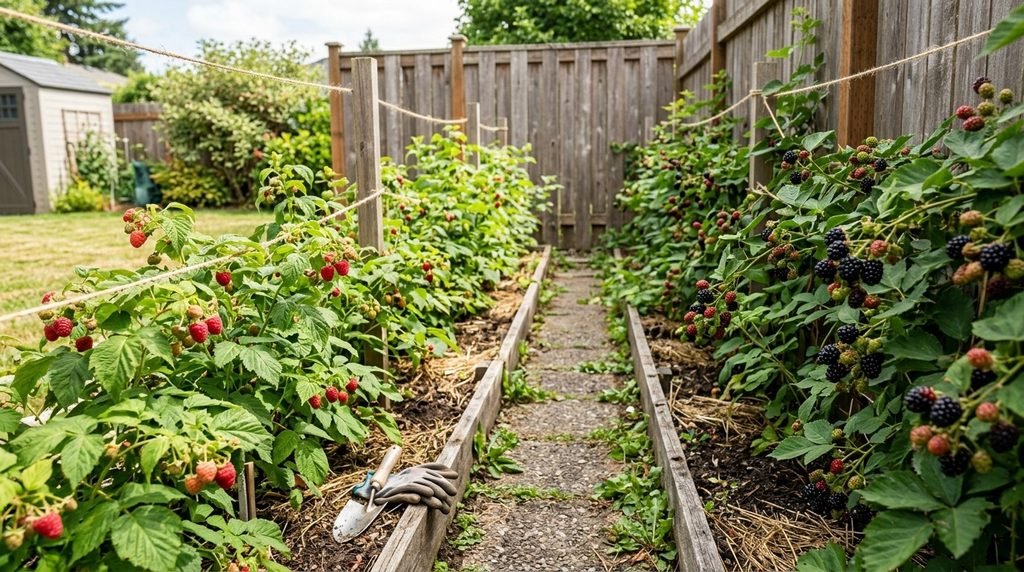
Raspberries are one of the strongest combinations of high fiber and space-efficient home growing. One cup provides about 8 grams of fiber, according to federal nutrition data.
Unlike a fruit tree, raspberries grow as canes. That makes them particularly useful along a fence, at the back of a sunny edible bed, or in a dedicated narrow strip.
University of Minnesota Extension guidance spaces raspberry plants roughly 2 to 3 feet apart within a row. The plants spread by sending up new canes, so a raspberry patch needs boundaries and routine pruning rather than unlimited freedom to wander across the yard.
A simple trellis can keep canes upright, improve access, and make harvesting less frustrating. If you’re building an edible-garden support system, the support-first principle in HomeWorks Daily’s guide to installing trellises early for climbing crops applies here too: it’s easier to provide structure before vigorous growth becomes tangled.
Good fit for: sunny fence lines, narrow side gardens, dedicated berry beds.
Watch for: spreading canes, pruning requirements, heat sensitivity in some cultivars, and local disease pressure.
Blackberries: High Fiber With More Variety in Growth Habit
Blackberries are another strong option when fiber and backyard productivity both matter. North Carolina Cooperative Extension cites USDA data showing about 7.6 grams of fiber in 1 cup of raw blackberries weighing 144 grams.
Blackberries aren’t all alike. University of Georgia Cooperative Extension describes both erect and trailing types; some can stand with relatively little support, while trailing varieties require a trellis. UGA also recommends 6 to 8 hours of sunlight for brambles and notes that poor drainage is a problem.
For an erect blackberry hedge, UGA’s Georgia-specific guidance uses roughly 2 to 4 feet between plants. That’s useful as a planning reference, but gardeners elsewhere should confirm cultivar spacing with their local Cooperative Extension because climate and growth vigor vary.
Thornless cultivars can make sense beside walkways or frequently harvested areas. Even thornless plants, however, shouldn’t be squeezed into a narrow path where vigorous canes will constantly need cutting back.
Good fit for: sunny property edges, edible hedges, fence lines, larger raised-bed zones.
Watch for: cultivar-specific support, spreading growth, birds, pruning, and regional disease issues.
Pears and Asian Pears: More Fiber From a Permanent Tree
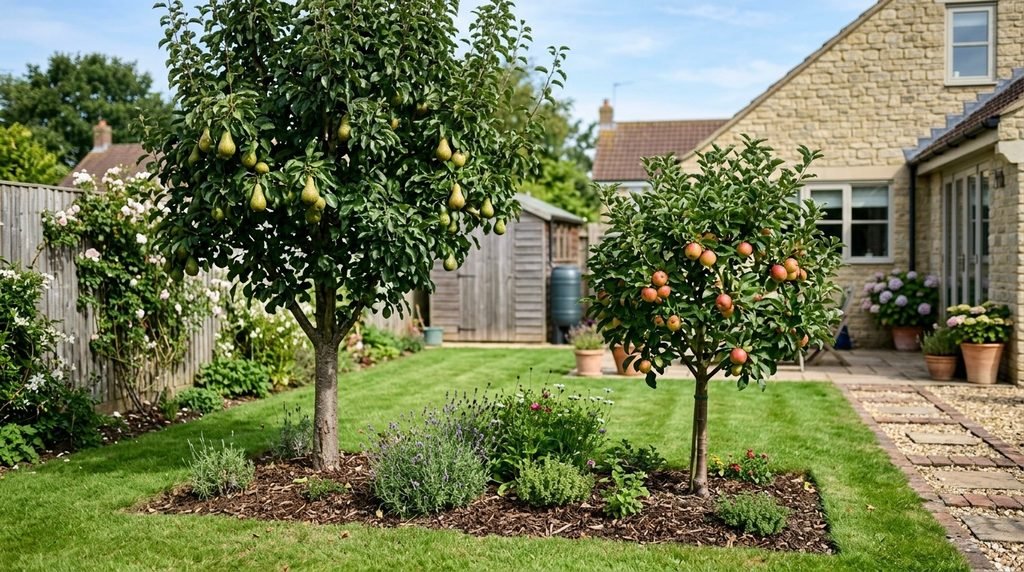
Pears offer a useful amount of fiber in a single fruit, but they require a much larger and longer-term commitment than berries. A medium pear with skin provides about 5.5 grams of fiber, while federal data list about 6.5 grams for a medium Asian pear.
The gardening trade-off is space and patience.
University of Minnesota Extension recommends full sun and notes that two pear varieties are generally needed for reliable pollination and fruit set. Pear trees may take several years to begin bearing, and mature trees can produce a large crop within a relatively short harvest window.
That’s useful if your household eats, cans, poaches, bakes, or shares pears. It’s less convenient if you only want an occasional piece of fruit.
Before purchasing, check:
- Mature height and spread
- Rootstock, if applicable
- Pollination compatibility
- Cold hardiness
- Local fire blight concerns
- Expected harvest period
- Whether the cultivar is recommended by your state Extension service
Good fit for: medium to large yards with long-term planting space.
Watch for: pollination requirements, eventual tree size, pruning, and the time needed before substantial harvests.
Apples: Familiar Fruit, but Usually More Management
Apples are practical fiber-containing fruit trees, especially when you want a familiar crop that stores and cooks well. A medium apple with skin provides about 4.8 grams of fiber.
An apple tree’s eventual size depends heavily on its rootstock. Dwarfing rootstocks can make a tree far more manageable in a residential yard, while more vigorous rootstocks need considerably more room. Rootstock also affects how soon trees bear and how the planting should be supported and managed.
Don’t buy by fruit variety alone. The tag should also tell you what the tree is grafted onto—or the nursery should be able to explain it.
Apples can require more routine pest and disease attention than many homeowners expect. University of Minnesota’s broad home-fruit guidance rates apples as requiring meaningful effort across several management areas rather than functioning as a plant-and-forget crop.
Good fit for: homeowners prepared to prune, monitor pests, and select a regionally appropriate cultivar and rootstock.
Watch for: pollination compatibility, disease pressure, rootstock size, fruit thinning, and dropped fruit.
What About Figs and Avocados?
Both can be worthwhile, but climate changes the decision.
Figs can form attractive shrubs or small trees with broad foliage and are often more adaptable to large containers than a full-size pear or apple. They favor warm, sunny conditions; gardeners near the cold edge of a cultivar’s range may need winter protection. University of Georgia Extension notes that cold exposure strongly influences fig suitability and recommends particularly sunny growing-season sites.
Avocados contain useful fiber—a USDA-based published analysis reports about 4.6 grams in one-half of an avocado—but the tree is far less practical across most of the United States because outdoor production requires an appropriately warm climate.
For a gardener in a cold-winter state, buying avocados may make considerably more sense than devoting years to a container tree that never becomes a practical producer.
Comparison Table: High-Fiber Fruits for Home Growing
| Fruit | Fiber per listed serving | Plant type | Practical space need | Container friendly? | Sun needs | Best fit for |
| Raspberries | 8.0 g per 1 cup | Bramble/canes | About 2–3 ft between plants in a row; leave harvest access | Possible with a large pot and suitable cultivar | Full sun preferred | Fence lines and narrow sunny beds |
| Blackberries | 7.6 g per 1 cup (144 g) | Bramble/canes | Type-dependent; erect types can form a compact hedgerow | Possible for selected compact types | About 6–8 hours in UGA guidance | Edible hedges and sunny property edges |
| Asian pear | 6.5 g per medium fruit | Tree | Tree-scale; cultivar/rootstock determine final footprint | Usually not the easiest long-term choice | Full sun | Yards with permanent tree space |
| Pear | 5.5 g per medium fruit with skin | Tree | Tree-scale; allow for pollination needs and harvest access | Generally better in ground | Full sun | Medium or larger yards |
| Apple | 4.8 g per medium fruit with skin | Grafted tree | Highly rootstock-dependent | Dwarf types can be grown in large containers, but require care | Full sun | Homeowners willing to prune and manage pests |
Serving note: These are the household serving sizes reported by the cited nutrition sources, not equal-weight servings. Raspberries, Asian pears, pears, and apples are reported by NIDDK; blackberry data are USDA-derived figures published by North Carolina Cooperative Extension.
Which High-Fiber Fruits Work in Small Spaces?
Raspberries and blackberries are often the most practical high-fiber choices for small yards because they can be trained along a line rather than occupying a broad tree canopy. A carefully selected dwarf apple can also work where vertical space is available, but the tree still needs adequate root volume, sunlight, airflow, pruning access, and—depending on the cultivar—compatible pollination.
Think about usable growing volume, not just empty ground.
A 20-foot sunny fence may be more valuable for fruit production than a 10-by-10-foot bed shaded by the house. Likewise, a narrow side yard can support canes if you can still walk beside them to prune and harvest.
Avoid placing thorny berries directly beside children’s play areas, gates, or heavily traveled paths.
Best Options for Containers and Patios
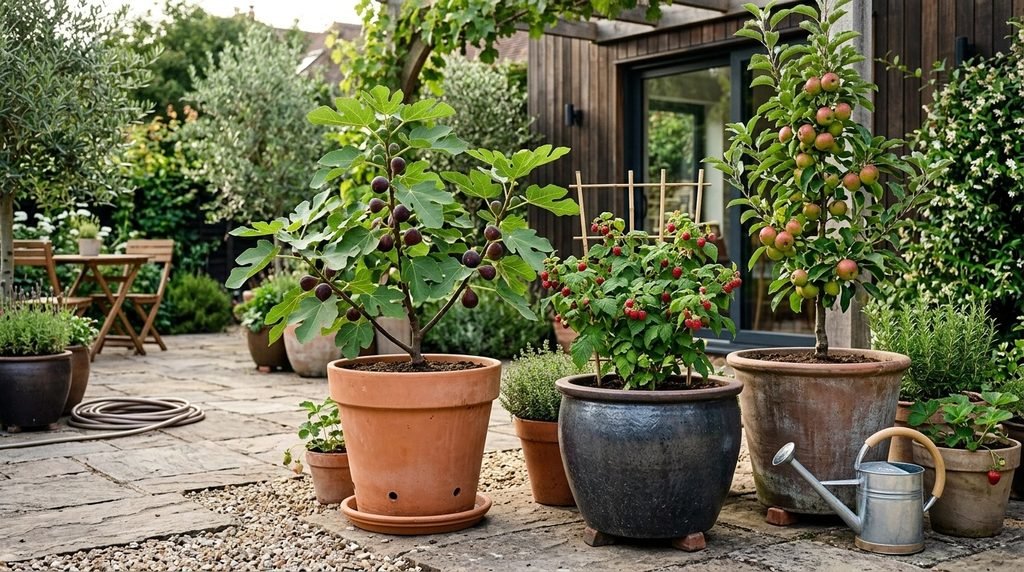
Large containers can make fruit growing possible on patios, balconies, and other paved spaces, but containers don’t make a large plant magically small. Compact raspberries, certain figs, strawberries, and appropriately selected dwarf fruit trees are more realistic than trying to maintain a standard pear or apple in an undersized pot.
For any container fruit plant, prioritize:
- A container large enough for the mature root system
- Unobstructed drainage holes
- High-quality potting mix rather than dense garden soil
- Reliable watering during hot weather
- Space for pruning and harvesting
- A cultivar actually suited to container culture
- Winter protection where roots will be exposed to temperatures they wouldn’t encounter underground
Containers dry out and change temperature faster than in-ground soil. That makes consistent irrigation more important, not less.
For rooftop growing, weight and drainage become structural issues as well as horticultural ones. HomeWorks Daily’s specifically covers saturated-container weight, wind exposure, drainage access, and maintenance clearance—questions that should be resolved before adding large fruit planters.
Which Fruits Work Best for Edible Landscaping?
Berry hedges, espaliered or compact fruit trees, and figs can combine food production with landscape structure when they’re positioned according to mature size and maintenance needs. The best edible landscaping plant isn’t necessarily the one with the prettiest nursery photo; it’s the one that still fits the property after several years of growth.
Raspberries or blackberries can screen a fence. A carefully sized apple can provide spring flowers, summer foliage, and an edible crop. A fig can create bold foliage in a warm sheltered corner.
There are trade-offs:
- Fruit can fall onto paving.
- Birds may discover the harvest first.
- Brambles can spread beyond their intended bed.
- Trees need pruning access.
- Some fruits attract insects or wildlife.
- Thorny varieties can conflict with walkways.
- Heavy crops may require harvesting or preservation within a short window.
Edible landscaping works best when harvesting is treated as part of maintenance—not as an unexpected bonus.
What U.S. Gardeners Should Check Before Planting
USDA Hardiness Zone is a starting point, not a complete climate description. Winter minimum temperature matters, but so do local frost dates, summer heat, humidity, rainfall, wind, elevation, soil, and cultivar choice.
HomeWorks Daily’s garden-planning guidance makes the same distinction: two gardens in the same hardiness zone can perform very differently because their summer and moisture conditions aren’t identical.
Before buying a perennial fruit plant, check these eight things:
- Direct sunlight. Most productive fruit crops perform best with substantial sun.
- Drainage. A low, wet corner is not automatically useful simply because nothing else grows there.
- Winter hardiness. Match perennial plants to local cold conditions.
- Summer climate. Some berries dislike extreme heat; other fruits need a long warm season.
- Pollination. Determine whether one plant can set a useful crop or whether a compatible second cultivar is needed.
- Mature size. Read the mature height and spread, not the size of the nursery pot.
- Disease and pest pressure. Cultivars recommended by your state Cooperative Extension may reduce avoidable problems.
- Harvest access. Leave room to reach both sides of a hedge or the canopy of a tree.
Local Cooperative Extension recommendations are especially valuable because cultivar performance can change dramatically between the Pacific Northwest, Upper Midwest, Southeast, Southwest, and other U.S. growing regions.
Common Mistakes When Growing Fruit at Home
The expensive mistakes usually happen before the first shovel of soil is moved.
Choosing the Fruit Before Choosing the Site
A homeowner falls in love with a pear tree, then tries to find somewhere to put it. Reverse that process. Measure sunlight, drainage, available width, and overhead clearance first.
Ignoring Rootstock and Cultivar
“Apple tree” isn’t enough information.
Rootstock influences tree size and management, while the named cultivar affects harvest timing, climate suitability, disease resistance, and pollination relationships. The same principle applies to brambles: erect, semi-erect, trailing, primocane-fruiting, thorny, and thornless selections behave differently.
Forgetting the Pollination Plan
A beautiful flowering fruit tree isn’t necessarily a productive fruit tree.
Before buying, ask whether the cultivar is self-fruitful, partially self-fruitful, or needs compatible cross-pollination. Pears are a good example: University of Minnesota Extension generally recommends two varieties for successful fruit set.
Installing Support Too Late
If your selected berry needs a trellis, build it while you can still move freely around the plants. Wrestling support wire through mature, fruiting canes is unnecessary work.
Choosing a Pot That’s Too Small
A tiny container can turn a theoretically patio-friendly plant into a constant watering problem. Plan for the mature root system and remember that a container full of wet growing mix is much heavier than an empty pot.
Expecting Fruit Immediately
Berries can establish relatively quickly, while fruit trees are a longer-term landscape investment. Don’t judge a tree by its first season.
Is Growing Your Own Fruit Worth It?
Growing fruit is most worthwhile when the plant fits your property and you value freshness, cultivar choice, garden use, or the pleasure of harvesting at home—not when you’re counting on guaranteed grocery-store savings.
Berries are particularly attractive for homeowners who want a productive crop without dedicating space to a large tree. Fruit trees make more sense when you want a permanent landscape feature and are comfortable waiting for it to mature.
Buying fruit may be the more practical choice if:
- Your yard receives little direct sun.
- You move frequently or rent.
- Your climate is poorly suited to the fruit you most enjoy.
- You don’t want to prune, trellis, thin, or monitor pests.
- Wildlife pressure makes harvesting difficult.
- Water is scarce or expensive.
- You only eat a small amount of that fruit each year.
There’s no gardening prize for forcing a crop into the wrong yard.
How to Choose the Right Fruit for Your Yard

Use this simple decision sequence:
If you have a sunny fence: Start by investigating raspberries or blackberries suited to your region.
If you have a patio but no soil: Look at compact berries, strawberries, or climate-appropriate figs before attempting large tree fruit.
If you have a modest sunny yard: Compare dwarf or semi-dwarf apples with berry beds. Don’t forget the pollination plan.
If you have room for a long-term tree: Pears and apples become more realistic, provided their mature size and maintenance fit the property.
If your climate is marginal for a crop: Check your state or county Cooperative Extension before ordering the plant. A regional cultivar recommendation is worth far more than a generic “grows in zones X–Y” sales label.
And when shopping for bare-root or container-grown plants, look beyond price. Check the exact cultivar, rootstock where applicable, mature dimensions, pollination information, disease resistance, nursery health, and regional suitability.
Frequently Asked Questions
Which Fruits Are Highest in Fiber?
Among the practical home-garden fruits compared here, raspberries and blackberries provide the most fiber per listed cup serving, at about 8.0 grams and 7.6 grams respectively. A medium Asian pear provides about 6.5 grams, a medium pear with skin 5.5 grams, and a medium apple with skin 4.8 grams. Serving sizes differ, so these aren’t equal-weight comparisons.
Which High-Fiber Fruits Are Easiest to Grow at Home?
Raspberries and blackberries are often approachable choices where the climate is suitable and the site has good sun and drainage. University of Georgia Extension describes brambles as among the easier fruits for home gardeners to produce, although cultivar choice, pruning, support, and regional conditions still matter.
What High-Fiber Fruit Can Grow in a Small Backyard?
Raspberries are an especially useful option for a small sunny backyard because the canes can be managed in a narrow row along a fence or trellis. Blackberries can work similarly if you choose an appropriate growth habit. A dwarf apple is another possibility, but it needs more long-term planning for roots, pruning, pollination, and pest management.
Which High-Fiber Fruits Work Well in Containers?
Compact berries and figs are generally more realistic container candidates than full-size pear or apple trees. Dwarf apples can be grown in substantial containers in suitable situations, but container size, irrigation, root protection, pollination, and long-term maintenance all become more demanding. Always check the specific cultivar rather than assuming the entire fruit species is “container friendly.”
Which Fruits Are Suitable for Different U.S. Climates?
There isn’t one fruit that is best for every U.S. climate. Winter lows, summer heat, humidity, rainfall, frost dates, soil, and cultivar all affect performance. Use USDA Hardiness Zone as one screening tool, then confirm local cultivars through a Cooperative Extension service familiar with your state or county.
Does Fresh Fruit Usually Contain More Fiber Than Juice?
Whole fruit is generally the better choice when fiber is the goal because juicing removes much of the fibrous structure. The current Dietary Guidelines for Americans, 2025–2030 emphasize whole fruit and recommend limiting 100% fruit juice portions.
Do I Need Two Fruit Trees for Pollination?
It depends on the fruit and cultivar. University of Minnesota Extension says two pear varieties are generally needed for successful pollination and fruit set. Apples and other fruits also vary by cultivar, so check the nursery label and a regional Extension guide rather than assuming one tree will produce a full crop.
Final Takeaway
The most useful high fiber containing fruits for a home landscape aren’t simply the ones with the biggest nutrition number. They’re the fruits that combine meaningful fiber with a plant you can realistically give enough sun, root space, water, pruning, support, pollination, and harvest attention.
For many homes, that points first toward raspberries or blackberries. Pears and apples become attractive when there’s room for permanent trees and a willingness to manage them for years. Containers expand your choices, but they also make irrigation, root space, winter exposure, and plant size more important.
Before buying, measure the site, identify the growing conditions, then choose the fruit.
For more practical ideas on turning unused outdoor space into something productive, browse .







One Response