A Monstera can look perfectly happy one month and then suddenly seem to have a mind of its own. The stem starts leaning, leaves spread in every direction, and those long aerial roots appear as if the plant is reaching for something.
It actually is.
In nature, Monstera deliciosa is a climbing vine that uses aerial roots to anchor itself to trees and other surfaces. Indoors, a moss pole can give that climbing habit somewhere to go while helping you keep a large plant more upright and manageable.
But simply sticking a pole into a pot doesn’t guarantee success.
The pole needs to be positioned correctly, the stem needs to be secured gently, and the growing conditions still matter. Here’s how to make a moss pole for Monstera work as a practical climbing support rather than just another decoration in the pot.
Quick Answer: Does Monstera Need a Moss Pole?
No, a Monstera doesn’t strictly need a moss pole, but a suitable climbing support can be very helpful as the plant gets larger.
Monsteras naturally climb using aerial roots. A moss-covered support provides a textured surface where those roots can attach, while the structure itself helps support the plant’s increasingly large stems and leaves. University horticulture guidance specifically recommends strong, moss-covered supports for vigorous Monstera plants.
A moss pole can be especially useful if you want your Monstera to:
- Grow vertically instead of sprawling.
- Stay more organized in a smaller space.
- Develop a stronger climbing structure.
- Give aerial roots a surface to attach to.
- Support heavy stems and foliage.
- Mimic some of the physical conditions of its natural climbing habit.
However, a moss pole isn’t a magic device. Light, watering, temperature, potting mix, and general plant health still determine how well your Monstera grows.
What Is a Moss Pole for Monstera?
A moss pole is a vertical plant support covered with a material such as sphagnum moss or another moisture-retaining, textured medium.
Think of it as an indoor substitute for the rough surface of a tree trunk.
Monstera plants produce aerial roots from their stems. In their natural environment, these roots help the plant anchor itself as it climbs. A moss-covered support gives those roots somewhere to make contact.
A typical moss pole may contain:
- A sturdy central support.
- Sphagnum moss or another suitable covering.
- Mesh, twine, fishing line, or another material holding the covering in place.
- A pointed or insertable bottom section for placing it into the pot.
Not every “moss pole” is actually made from moss. Coir or coconut-fiber poles are also common and can provide a textured climbing surface, although their moisture-retention characteristics differ from sphagnum moss.
Why Do Monsteras Like Climbing Supports?
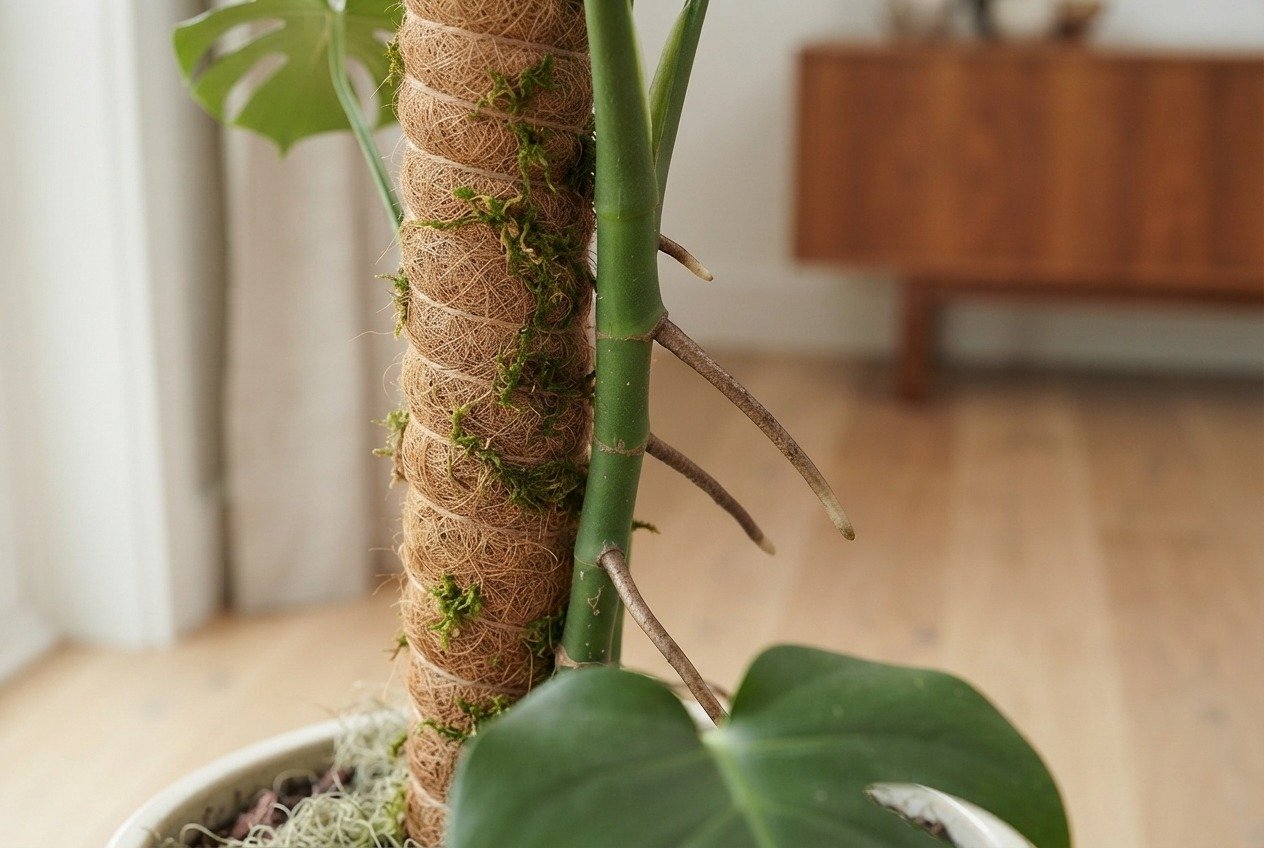
The clue is sitting right on the plant: aerial roots.
Monsteras naturally use these roots to attach themselves to trees and other structures. As a houseplant grows larger, allowing the stem to sprawl can make it increasingly difficult to manage. A sturdy vertical support gives the plant a more controlled growth direction.
A climbing support also makes sense because Monstera leaves can become quite large. University of Wisconsin horticulture guidance notes that vigorous Monsteras benefit from support to help prevent stems from breaking.
Does a Moss Pole Make Monstera Leaves Bigger?
A moss pole can support mature climbing growth, but it shouldn’t be treated as a guaranteed “big leaf” switch.
Mature Monstera foliage depends on several factors, including the plant’s age, light, overall health, and growth conditions. Vertical support and aerial-root attachment can contribute to the plant’s natural climbing habit, but a pole can’t compensate for inadequate light or poor care.
For example, a Monstera placed in a very dim corner may remain stretched and produce less impressive growth even if it has an expensive moss pole.
Light comes first. The pole supports the growth strategy.
Moss Pole vs. Regular Stake: What’s the Difference?
Both can support a Monstera, but they serve slightly different purposes.
| Support | Main Purpose | Aerial Root Attachment | Moisture Retention | Best For |
| Sphagnum moss pole | Climbing + support | Excellent when kept suitable and moist | High | Larger climbing Monsteras |
| Coir pole | Climbing + support | Possible | Lower than sphagnum | Simple, tidy support |
| Wooden stake | Structural support | Limited | Low | Small plants or temporary support |
| Trellis | Training/spreading | Depends on material | Usually low | Plants trained across a wider area |
A wooden stake can absolutely keep a plant upright. But it doesn’t provide the same porous, textured environment that a moss-covered support can offer.
University of Wisconsin specifically describes a moss-covered support as useful for aerial-root attachment, while Penn State also recommends gently attaching Monstera to a support as it grows.
How to Choose the Best Moss Pole for Monstera
The “best” moss pole isn’t necessarily the biggest or most expensive one.
The important thing is whether it can support the plant securely and accommodate future growth.
Look for these features:
1. A sturdy core
A mature Monstera can become surprisingly heavy. A flimsy pole may lean or fall once the plant grows.
2. Enough height
Choose a pole that gives the current growing stem room to climb. Modular or stackable poles are particularly convenient because you can extend them later.
3. A suitable climbing surface
Sphagnum moss provides a porous, moisture-retaining surface that aerial roots can grow into. Coir provides texture too, but tends to dry more quickly.
4. Secure construction
The covering shouldn’t fall apart every time you touch the pole.
5. Easy maintenance
If you want aerial roots to interact with the pole, choose a material you can keep appropriately moist without making your plant’s potting mix constantly wet.
When Should You Add a Moss Pole to Monstera?
The earlier you provide suitable support, the easier it is to train the plant.
That doesn’t mean a mature, sprawling Monstera is impossible to train. It simply means a young plant is easier to position because its stem hasn’t become as large and rigid.
A Fairfax Master Gardener article also notes that adding a moss pole while the plant is small makes it easier to guide aerial roots and encourage upward growth.
A good opportunity is during repotting because you can position the support before filling the container with potting mix.
What if Your Monstera Is Already Huge?
Don’t panic.
You can still add support, but avoid aggressively bending the main stem into a position it doesn’t naturally want to take.
Instead:
- Identify the main climbing stem.
- Determine where its aerial roots emerge.
- Place the support behind that part of the stem.
- Secure the stem gradually.
- Allow new growth to follow the support.
Trying to force a thick, established stem into a sharp curve is more likely to cause damage than help.
How to Install a Moss Pole for Monstera
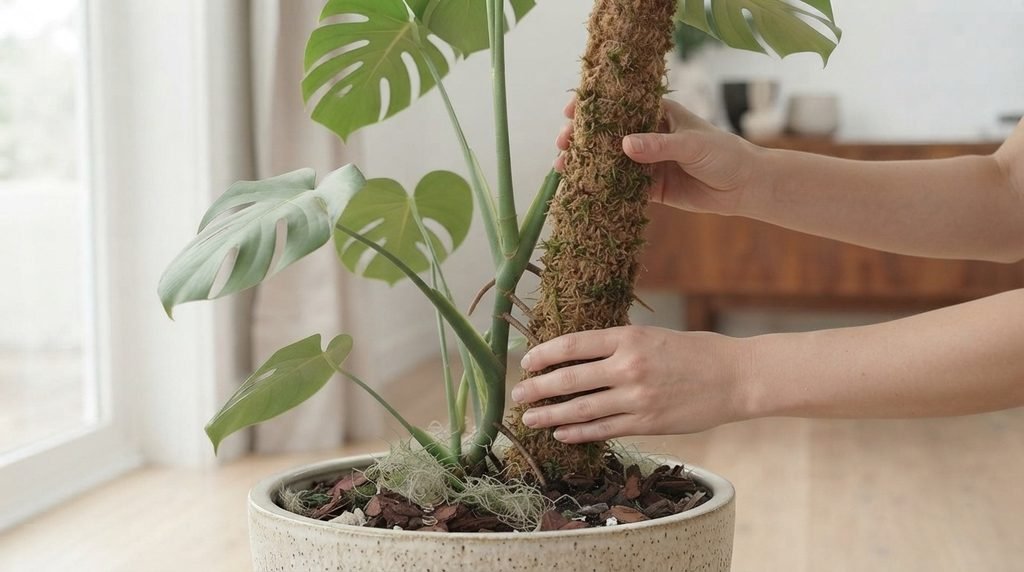
Installing the pole correctly is just as important as choosing it.
Step 1: Identify the Main Stem
Before touching the plant, determine which stem represents the main climbing growth.
Don’t confuse the individual leaf stalks, known as petioles, with the main stem.
Your goal is to support the main stem, not trap every leaf in place.
Step 2: Find the Aerial Roots
Look for the roots emerging from the stem.
These may look strange at first, particularly if you’re new to Monsteras. They’re a normal part of the plant’s climbing strategy and aren’t automatically a sign that something is wrong.
The side of the stem producing aerial roots is generally the side you want facing the climbing support.
Step 3: Position the Pole Behind the Stem
Place the moss pole directly behind the main stem so the aerial roots can reach the climbing surface.
The leaves should generally face outward toward the light rather than being pressed against the pole.
This orientation makes the plant look more natural and allows the stem to climb while the foliage has room to spread.
Step 4: Anchor the Pole Firmly
Push the pole deeply enough into the potting mix that it doesn’t wobble when the plant moves.
If you’re repotting, positioning the pole while arranging the fresh potting mix can make this easier.
If you’re inserting a pole into an established pot, work slowly. Don’t force it through thick resistance because the pot may contain established roots.
A stable pole is important because the support is only useful if it can handle the plant’s increasing weight.
Step 5: Attach the Stem Gently
Use soft plant ties, flexible tape, or another gentle fastening material.
The goal isn’t to squeeze the stem tightly against the pole.
Instead, the tie should:
- Hold the stem close to the support.
- Allow some movement.
- Leave room for the stem to thicken.
- Avoid damaging the stem.
- Stay away from delicate leaf stalks.
Penn State recommends gently attaching Monstera to its support, while guidance on moss-pole installation emphasizes securing the main stem rather than constricting the plant.
How to Attach Monstera to a Moss Pole
One common mistake is treating the plant like it needs to be permanently strapped to the pole.
It doesn’t.
The ties are there to guide the stem while the plant establishes itself on the support.
Position the stem against the pole and secure it at several points rather than wrapping it tightly from top to bottom.
As new aerial roots appear, gently direct them toward the climbing surface.
Don’t yank them into place.
If an aerial root is pointing away from the pole, you can leave it alone or gently redirect it if it can be moved without resistance.
Should You Put Monstera Aerial Roots Into the Moss Pole?
You can encourage aerial roots to contact a suitable moss pole, but you don’t need to force every root into it.
Aerial roots naturally help Monsteras anchor themselves to climbing surfaces. A moist, porous support can give them an opportunity to attach.
Some aerial roots may:
- Grow toward the pole.
- Enter the moss.
- Remain outside the pole.
- Curve toward the soil.
- Grow in an unexpected direction.
That’s normal.
Don’t become obsessed with making every aerial root look perfectly arranged. Plants aren’t interior-design projects.
How to Keep a Moss Pole Moist
This is where many moss poles disappoint their owners.
A pole that’s supposed to provide a moist climbing surface won’t do much if it dries out completely all the time.
Sphagnum moss generally holds moisture better than coir, but the correct approach depends on your indoor conditions and the particular pole.
Ways to moisten a moss pole include:
- Slowly pouring water over the moss.
- Misting the surface.
- Watering according to how quickly the pole dries.
- Using a design that allows water to travel through the pole.
However, moist moss doesn’t mean a constantly saturated Monstera pot.
The plant’s soil and the pole are related, but they aren’t the same watering system.
University of Wisconsin recommends watering the moss-covered support so aerial roots can access moisture while allowing the soil to dry somewhat between waterings.
How Often Should You Water a Monstera Moss Pole?
There’s no universal number of days.
A pole in a warm, dry room may dry much faster than one in a humid environment.
Instead of following a rigid schedule, check the moss itself.
Consider:
- How quickly the pole dries.
- Indoor humidity.
- Temperature.
- Pole material.
- Plant size.
- Season.
- Air movement around the plant.
The important distinction is this:
Keep the pole appropriately moist if you’re using it to encourage aerial-root contact, but don’t compensate by keeping the potting soil excessively wet.
Overwatering the root zone can create problems. Monstera care guidance from the University of Connecticut recommends a well-draining growing medium and allowing the upper portion of the soil to dry between waterings.
Common Moss Pole Mistakes to Avoid
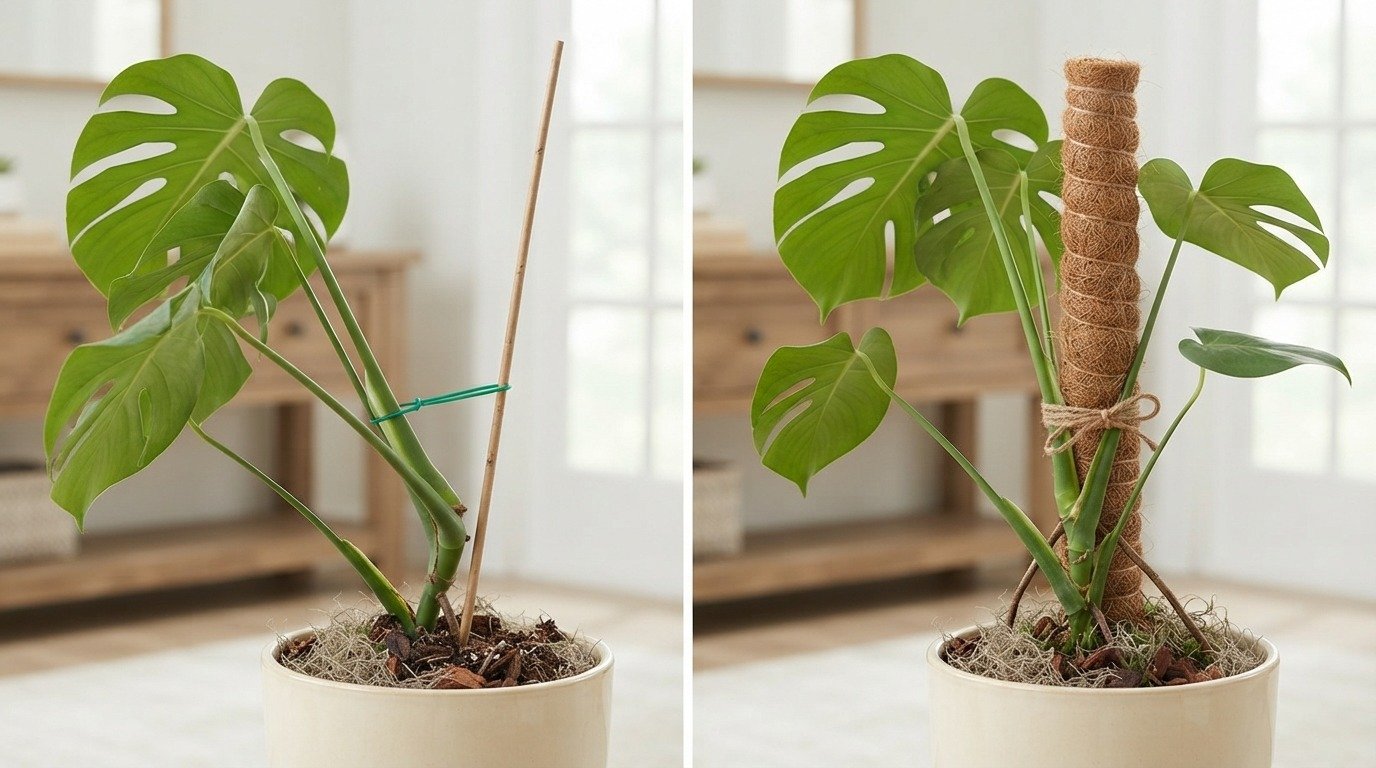
Even a good moss pole can fail if the setup is wrong.
1. Using a Weak Pole
A small support may work initially but become unstable as the plant grows.
Better approach: Think about the Monstera you’ll have in several months, not just the plant you have today.
2. Tying the Plant Too Tightly
Tight ties can restrict the stem as it grows.
Better approach: Secure it firmly enough to guide it, but leave room for natural growth.
3. Tying the Leaf Stalks
The petioles need freedom to position the leaves.
Better approach: Secure the main stem rather than bundling individual leaves against the pole.
4. Forcing the Stem Into Position
A thick Monstera stem isn’t something to wrestle into a perfect curve.
Better approach: Train gradually and let new growth do most of the work.
5. Cutting Every Aerial Root
Those roots aren’t automatically a problem.
They are part of the Monstera’s natural climbing system.
Better approach: Redirect them toward the pole when practical.
6. Keeping the Soil Too Wet
A moss pole shouldn’t become an excuse to overwater the pot.
Monstera is susceptible to root problems when growing conditions remain excessively wet.
Better approach: Monitor the potting mix separately from the pole.
7. Putting the Plant in Poor Light
A moss pole won’t fix insufficient light.
Monstera prefers bright conditions, and insufficient light can contribute to stretched growth and reduced leaf development.
Better approach: Give the plant suitable bright, indirect light while using the pole for support and training.
Moss Pole Problems and Troubleshooting
| Problem | Likely Reason | What to Do |
| Pole keeps falling | Too shallow or weak | Use a stronger, better-anchored support |
| Monstera leans away | Stem isn’t guided or light is coming strongly from one side | Adjust support and light placement |
| Aerial roots aren’t attaching | Pole may be too dry or roots aren’t contacting it | Guide roots toward the surface and maintain suitable moisture |
| Stem feels restricted | Ties are too tight | Loosen or reposition ties |
| Leaves remain small | Light, maturity, or general growing conditions may be limiting growth | Improve overall care rather than relying on the pole |
| Soil stays wet | Overwatering or poor drainage | Review watering and potting mix |
| Pole dries very quickly | Dry indoor air or fast-drying material | Check moisture more frequently or consider a different pole material |
Does a Moss Pole Guarantee Monstera Fenestrations?
No.
This is one of the most important expectations to set.
Fenestrations—the characteristic holes and splits in mature Monstera leaves—are influenced by the plant’s development and growing conditions. A climbing support can help the plant express its natural climbing habit, but simply installing a pole doesn’t guarantee dramatically split leaves.
Light is particularly important. Wisconsin Horticulture notes that inadequate light can prevent Monstera from developing its characteristic leaf perforations.
So if your Monstera has a moss pole but still produces smaller, less mature-looking leaves, don’t immediately blame the pole.
Check the whole growing environment.
Can You Use a Coir Pole Instead of a Moss Pole?
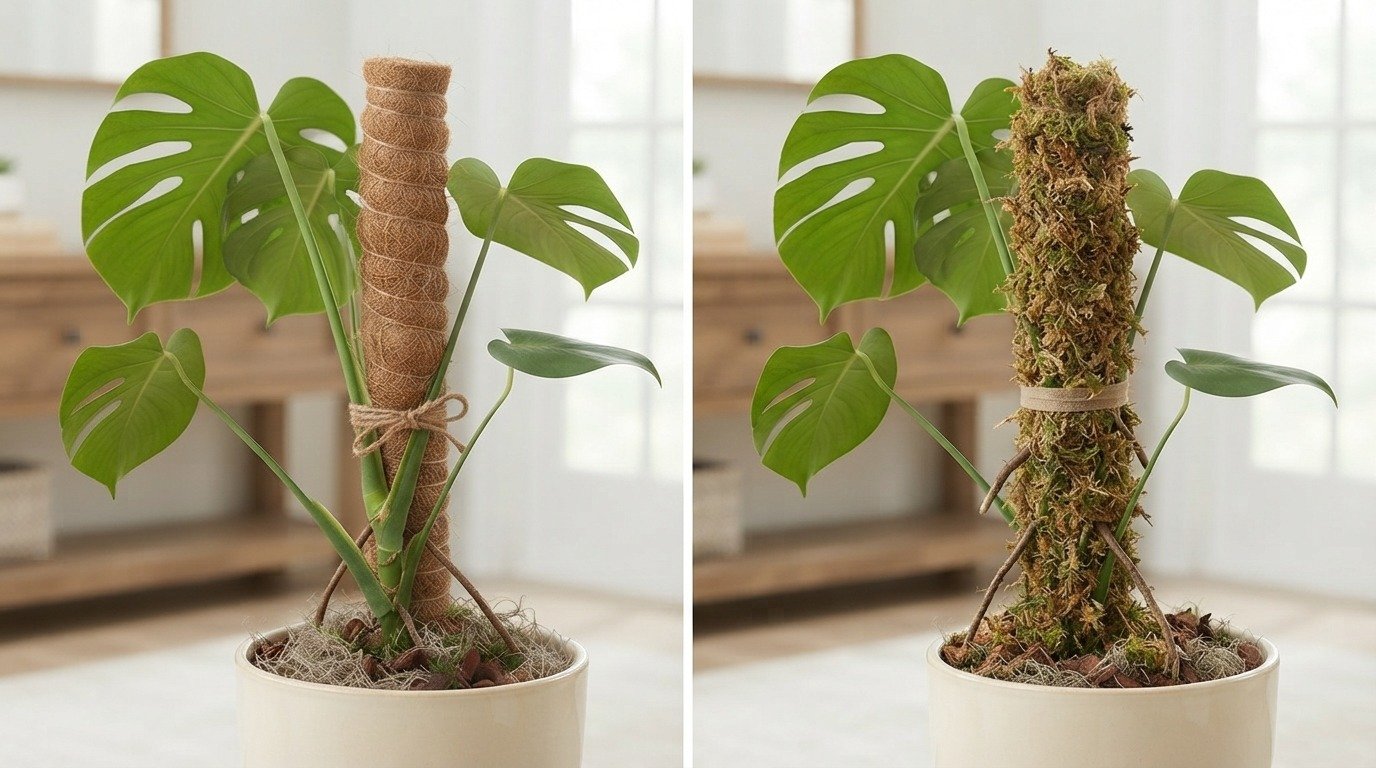
Yes.
Coir poles are a practical alternative to sphagnum moss poles.
Coconut fiber provides a textured surface that can give climbing plants something to grip. However, coir generally doesn’t retain moisture in exactly the same way as sphagnum moss.
That distinction matters if your goal is to encourage aerial roots to grow into a moist support.
For a simple structural climbing aid, coir can work well.
For a moisture-retaining rootable surface, sphagnum moss may be more suitable.
The choice ultimately depends on your plant, environment, maintenance preferences, and the type of support you want.
Can You Make a DIY Moss Pole for Monstera?
Yes. A simple DIY moss pole can be made from a sturdy central support and suitable moss or fiber held securely around it.
A basic concept involves:
- Choosing a rigid central support.
- Preparing damp sphagnum moss or another suitable material.
- Wrapping the material around the support.
- Securing it firmly with appropriate string, mesh, or line.
- Making sure the finished pole is strong enough for the plant.
- Anchoring it securely in the pot.
The advantage of making one yourself is that you can customize the height and thickness.
The disadvantage is that a poorly constructed pole can become unstable or shed its covering.
For a large Monstera, stability should matter more than saving a few minutes or dollars.
How to Train Monstera Up a Moss Pole
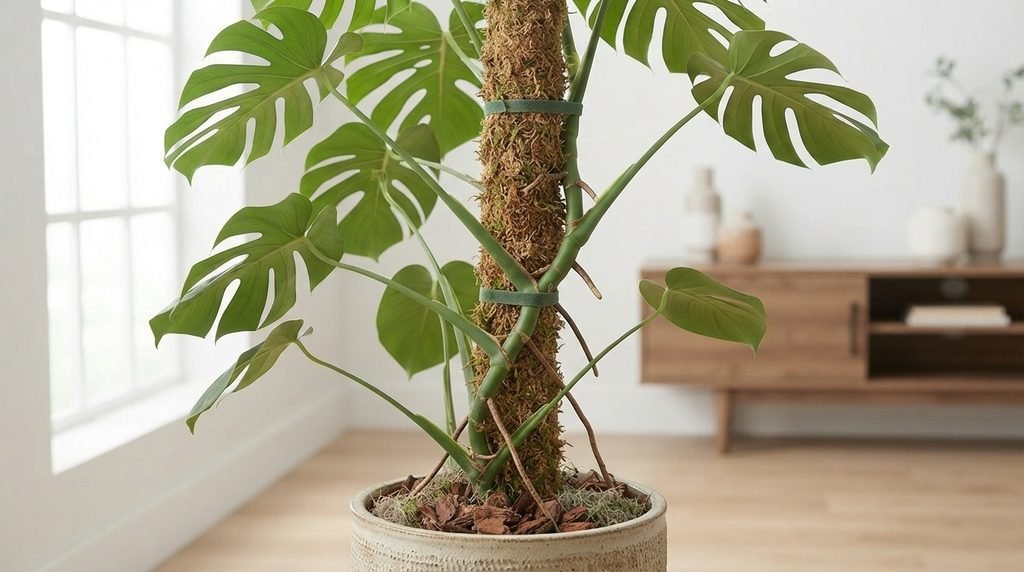
Training works best as an ongoing process rather than a one-time installation.
As the plant produces new growth:
- Check the direction of the new stem.
- Guide it toward the pole.
- Position aerial roots near the climbing surface.
- Secure the stem loosely if necessary.
- Check existing ties periodically.
- Extend the support when the plant outgrows it.
Don’t try to rearrange the entire plant every week.
A little guidance at the right time is usually better than repeated major adjustments.
What Happens When Monstera Outgrows the Moss Pole?
Eventually, it probably will.
That’s actually a good problem to have.
If the plant reaches the top of its support, you have several choices:
- Add another compatible section.
- Replace the pole with a taller support.
- Redirect the growth.
- Prune and propagate if the plant has become too large for the available space.
Modular poles are particularly convenient because you can extend the support without completely rebuilding the setup.
Before adding another section, make sure the original pole and pot are stable enough to support the additional height.
Moss Pole Care: A Simple Maintenance Routine
You don’t need to spend hours maintaining a Monstera.
A quick check every week or two can catch most problems early.
Check the pole
Is the moss still appropriately moist?
Check the ties
Are they still loose enough?
Check the stem
Is the plant growing naturally against the support?
Check aerial roots
Are new roots appearing and where are they heading?
Check the leaves
Look for dust, discoloration, pests, or other changes.
Check the pot
Make sure the plant isn’t becoming unstable as it gets taller.
This small routine can prevent a surprisingly large number of problems.
Frequently Asked Questions
Is a moss pole good for Monstera?
Yes. A moss pole can provide vertical support and a textured surface for Monstera’s aerial roots. It’s particularly useful for larger plants that naturally want to climb.
Should Monstera face the moss pole?
The main stem’s aerial-root side should generally face the pole. The leaves should remain oriented toward the available light rather than being pressed against the support.
Should I tie every Monstera leaf to the pole?
No. Secure the main stem rather than tightly tying individual leaf stalks. The leaves need room to move and orient themselves toward light.
Should I cut off Monstera aerial roots?
Usually, there’s no need to remove them simply because they look unusual. Aerial roots are a normal part of Monstera’s climbing habit.
Should a Monstera moss pole always be wet?
No. The goal is appropriate moisture, not constant saturation. The ideal frequency depends on the pole material and indoor conditions.
Is sphagnum moss better than coir for Monstera?
Sphagnum generally retains moisture better, while coir provides a drier, fibrous climbing surface. Either can be useful depending on what you want from the support.
Can a moss pole make Monstera grow faster?
A moss pole can support the plant’s natural climbing habit, but it isn’t a fertilizer or growth accelerator by itself. Growth still depends heavily on light, water, temperature, nutrition, and overall plant health.
How tall should a moss pole be?
Choose a support that’s tall enough for the current climbing stem and preferably allows room for future growth. A stackable system can be useful for a rapidly growing Monstera.
Can I add a moss pole without repotting?
Yes, but be careful. Inserting a pole into an established pot can disturb roots. If the plant is already due for repotting, installing the support during that process is often simpler.
Final Takeaway
A moss pole for Monstera isn’t just a decorative accessory. It gives a naturally climbing plant a place to direct its growth and provides aerial roots with a textured support surface.
The setup is fairly simple: choose a sturdy pole, position the aerial-root side of the stem toward it, secure the main stem loosely, and keep the climbing surface appropriately moist if you’re encouraging root attachment.
But don’t expect the pole to solve every Monstera problem.
Good light, suitable watering, well-draining soil, warmth, and healthy roots still form the foundation of successful growth. A moss pole works best as part of that bigger care routine—not as a shortcut around it.
If your Monstera is starting to sprawl across a shelf or floor, this may be the right time to give it something to climb.