The best carpet cleaning solution depends on what you’re trying to remove, the type of carpet you have, and the cleaning method you’re using. For everyday soil, a properly matched carpet formula is usually the safest starting point. For pet accidents, odors, or stubborn stains, a purpose-built treatment can make more sense. The Carpet and Rug Institute recommends looking for products that have earned its Seal of Approval because they have been tested for cleaning effectiveness and carpet compatibility.
There’s a moment every homeowner knows.
You walk across the living room and notice a dark trail near the doorway. Then you see the coffee mark beside the sofa. And if you have a dog or cat, there may be one suspicious-looking spot that you’d rather not investigate too closely.
Suddenly, the carpet doesn’t look quite as clean as it did last month.
The good news? You don’t necessarily need an expensive professional cleaning every time the carpet has a rough day. The right cleaning solution, used correctly, can handle many everyday messes.
The tricky part is choosing the right solution.
A powerful formula isn’t automatically the best choice. A pet formula isn’t necessarily what you need for greasy food stains. And adding more cleaning solution than the label recommends can actually work against you.
This guide breaks down what matters, which types of solutions make sense for different situations, what to avoid, and how to choose a carpet cleaner without wasting money on a product that isn’t suited to your carpet.
What Makes a Good Carpet Cleaning Solution?

A good carpet cleaning solution should effectively remove soil or stains while being appropriate for the carpet, cleaning equipment, and manufacturer’s care requirements.
There’s more to choosing one than picking the bottle with the most impressive label.
A practical carpet-cleaning formula should ideally offer:
- Effective soil removal
- Compatibility with your carpet and cleaning method
- Clear dilution and usage instructions
- Reasonable residue control
- Appropriate stain treatment
- Odor control when needed
- Compatibility with the machine you’re using
- Instructions that are easy to follow
The Carpet and Rug Institute’s Seal of Approval program is particularly useful here. Its program tests cleaning products and equipment for effectiveness, and certified solutions are intended to clean without adversely affecting carpet appearance or performance.
That’s a much more useful standard than simply choosing the product with the boldest marketing claim.
Why the “Strongest” Carpet Cleaner Isn’t Always the Best
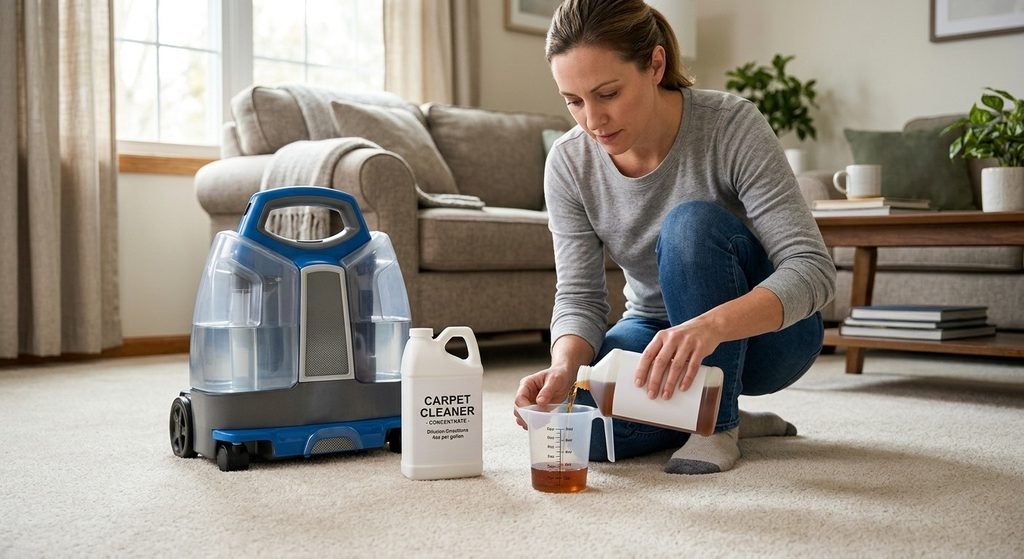
It’s tempting to assume that stronger chemicals mean cleaner carpet.
But carpet cleaning isn’t quite that simple.
A solution has to work with the carpet fiber, soil type, cleaning process, and extraction method. The Carpet and Rug Institute’s residential guidance specifically emphasizes selecting the right cleaning product and method rather than simply applying more product.
In fact, more cleaner isn’t necessarily better.
Too much product can leave unnecessary residue, while an unsuitable formula can create other problems such as discoloration or faster resoiling.
Think of carpet cleaner the way you’d think about laundry detergent: you wouldn’t automatically pour half the bottle into the washing machine because the clothes were especially dirty.
Follow the product directions instead.
Best Carpet Cleaning Solution for Different Situations
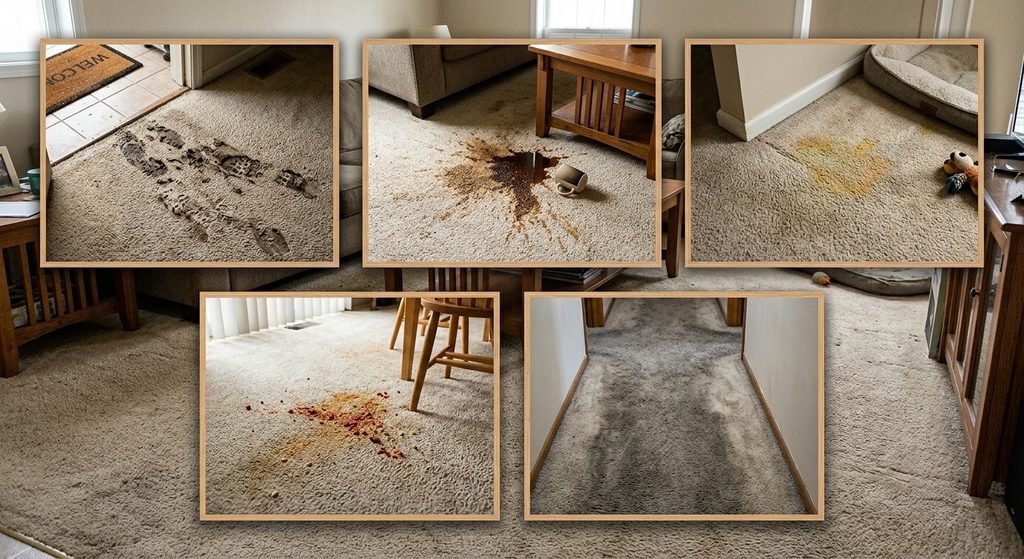
There isn’t one universal formula that wins for every carpet and every mess.
Here’s a more practical way to think about it:
| Situation | What to Look For | Why It Matters | Important Caution |
| Everyday dirt | General carpet-cleaning formula | Handles routine soil and traffic | Follow machine directions |
| Pet stains | Pet-specific stain and odor formula | Targets stains and odors associated with accidents | Follow carpet-care instructions |
| Pet urine | Urine/odor treatment | Designed specifically for urine-related messes | Avoid inappropriate heat-based treatment |
| Food stains | Stain-specific or oxygen-based treatment where appropriate | Food spills vary widely | Spot-test when appropriate |
| High-traffic areas | Deep-cleaning formula | Helps address accumulated soil | Don’t oversaturate carpet |
| Odors | Odor-focused treatment | Addresses odor rather than simply masking it | Identify the odor source |
| Old stains | Pre-treatment + appropriate deep cleaning | Gives embedded soil more attention | Results vary by stain and carpet |
| Small accidents | Spot cleaner | Faster and more targeted | Blot rather than aggressively scrub |
The important takeaway is that the stain should influence your choice.
Best Carpet Cleaning Solution for Everyday Dirt
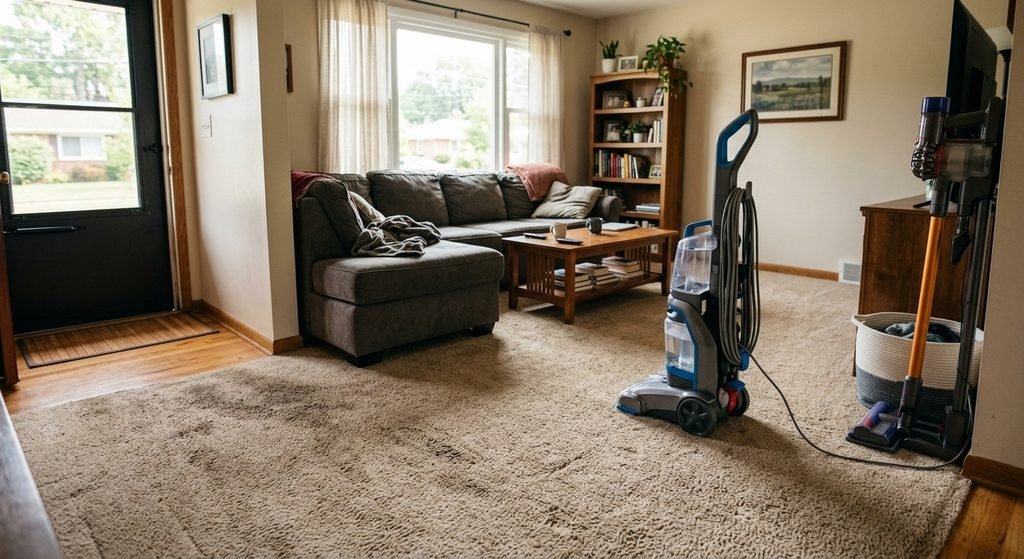
For routine household cleaning, look for a general-purpose carpet formula that’s compatible with your machine or cleaning method.
This is where you don’t necessarily need a specialized product.
Regular vacuuming also matters. The Carpet and Rug Institute recommends frequent vacuuming in high-traffic areas and prompt treatment of spills and spots.
A sensible routine looks something like this:
- Vacuum thoroughly.
- Identify visible stains.
- Pre-treat problem spots if the product calls for it.
- Use the appropriate carpet-cleaning solution.
- Follow the machine’s recommended solution ratio.
- Avoid soaking the carpet unnecessarily.
- Allow adequate drying.
It’s not glamorous. It works.
Best Carpet Cleaning Solution for Pet Stains and Odors

Pet messes are different from ordinary dirt.
A carpet may look clean after treatment while an odor remains because the original accident wasn’t fully addressed.
For pet households, look for a product specifically designed for pet stains and odors rather than assuming a standard carpet shampoo will do everything.
The CRI recommends certified cleaning products designed for pet stains and odors and emphasizes prompt treatment of new accidents.
Some manufacturers also offer separate urine-focused treatments. For example, Rug Doctor currently sells a Professional Urine Eliminator specifically positioned for tough pet stains and odors, as well as pet-specific deep-cleaning formulas.
One important pet-stain warning
Don’t automatically reach for a steam cleaner when dealing with urine.
The Carpet and Rug Institute specifically advises against using a steam cleaner on urine spots because heat can set the stain and odor. Its guidance recommends extraction with a wet vacuum and cool-water rinsing instead.
If the odor keeps returning, that’s a sign the problem may require more than a surface-level treatment.
Best Carpet Cleaning Solution for High-Traffic Areas
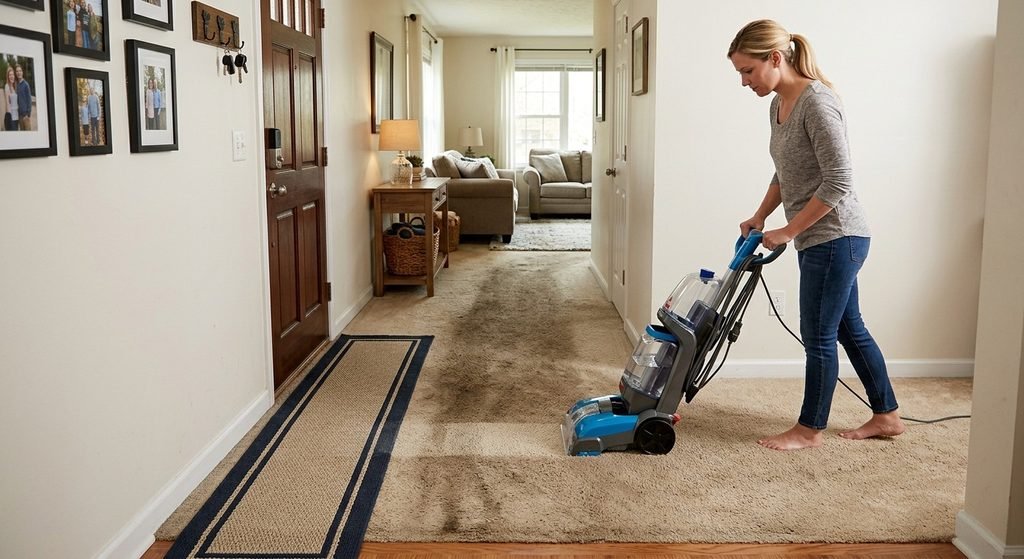
Hallways, stairs, entryways, and the carpet directly in front of the sofa usually tell the story of how a house is actually used.
These areas collect soil faster because they’re exposed to more foot traffic.
For these locations, a suitable deep-cleaning formula can be helpful, but the process matters just as much as the solution.
The Carpet and Rug Institute explains that effective carpet cleaning involves more than simply applying chemicals. Cleaning can involve chemical action, heat, agitation, and removal/extraction, depending on the cleaning method.
So if a hallway still looks dingy after cleaning, don’t immediately assume you need a stronger chemical.
You may need:
- Better vacuuming before cleaning
- Appropriate pre-treatment
- Better agitation
- More effective extraction
- Correct solution dilution
- A suitable cleaning machine
The solution is only one piece of the puzzle.
What About Old Carpet Stains?

Old stains are frustrating because they may have had plenty of time to penetrate, dry, oxidize, or become mixed with other soils.
A carpet cleaner may improve them without completely removing them.
That’s why it’s better to avoid promises such as “removes every stain.”
The result depends on:
- What caused the stain
- How long it has been there
- What was previously applied
- Carpet fiber
- Carpet color
- Stain location
- Cleaning method
- Whether the substance affected the backing or padding
For stubborn spots, a suitable pre-treatment followed by appropriate extraction may work better than repeatedly spraying the same general-purpose cleaner.
How to Choose the Best Carpet Cleaning Solution
Choosing a product gets much easier if you work through a few questions first.
Step 1: Identify Your Carpet
Before buying anything, check your carpet-care information if it’s available.
Different fibers and carpet constructions can have different cleaning requirements.
If you’re unsure, don’t guess based on appearance alone.
Check:
- Manufacturer care instructions
- Carpet warranty requirements
- Cleaning recommendations
- Recommended cleaning method
- Product compatibility
The CRI notes that some carpet manufacturers recommend or require Seal of Approval-certified products and methods for warranty protection.
Step 2: Identify the Problem
Ask yourself what you’re actually trying to solve.
Is it:
- General dirt?
- Mud?
- Food?
- Grease?
- Pet urine?
- Pet odor?
- Beverage spills?
- Ground-in traffic soil?
- A mystery stain?
That answer should guide your product choice.
A general carpet cleaner may be perfectly reasonable for routine dirt but less appropriate for a specialized pet-odor problem.
Step 3: Check Your Cleaning Equipment
This step is easy to overlook.
A solution intended for an upright extraction machine isn’t automatically interchangeable with every portable spot cleaner, upholstery tool, or other cleaning system.
For example, Rug Doctor separates its products into upright carpet solutions, portable spot-cleaning solutions, and spot/stain removers.
Before pouring anything into a machine, verify:
- The machine type
- Manufacturer recommendations
- Recommended formula
- Dilution instructions
- Whether the solution is intended for carpet, upholstery, or both
Step 4: Look for Evidence of Cleaning Performance
Marketing language can be useful, but certification is more meaningful.
The Carpet and Rug Institute says its Seal of Approval program is the industry’s scientific program for testing carpet cleaning products and equipment. Certified products are evaluated for cleaning effectiveness and potential impact on carpet appearance and performance.
So when comparing products, ask:
Has the product been independently tested or certified for carpet-cleaning performance?
That’s a better question than:
Does the bottle say “professional strength”?
Step 5: Think About Residue
This is one of those details that doesn’t get enough attention.
A cleaner that leaves unnecessary residue can create another cleaning problem.
The CRI specifically discusses the importance of products and methods that reduce the risk of rapid resoiling and recurring stains.
Use the recommended amount.
Don’t assume that doubling the formula will double the cleaning power.
Commercial vs. Homemade Carpet Cleaning Solutions
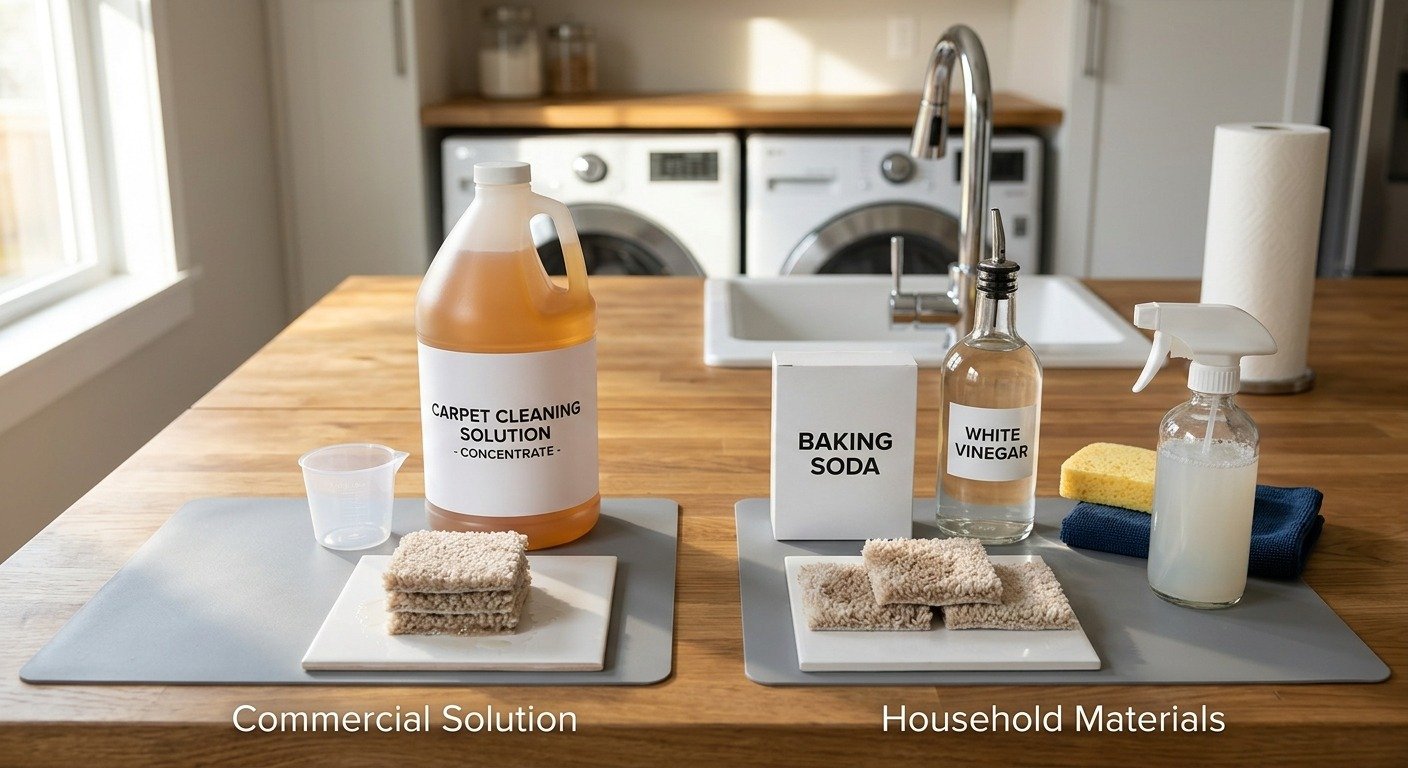
Homemade carpet-cleaning advice is everywhere online.
Some approaches may be useful for particular spot-cleaning situations, but there’s a difference between a simple household remedy and a carefully formulated carpet-cleaning product.
| Option | Advantages | Drawbacks | Best For |
| Commercial carpet formula | Designed for a specific cleaning method | Costs more than some household remedies | Routine deep cleaning |
| Specialized stain remover | Targets particular stains | May not be needed for everyday soil | Tough spots |
| Pet-specific formula | Designed around pet messes | More specialized | Pet households |
| Homemade spot treatment | May use readily available household items | Compatibility and effectiveness can vary | Limited spot-cleaning situations |
| Professional cleaning | Specialized equipment and expertise | Higher cost | Deep or difficult cleaning |
The big safety rule
Never mix cleaning chemicals simply because an online recipe suggests doing so.
Different chemicals can react in unsafe ways.
If you’re using a commercial product, follow the label.
If you’re considering a homemade treatment, make sure the approach is actually appropriate for your carpet rather than assuming a kitchen-cleaning recipe is automatically carpet-safe.
Should You Use Vinegar, Baking Soda, or Dish Soap on Carpet?
This is where online carpet advice can become confusing.
A household product that works well on one surface isn’t automatically a good choice for carpet.
The safest approach is to follow the carpet manufacturer’s cleaning instructions and use products designed or specifically approved for the carpet and cleaning method.
For a commercial carpet-cleaning machine, don’t substitute random household cleaners unless the machine manufacturer specifically permits it.
There’s a reason manufacturers provide solution recommendations.
How to Use Carpet Cleaning Solution Properly
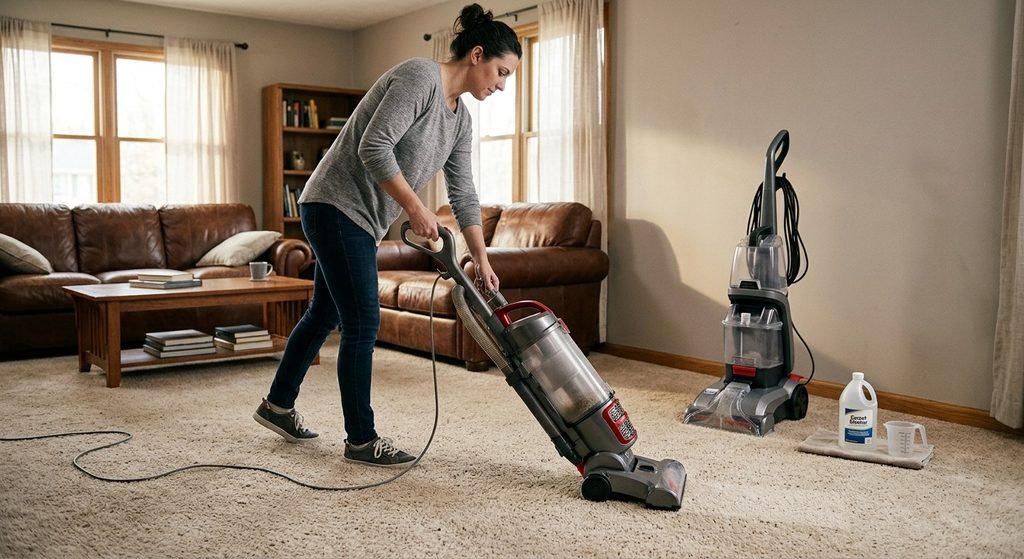
The product matters, but application matters too.
For a typical machine-cleaning process:
1. Vacuum First
Remove loose dirt before introducing moisture.
2. Treat Problem Spots
If the product recommends pre-treatment, apply it to the appropriate areas.
3. Measure the Solution
Follow the manufacturer’s dilution instructions.
Don’t guess.
4. Clean Methodically
Work in manageable sections and avoid repeatedly flooding the same area.
5. Extract Thoroughly
The goal isn’t just to put cleaning solution into the carpet. You also need to remove suspended soil and excess moisture.
6. Let the Carpet Dry
Good ventilation can help.
Avoid heavy traffic until the carpet is adequately dry.
Rug Doctor’s current operating guidance, for example, recommends vacuuming before deep cleaning and pre-treating problem areas such as old stains, high-traffic areas, and pet stains.
Common Carpet Cleaning Mistakes

Even a good carpet cleaner can produce disappointing results when the process goes sideways.
Using Too Much Solution
More isn’t automatically better.
Excess product can make rinsing and extraction more difficult.
Skipping Vacuuming
Loose dirt should be removed before deep cleaning.
Otherwise, you’re asking the wet-cleaning process to handle work that vacuuming could have done first.
Scrubbing Stains Aggressively
Hard scrubbing can spread a stain or affect carpet fibers.
The CRI recommends blotting spots rather than aggressively scrubbing them.
Ignoring the Carpet Manufacturer
A generic cleaning recommendation isn’t more important than your carpet’s care requirements.
Using the Wrong Machine Formula
A product designed for one cleaning system may not be suitable for another.
Over-Wetting the Carpet
Excess moisture can create drying problems and may contribute to other issues.
Cleaning Without Addressing the Source
If muddy shoes keep coming through the door, cleaning the carpet every few days isn’t the complete solution.
Use mats.
Take shoes off.
Deal with the source.
That’s usually the smarter long-term strategy.
Carpet Cleaning Safety: What Should You Keep in Mind?

Carpet cleaning products are household chemicals, so basic caution is worthwhile.
Always:
- Read the product label.
- Follow dilution instructions.
- Follow your carpet manufacturer’s care instructions.
- Follow your machine’s instructions.
- Ventilate the room appropriately.
- Keep cleaning products away from children and pets.
- Avoid mixing cleaning chemicals.
- Spot-test where appropriate.
- Don’t use a product for a purpose it wasn’t designed for.
If you aren’t sure whether a particular product is compatible with your carpet, check before applying it broadly.
A five-minute check can save you from a much more expensive problem.
What Is the Best Carpet Cleaning Solution for Pet Owners?
For homes with pets, the best choice is usually a solution specifically designed for pet stains and odors and compatible with your carpet and cleaning equipment.
Look for:
- Pet-specific stain treatment
- Odor-focused cleaning
- Appropriate extraction compatibility
- Clear usage directions
- Carpet compatibility
- Independent certification when available
Rug Doctor currently offers separate pet-focused formulas and a urine-specific treatment rather than treating every stain as the same type of problem.
That distinction makes sense.
Pet urine, muddy paw prints, and spilled kibble aren’t exactly the same cleaning challenge.
What Is the Best Carpet Cleaning Solution for a Rental?
Renters have another consideration: the carpet may not belong to you.
Before using a new chemical product, check your lease or property-management instructions when relevant.
If you’re preparing for a move-out inspection, aggressive experimentation is rarely worth it.
A better approach is:
- Identify visible stains.
- Check the carpet-care requirements.
- Use a compatible cleaning method.
- Treat spots appropriately.
- Avoid damaging the carpet while trying to improve it.
- Keep receipts or documentation if professional cleaning is required.
If the property owner requires professional cleaning, a DIY treatment may not satisfy that requirement.
When DIY Carpet Cleaning Isn’t Enough

Sometimes the smartest cleaning decision is knowing when to stop.
Consider professional help when:
- The carpet has extensive water damage.
- Strong odors keep returning.
- Pet urine has penetrated deeply.
- Stains cover large areas.
- The carpet has unusual or delicate construction.
- You’re worried about discoloration.
- The carpet-care instructions require specialized treatment.
- DIY cleaning repeatedly fails.
- You don’t have the right equipment.
The CRI recommends professional deep cleaning on a regular basis; its residential guidance gives 12 to 18 months as a general interval, while noting that cleaning needs vary.
Homes with pets, children, allergies, or unusually heavy traffic may need a different schedule.
How Often Should You Deep Clean Carpet?

There’s no universal calendar date that works for every household.
The Carpet and Rug Institute recommends professional deep cleaning every 12 to 18 months as part of routine carpet care, with more frequent cleaning when circumstances require it. (Carpet and Rug Institute)
Your actual schedule may depend on:
- Household traffic
- Pets
- Children
- Outdoor soil
- Carpet color
- Carpet type
- Allergies or indoor-air concerns
- Whether shoes are worn indoors
A household with two adults who remove their shoes is going to have a very different cleaning pattern from a busy family with two dogs and a backyard entrance.
Questions to Ask Before Buying a Carpet Cleaning Solution
Before buying, ask yourself:
- What type of carpet do I have?
- What type of stain am I dealing with?
- Do I need a spot cleaner or a full-machine formula?
- Is the product compatible with my carpet cleaner?
- Does the carpet manufacturer have specific requirements?
- Is the product independently certified?
- Will it address the actual problem, such as odor rather than just appearance?
- What dilution does the manufacturer recommend?
- Do I need a pre-treatment?
- Is this something I can safely handle myself?
These questions will usually get you closer to the right product than searching for the strongest bottle on the shelf.
FAQ: Best Carpet Cleaning Solution
What is the best carpet cleaning solution for everyday stains?
The best choice is generally a carpet-cleaning formula compatible with your carpet and cleaning machine, with a stain-specific treatment used when necessary. For routine dirt, you usually don’t need a specialized product for every individual spot.
What is the best carpet cleaning solution for pet stains?
A pet-specific carpet solution designed for stains and odors is generally a better starting point than a standard general-purpose cleaner. For urine-related problems, use a product specifically intended for that type of contamination and follow carpet-care instructions. The CRI recommends products designed for pet stains and odors and cautions against steam cleaning urine spots. (Carpet and Rug Institute)
Can homemade carpet cleaning solutions be used?
Some household spot-cleaning methods may be appropriate in particular circumstances, but you shouldn’t assume that every homemade cleaning mixture is carpet-safe. For machine cleaning, use the solution recommended or approved for the equipment and carpet.
Is more carpet cleaning solution better?
No. More solution isn’t automatically better. Follow the product’s dilution instructions. Excess product can make extraction more difficult and may contribute to residue.
How do I choose a carpet cleaner for my carpet type?
Start with the carpet manufacturer’s care instructions. Then choose a cleaning solution compatible with both the carpet and the cleaning method. If you’re uncertain, don’t experiment on the entire room—check compatibility first.
Can carpet cleaning solution remove old stains?
It can improve or remove some old stains, but results vary considerably. The stain’s substance, age, carpet fiber, previous treatments, and cleaning method all affect the outcome.
Does carpet cleaning solution remove odors?
Some formulas are specifically designed to address odors, but the right solution depends on the odor source. If the source has penetrated deeply into carpet or padding, surface cleaning alone may not solve the problem.
How often should carpets be professionally cleaned?
The Carpet and Rug Institute recommends professional deep cleaning approximately every 12 to 18 months as general guidance, although households with heavier traffic, pets, or other specific needs may require more frequent cleaning. (Carpet and Rug Institute)
Final Takeaway
The best carpet cleaning solution isn’t necessarily the strongest, cheapest, or most heavily advertised option.
It’s the one that matches your carpet, your cleaning equipment, and the problem you’re actually trying to solve.
For everyday dirt, a compatible general carpet formula may be enough. Pet owners may benefit from specialized stain-and-odor products. Stubborn stains can require pre-treatment and more careful extraction. And if a problem keeps returning, professional cleaning may be more sensible than repeatedly adding more chemicals.
One useful benchmark is the Carpet and Rug Institute’s Seal of Approval program, which evaluates carpet-cleaning products and equipment for effectiveness and carpet compatibility. (Carpet and Rug Institute)
At HomeworkDaily, the goal is simple: make home-maintenance decisions easier to understand, so you can spend less time guessing and more time getting the job done right.