A living room can have the right sofa, a beautiful rug, and carefully chosen wall colors, yet something can still feel slightly unfinished. Often, it’s the windows.
Curtains do more than cover glass. They can soften a room, control harsh sunlight, improve privacy, add texture, and make windows appear larger. The trick is choosing a style that works with the room instead of competing with everything else in it.
If you’re searching for modern curtains for living room spaces, there’s no single style that works for everyone. A bright apartment with large windows needs a different approach from a traditional family room with dark wood furniture.
The good news? Once you know what to look for, the decision becomes much easier.
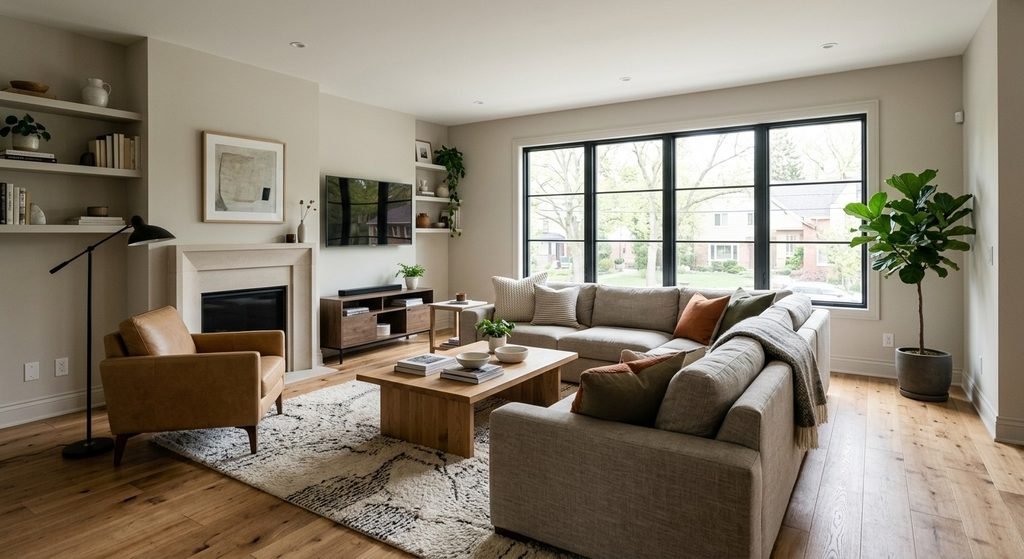
Quick Answer: What Are the Best Modern Curtains for a Living Room?
The best modern curtains for a living room depend on your light, privacy needs, room size, and existing décor. Sheer curtains create an airy look, while lined or blackout curtains offer stronger light control and privacy. For a balanced modern appearance, choose simple panels, understated colors, quality fabric, and a length that reaches the floor.
Why Curtains Matter More Than You Might Think
Curtains are sometimes treated as an afterthought. They’re installed after the furniture is in place, and the choice often comes down to whichever color seems to match the sofa.
That’s a missed opportunity.
A curtain occupies a surprisingly large visual area. Even a simple pair of panels can change how the entire room feels.
For example, imagine a living room with:
- Warm white walls
- A light gray sofa
- Natural wood flooring
- Black metal accents
- Large windows
Adding heavy, dark curtains could make the room feel more enclosed. Lightweight neutral panels, on the other hand, can preserve the open feeling while adding softness.
This is why the best choice isn’t necessarily the most expensive curtain or the trendiest pattern. It’s the one that solves the room’s actual needs.
What Makes Modern Curtains Look Modern?
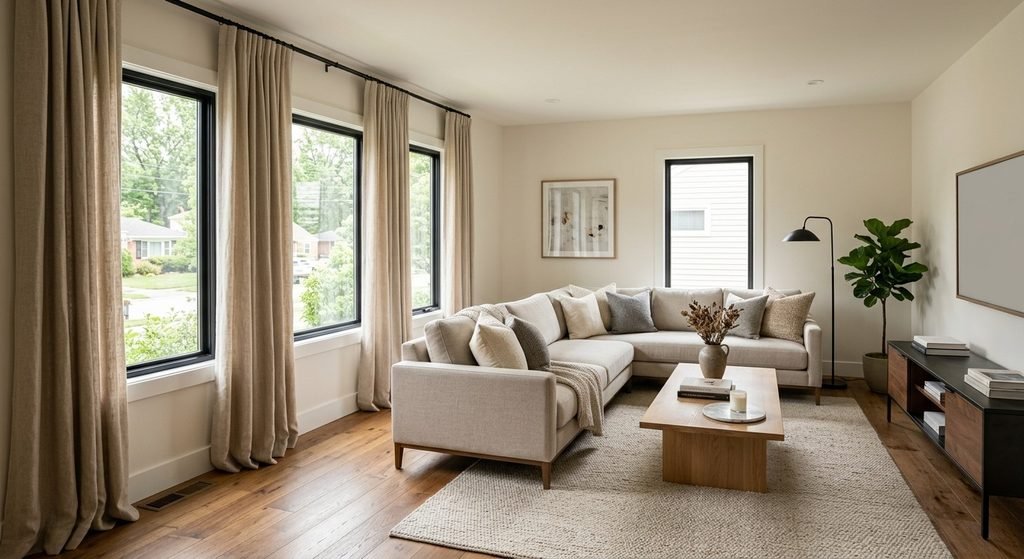
Modern curtain design usually favors simplicity, clean lines, useful functionality, and colors that work naturally with the rest of the room.
That doesn’t mean your curtains have to be plain white.
A modern look can include:
- Solid neutral fabrics
- Subtle textures
- Soft earth tones
- Floor-length panels
- Simple pleats
- Minimal hardware
- Sheer and opaque layers
- Carefully chosen geometric patterns
- Natural-looking fabrics
The important part is balance.
A heavily decorated curtain with an elaborate pattern may work beautifully in another interior style, but it can feel visually busy in a minimalist living room.
Simple Doesn’t Mean Boring
One of the easiest mistakes is assuming modern means completely plain.
Texture can provide plenty of visual interest without introducing a complicated pattern.
A soft linen-look fabric, for example, can add dimension to a neutral room while keeping the overall design understated.
If your furniture already has strong colors or patterns, textured solids can be especially useful.
Popular Modern Curtain Styles for Living Rooms
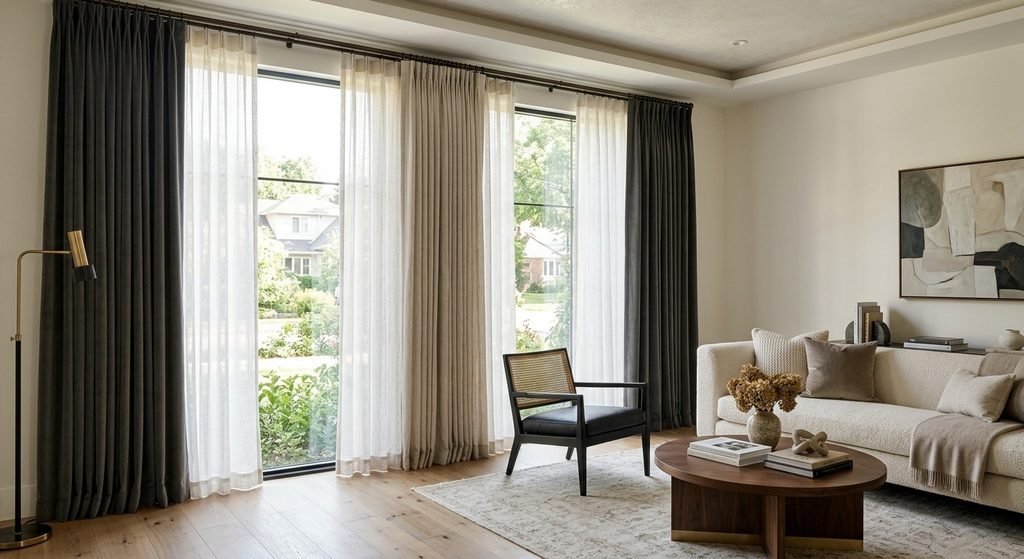
Different curtain styles solve different problems. Before choosing a color, consider the type of curtain you actually need.
Sheer Curtains
Sheer curtains allow plenty of daylight into the room while creating a softer appearance around the windows.
They’re particularly useful when you want:
- A bright, airy atmosphere
- Soft filtered daylight
- A lightweight appearance
- A layered window treatment
The downside is privacy. Sheers alone may not provide enough privacy at night when interior lights are on.
For that reason, they’re often more effective when paired with another curtain layer.
Light-Filtering Curtains
Light-filtering curtains sit somewhere between sheers and heavier panels.
They reduce brightness and soften incoming daylight without necessarily making the room dark.
They’re a practical choice for living rooms where you want comfortable daytime light but don’t need complete darkness.
Blackout Curtains
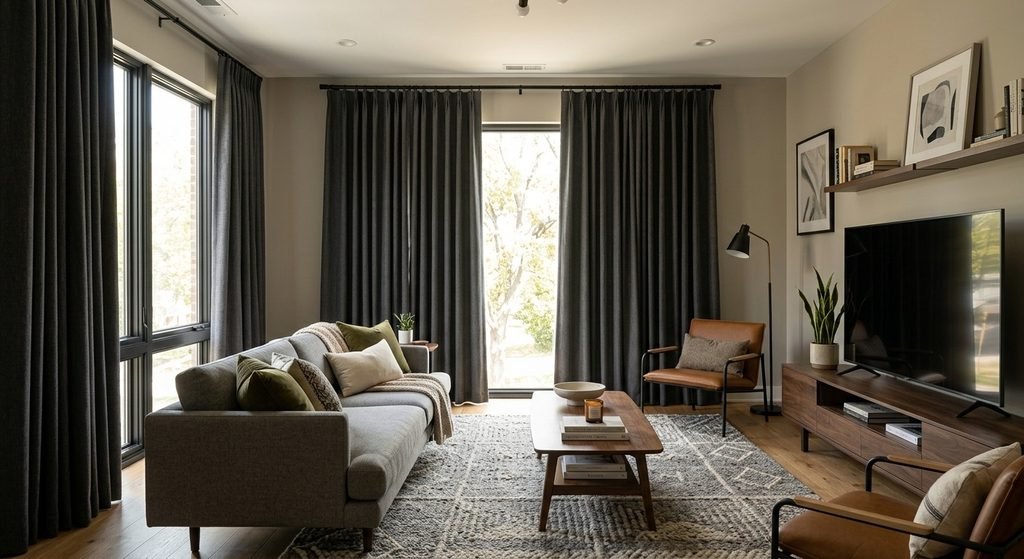
Blackout curtains are useful when controlling sunlight and privacy is a priority.
They’re particularly worth considering for living rooms with:
- Strong afternoon sunlight
- Glare on television screens
- Large exposed windows
- A need for greater nighttime privacy
However, blackout curtains can feel visually heavy if the fabric, color, or installation isn’t suited to the room.
If the living room depends on natural light, you may prefer blackout-lined panels that can be opened fully during the day.
Linen and Linen-Look Curtains
Linen and linen-look fabrics are popular choices for contemporary interiors because they tend to have a relaxed, textured appearance.
They can work particularly well with:
- Wood furniture
- Neutral sofas
- Natural materials
- Coastal-inspired rooms
- Scandinavian-style interiors
- Warm minimalist spaces
Keep in mind that genuine linen can have a different maintenance profile from synthetic linen-look fabrics, so check the care instructions before buying.
Layered Curtains
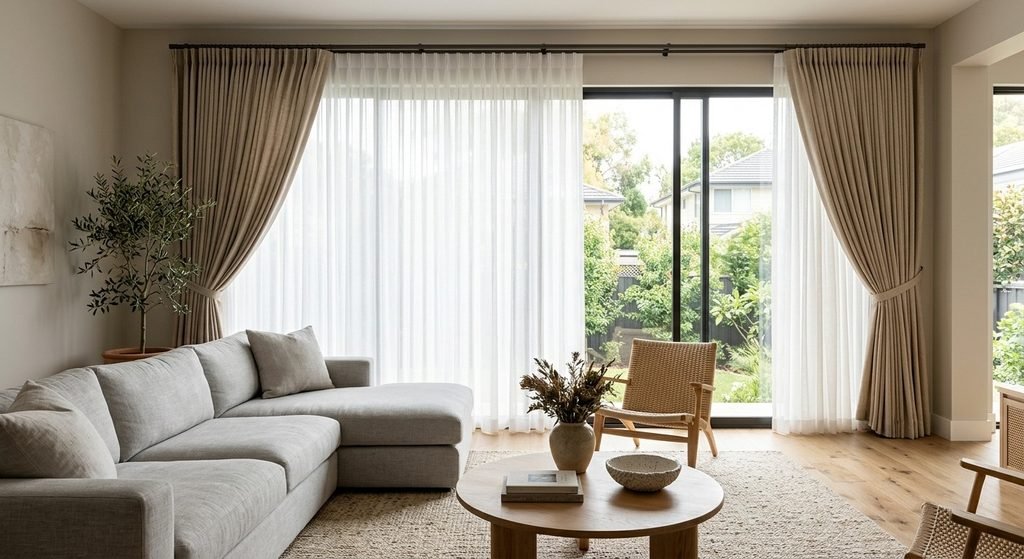
Layering can be one of the most versatile approaches.
A sheer layer can provide daytime softness, while a heavier outer curtain provides privacy and stronger light control when needed.
This arrangement gives you more flexibility than relying on one curtain type.
Modern Curtains for Living Room: Which Fabric Should You Choose?
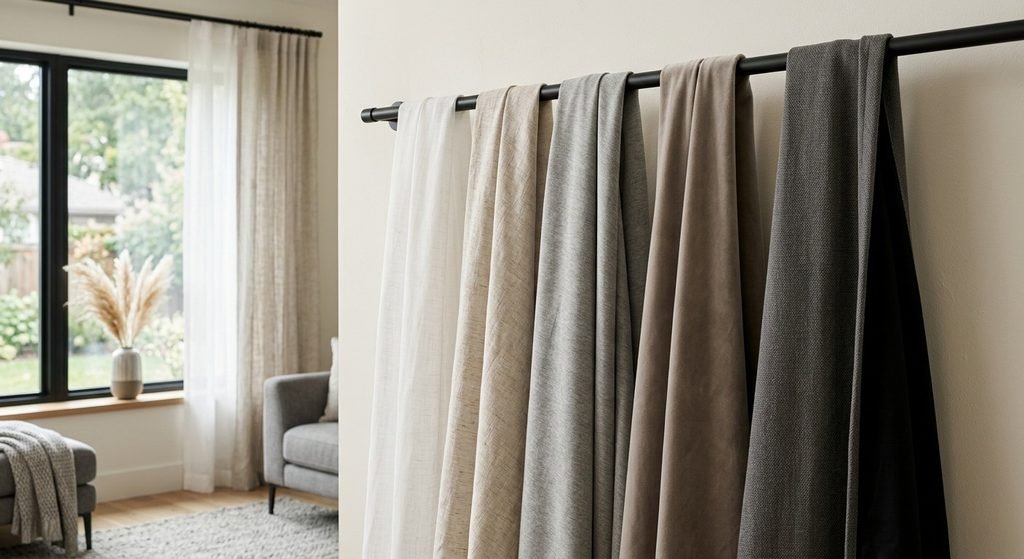
Fabric affects more than appearance. It can influence how much light enters the room, how the curtains hang, how easy they are to maintain, and how formal the space feels.
| Fabric or Finish | Appearance | Light Control | Maintenance | Good For |
| Sheer | Light and airy | Low | Usually easy | Bright rooms |
| Linen-look | Relaxed and textured | Low–Moderate | Varies | Casual modern spaces |
| Cotton blend | Soft and versatile | Moderate | Usually manageable | Everyday living rooms |
| Velvet | Rich and substantial | High | More demanding | Dramatic interiors |
| Blackout-lined | Structured | High | Varies | Glare and privacy |
| Polyester blend | Versatile | Moderate–High | Often easy | Practical households |
There isn’t a universally “best” curtain fabric.
A busy household may value easy maintenance more than delicate natural fabric. Someone designing a formal sitting room may prioritize texture and drape instead.
How to Choose Curtain Colors
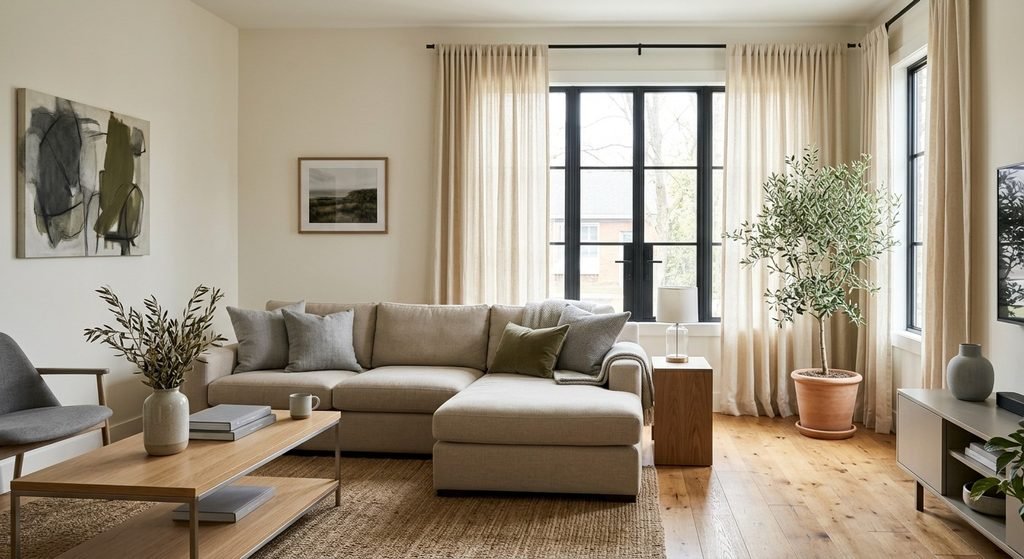
Color is where many people get stuck.
The curtains don’t have to match the sofa exactly. In fact, an exact match can sometimes make a room feel overly coordinated.
Instead, look for relationships between the curtains and existing elements.
Neutral Curtains
Neutral colors such as:
- White
- Cream
- Beige
- Taupe
- Light gray
- Warm greige
can create a calm backdrop.
They’re especially useful if you’re likely to change furniture or accessories later.
Earthy Colors
Soft olive, muted brown, sand, terracotta, and similar tones can add warmth without becoming overwhelming.
These shades work particularly well alongside natural wood and warm neutral furnishings.
Dark Curtains
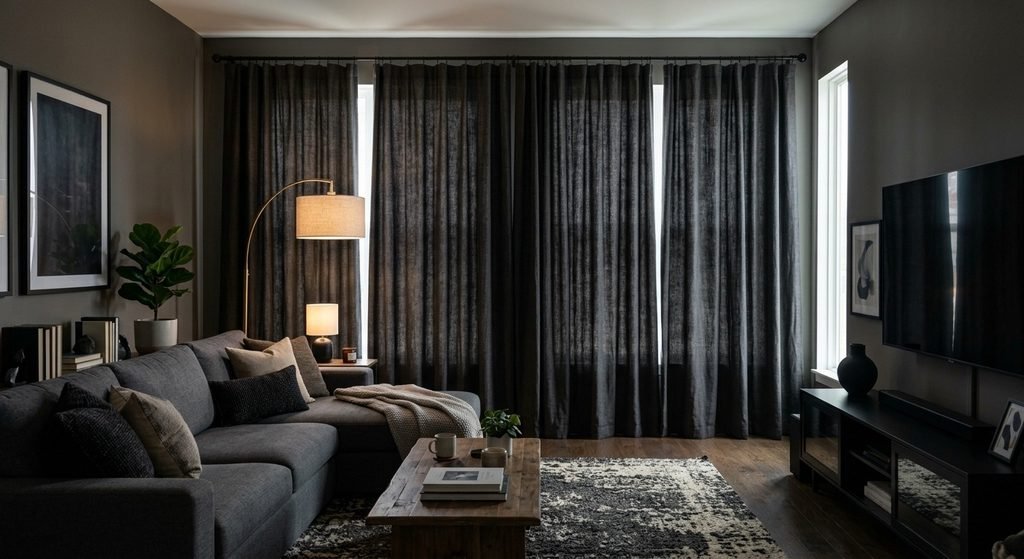
Charcoal, deep navy, dark brown, or similar shades can create contrast.
They’re often more effective when the room already contains darker elements that help visually connect the curtain color to the rest of the design.
Should Curtains Match the Sofa?
Not necessarily.
A better approach is to coordinate rather than duplicate.
For instance, if you have a beige sofa, you could choose:
- Warm white curtains
- Taupe curtains
- Soft olive curtains
- Textured cream panels
The goal is to make the elements feel related, not identical.
How Long Should Living Room Curtains Be?
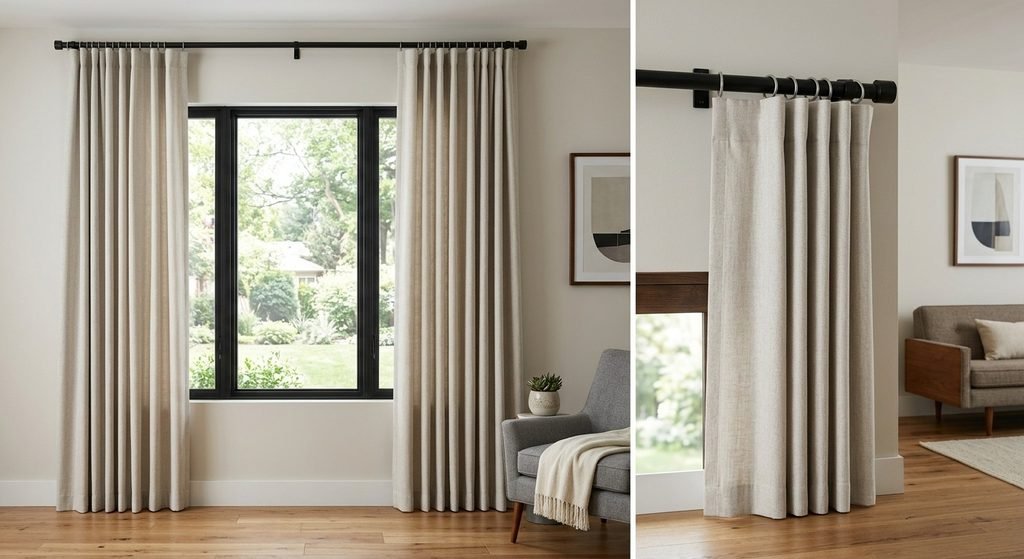
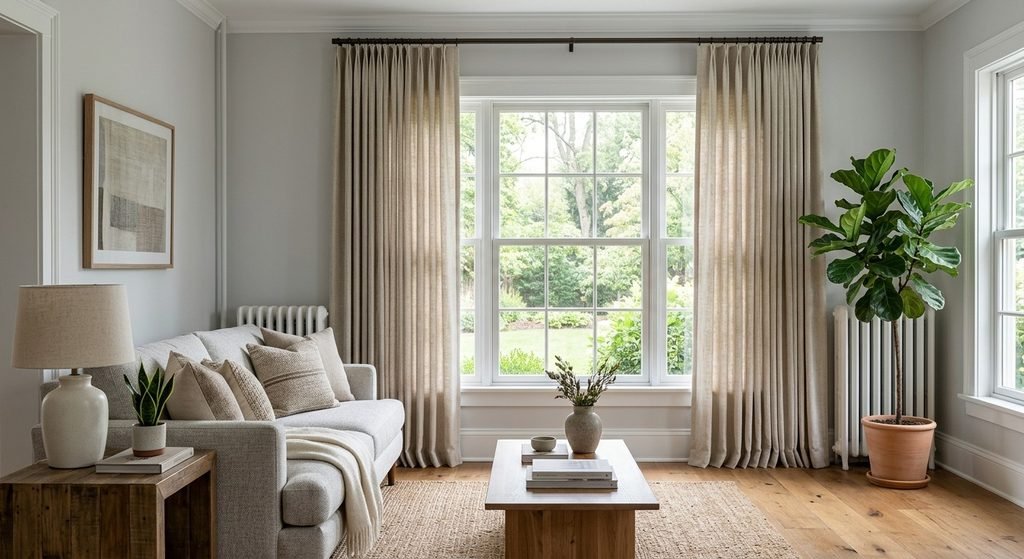
For a polished modern appearance, floor-length curtains are often a strong starting point.
Curtains that stop noticeably above the floor can make the window treatment look disconnected from the room.
Before ordering, measure carefully.
Consider:
- Where the rod will be installed
- Distance from the rod to the floor
- Whether the curtains will hang inside or outside the window frame
- Whether the fabric has a specific heading style
- Whether the panels are intended to touch, hover just above, or gently break at the floor
Don’t assume the advertised curtain length will produce the exact appearance you want. Installation height changes the final result.
Should Curtains Be Wider Than the Window?
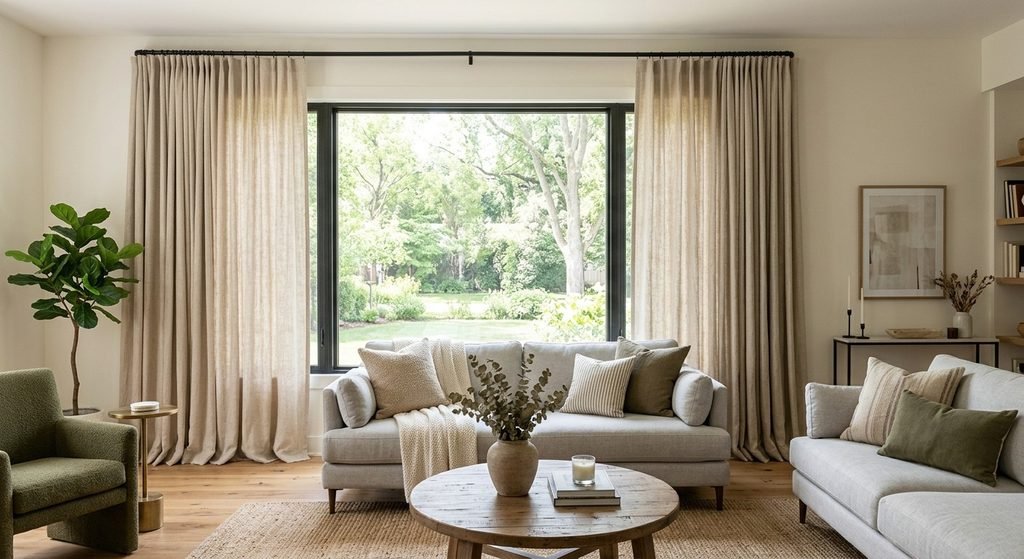
Usually, yes.
Curtain panels need enough fabric to cover the window while still looking full when closed or gathered.
If curtains are barely wider than the glass, they can look stretched and skimpy.
When choosing width, consider both the window dimensions and the fullness you want.
A fuller appearance generally requires more fabric.
A Simple Measuring Checklist
Before shopping, record:
- Window width
- Window height
- Desired rod position
- Distance from rod to floor
- Available wall space beside the window
- Number of panels needed
- Desired fullness
If you’re replacing existing curtains, measuring the current setup can provide a useful starting point, but don’t automatically copy the old dimensions. The previous installation may not have been ideal.
Where Should You Install the Curtain Rod?
Curtain placement can have a major visual effect.
Mounting the rod very close to the top of the window frame can make the window treatment feel cramped.
A higher rod can create the impression of a taller window by drawing the eye upward.
But don’t treat one measurement as a universal rule. Ceiling height, trim, window placement, and the available wall area all matter.
The goal is a proportion that looks intentional.
How to Make a Small Living Room Feel Bigger With Curtains
Curtains can’t physically increase the size of a room, but they can influence how spacious it feels.
A few approaches can help:
- Use lighter curtain colors.
- Keep patterns restrained.
- Consider floor-length panels.
- Avoid unnecessarily bulky hardware.
- Extend the curtain treatment beyond the window where appropriate.
- Keep the overall palette visually connected.
For a small living room, extremely heavy curtains can sometimes make the windows feel crowded.
A lightweight or medium-weight fabric may create a cleaner appearance.
What If Your Living Room Gets Strong Sunlight?
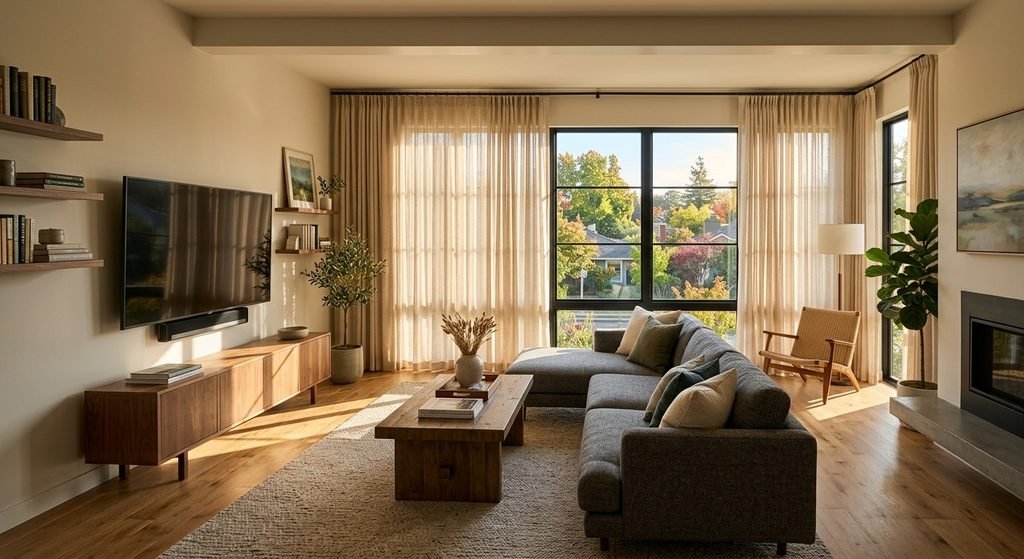
Sunlight is wonderful until it starts creating glare, fading concerns, or uncomfortable heat.
If your living room receives strong direct sunlight, think about the problem you’re trying to solve.
For glare
Light-filtering or lined curtains may help reduce the amount of harsh light entering the room.
For privacy
A denser fabric can provide greater coverage, particularly at night.
For flexible control
Layered curtains can give you more control throughout the day.
Instead of automatically choosing the darkest curtain available, match the solution to the room’s exposure.
Modern Curtains for Living Room With a TV
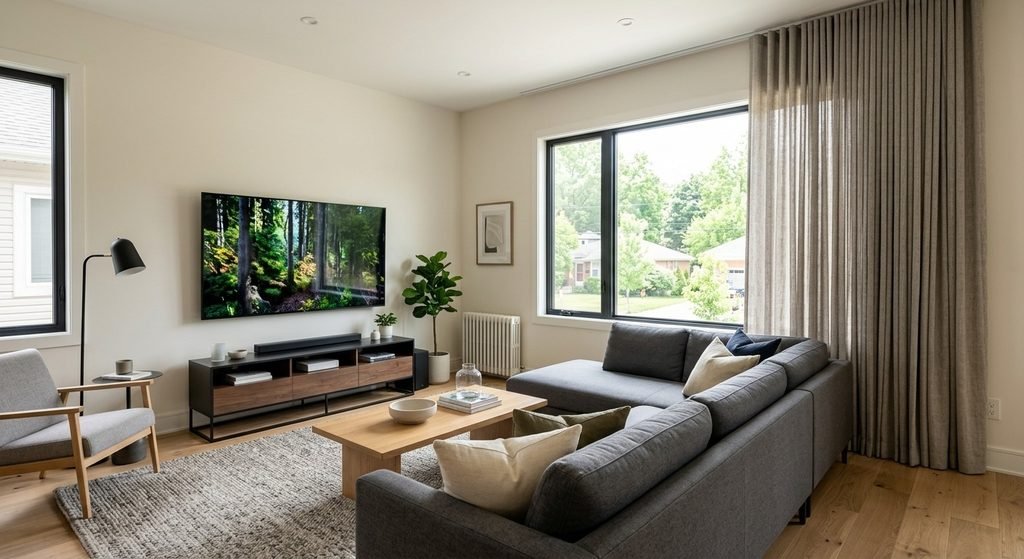
Television glare is an easy detail to overlook.
If your sofa faces a TV positioned near or opposite a sunny window, direct daylight can make the screen harder to see.
In that situation, consider curtains that provide enough light control to reduce glare.
A layered setup can be especially useful because you can filter daylight without keeping the entire living room dark.
Should You Use Patterned Curtains?
Absolutely, if the room can support them.
Patterned curtains can become a focal point, but they should have a reason for being there.
If your sofa, rug, artwork, and cushions already contain several patterns, a solid curtain may create better balance.
If the rest of the room is simple, a subtle geometric or botanical pattern can add personality.
A useful test is to step back and look at the room as a whole.
If your eye immediately jumps between too many competing patterns, simplify one element.
Common Mistakes to Avoid
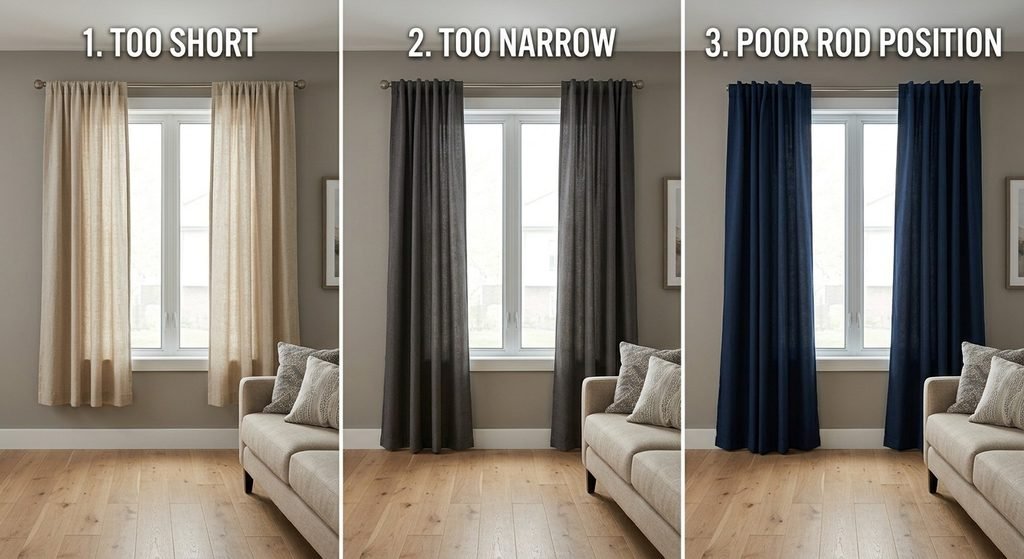
Even attractive curtains can look wrong when they’re poorly proportioned.
1. Choosing Curtains That Are Too Short
Short panels can make the window treatment feel unfinished.
Measure from the actual planned rod position to the floor before ordering.
2. Ignoring Window Width
Curtains need enough width to provide useful coverage and visual fullness.
3. Matching Everything Too Closely
Curtains don’t have to be the same color as your sofa, walls, and cushions.
A little contrast can make the room feel more layered.
4. Choosing Fabric Without Considering Sunlight
A beautiful lightweight fabric may not be the right choice for a window exposed to intense afternoon sun.
5. Mounting the Rod Without Considering Proportion
Curtain hardware should work with the window, ceiling, trim, and overall room scale.
6. Buying Before Measuring
This sounds obvious, but it’s one of the easiest mistakes to make.
Measure first. Shop second.
How to Choose the Right Modern Curtains for Your Living Room
If you’re standing in a store or browsing online with dozens of options in front of you, narrow the decision down in this order.
Step 1: Assess the Natural Light
Is the room:
- Bright throughout the day?
- Bright only in the afternoon?
- Relatively dark?
- Exposed to direct sunlight?
This immediately eliminates some options.
Step 2: Decide How Much Privacy You Need
If privacy is important, sheers alone may not be enough.
Think about whether people outside can see into the room during the day, at night, or both.
Step 3: Look at Your Existing Décor
Identify the dominant:
- Wall color
- Sofa color
- Flooring
- Wood tones
- Metal finishes
- Accent colors
Your curtains should work with these elements.
Step 4: Select the Fabric
Choose based on appearance, light control, maintenance, and how formal or relaxed you want the room to feel.
Step 5: Choose the Color
Start with the room rather than the curtain itself.
Ask:
“Do I need more contrast, more warmth, or a quieter backdrop?”
That question is often more useful than simply asking which color is trendy.
Step 6: Measure Carefully
Record width and height before purchasing.
Also consider the position of the curtain rod.
Step 7: Think About Maintenance
A curtain that looks beautiful but requires more care than you’re willing to provide may not be the right choice.
Check washing, drying, ironing, and care instructions before purchasing.
Step 8: Consider the Whole Window
Don’t evaluate the curtain panel by itself.
Think about:
- Rod
- Finials
- Rings or hooks
- Tiebacks
- Window trim
- Wall color
The finished combination matters more than any single component.
Modern Curtain Ideas by Living Room Style
Different interiors call for different interpretations of modern design.
| Living Room Style | Curtain Direction | Why It Works |
| Minimalist | Solid neutral panels | Keeps the room visually clean |
| Scandinavian-inspired | Light textured fabrics | Adds softness without heaviness |
| Modern farmhouse | Linen-look or warm neutrals | Complements natural textures |
| Contemporary | Solid colors with clean hardware | Creates a streamlined appearance |
| Mid-century inspired | Simple panels with controlled color | Balances furniture shapes |
| Eclectic | Subtle pattern or richer color | Adds personality to a layered room |
These aren’t strict rules. Your existing furniture should have the final say.
Are Layered Curtains Worth It?
For many living rooms, yes.
Layering provides flexibility that a single curtain often can’t.
During the day, you might use the sheer layer for privacy and filtered light. In the evening, the heavier outer panels can provide additional privacy and darkness.
The approach is especially useful when the living room serves multiple purposes, such as:
- Watching television
- Entertaining guests
- Reading
- Working from home
- Relaxing during the day
The only drawback is that layered treatments generally require more hardware and fabric.
Renter-Friendly Curtain Ideas
Renters don’t necessarily have to give up a polished window treatment.
Depending on the lease and the type of window, options may include:
- Tension-based solutions where appropriate
- Removable hardware designed for the intended load
- Existing curtain hardware
- Freestanding room-dividing or window-covering solutions
Always check the manufacturer’s weight limits and installation requirements.
Don’t rely on adhesive products for heavy curtains unless they’re specifically designed and rated for that use.
What Features Are Worth Paying More For?
A higher price doesn’t automatically mean better quality.
Before spending more, decide what actually matters in your room.
Features that may justify additional cost include:
- Better construction
- Improved lining
- More suitable fabric
- Custom sizing
- Higher-quality hardware
- Better light control
- Easier maintenance
- A finish that complements the room
On the other hand, you may not need premium fabric or custom construction if the room has simple windows and modest requirements.
Spend where the improvement will actually be noticeable.
How to Keep Modern Curtains Looking Fresh
Curtains collect dust over time, particularly around windows and frequently used living spaces.
Maintenance depends on the fabric and manufacturer’s instructions.
Useful habits include:
- Follow the care label.
- Vacuum or dust curtains gently when appropriate.
- Avoid aggressive cleaning methods.
- Don’t assume every curtain can go into a washing machine.
- Address stains according to the manufacturer’s instructions.
- Check hardware occasionally.
Good maintenance can help preserve both appearance and function.
Final Takeaway
The right modern curtains for living room spaces aren’t necessarily the most dramatic or expensive ones. They’re the curtains that make sense for the room.
Start with the practical questions: How much sunlight enters? How much privacy do you need? What size is the window? Then consider fabric, color, length, texture, and installation.
A simple neutral panel may be exactly right for one living room, while another may benefit from layered sheers and heavier curtains.
The best window treatment is the one that looks intentional while making the room more comfortable to live in.
If you’re planning other home projects, explore more practical home-improvement and gardening ideas on HomeworkDaily for useful guidance you can apply to your own space.