Imagine approaching a grand stone mansion overlooking the Hudson River, with formal gardens, mature trees, and architecture designed for a family whose wealth helped define America’s Gilded Age.
That’s the setting of Vanderbilt Mansion in Hyde Park, New York.
But there’s more to this historic property than an impressive façade. The estate tells a larger story about American wealth, architecture, landscape design, social life, and the changing meaning of historic preservation.
Built for Frederick and Louise Vanderbilt, the mansion was designed by the renowned architectural firm McKim, Mead & White. Today, it is preserved as Vanderbilt Mansion National Historic Site, managed by the National Park Service.
And here’s the interesting part: the mansion isn’t the whole story.
Its gardens, landscape, interiors, historic views, and relationship with the surrounding Hudson Valley all help explain why this property remains so significant.
What Is Vanderbilt Mansion?
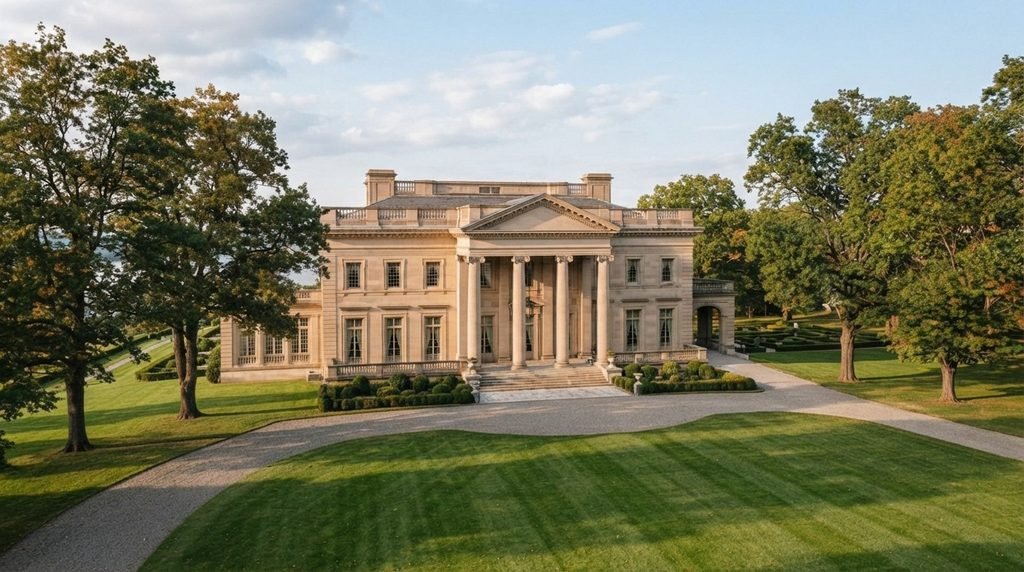
Vanderbilt Mansion is a historic Gilded Age estate in Hyde Park, New York, built for Frederick and Louise Vanderbilt between 1896 and 1898.
The National Park Service describes it as a home created for the aristocratic lifestyle and recognizes its importance in architecture and design. The mansion is part of Vanderbilt Mansion National Historic Site.
Here are some quick facts:
| Feature | Details |
| Location | Hyde Park, New York |
| Owners | Frederick and Louise Vanderbilt |
| Construction | 1896–1898 |
| Architects | McKim, Mead & White |
| Architectural character | Beaux-Arts / Neoclassical |
| Historic setting | Hudson Valley |
| Current steward | National Park Service |
| Public access | Guided tours |
| Original cost | $660,000 |
| Interior furnishings | About $1.5 million |
The mansion itself contains approximately 45,000 square feet, 54 rooms, and six floors, according to the National Park Service.
Those numbers are impressive, but they don’t fully explain what makes the estate memorable.
The design does.
Where Is Vanderbilt Mansion?
Vanderbilt Mansion is located in Hyde Park, New York, in the Hudson Valley along the Hudson River.
Its official address is 4097 Albany Post Road, Hyde Park, NY 12538.
Its location is important because the estate was designed as more than an isolated house. The surrounding landscape was part of the experience.
The property included:
- Formal gardens
- Lawns
- Mature specimen trees
- Agricultural areas
- Greenhouses
- Scenic views
- Estate buildings
- Access toward the Hudson River
In other words, the mansion and landscape were designed to work together.
That idea is especially useful for homeowners and garden enthusiasts today: a beautiful house often feels more connected to its surroundings when architecture and landscape are planned as one composition.
The Story Behind Vanderbilt Mansion
How Did the Vanderbilt Family Become So Wealthy?
To understand the mansion, it’s worth stepping back for a moment.
The Vanderbilt family’s fortune is closely associated with Cornelius Vanderbilt, whose wealth grew through steamboats and later railroads.
His grandson, Frederick William Vanderbilt, belonged to a later generation that inherited and expanded the family’s social prominence.
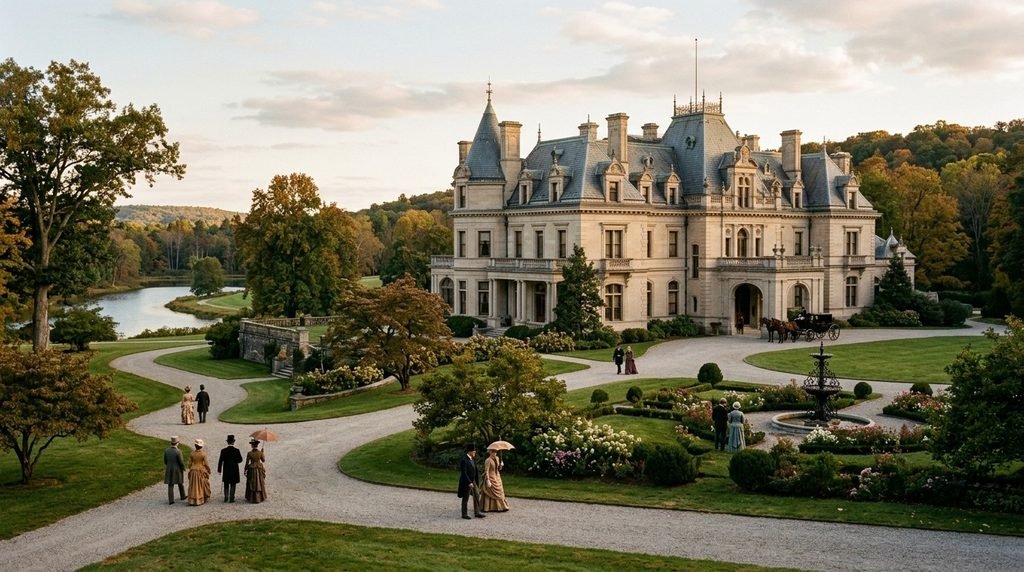
The Vanderbilt family became famous for constructing elaborate residences during America’s Gilded Age, a period when rapid industrial growth created enormous fortunes alongside major social and economic inequality.
Frederick and Louise Vanderbilt approached their Hyde Park property somewhat differently from some of their relatives.
The National Park Service describes the Hyde Park mansion as grand but comparatively restrained, reflecting a more controlled interpretation of classical architecture.
That restraint is part of the property’s appeal.
Frederick Vanderbilt Purchases Hyde Park
Frederick Vanderbilt purchased the Hyde Park property in 1895.
But the land wasn’t empty when he arrived.
It already had a long history involving earlier owners and landscape development. The estate had previously been associated with figures including Dr. Samuel Bard, David Hosack, and the Langdon family.
When the existing Langdon house proved structurally unsound, Frederick commissioned a new residence.
The result was the mansion visitors recognize today.
Who Designed Vanderbilt Mansion?

Vanderbilt Mansion was designed by McKim, Mead & White, one of the most prominent American architectural firms of the late 19th and early 20th centuries.
The firm was particularly influential in bringing sophisticated classical design to American architecture.
At Hyde Park, Charles F. McKim’s academic approach to classicism is especially visible.
The mansion’s design drew inspiration from the earlier Langdon mansion that had occupied the site. Classical elements such as pilasters and a semicircular portico helped connect the new structure with the property’s architectural history.
The National Park Service’s Historic Resource Study identifies the mansion as an example of Neoclassical Beaux-Arts architecture and notes its unusual significance within Hudson River Valley country-house architecture.
What Makes the Architecture So Special?

The mansion is impressive without relying entirely on visual excess.
Its architectural language includes:
- Classical symmetry
- Limestone exterior
- Monumental columns
- Pilasters
- Formal proportions
- A semicircular portico
- Carefully organized interior spaces
- Beaux-Arts and Neoclassical influences
The result is a house that feels formal and monumental while remaining surprisingly controlled.
That’s one reason the mansion is worth studying from an architectural perspective.
It isn’t simply a large house.
It’s a carefully composed architectural statement.
A Closer Look at the Interior

Walking into Vanderbilt Mansion reveals a completely different level of detail.
The National Park Service notes that the interiors include materials such as:
- Exotic wood paneling
- Imported marble
- French tapestries
- Rich textiles
- Decorative architectural elements
- Antique components from European buildings
Several decorating firms contributed to the interiors, including Herter Brothers, A. H. Davenport, Georges Glaenzer, and Ogden Codman.
The Interior Was a Collaborative Project
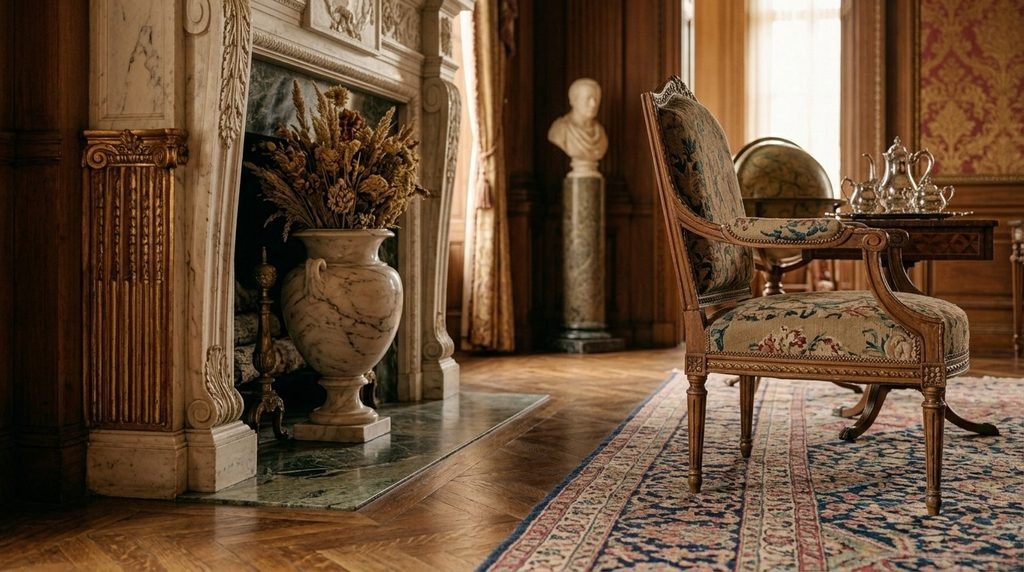
One fascinating detail is that the interiors weren’t simply designed by one person working alone.
The mansion demonstrates how Gilded Age houses often involved collaboration among:
- Architects
- Interior decorators
- Craftspeople
- Clients
- Furniture specialists
- Artisans
That collaboration helps explain why individual rooms can feel so carefully coordinated.
How Many Rooms Are in Vanderbilt Mansion?
Vanderbilt Mansion has approximately 54 rooms and six floors.
However, visitors don’t simply wander through every space independently.
The mansion is accessed through guided tours, and the standard tour presents about 18 rooms across three floors. Specific rooms or floors can occasionally be unavailable because of preservation work.
This is an important distinction for anyone planning a visit.
The building is much larger than the portion normally experienced during a tour.
Vanderbilt Mansion and Its Gardens
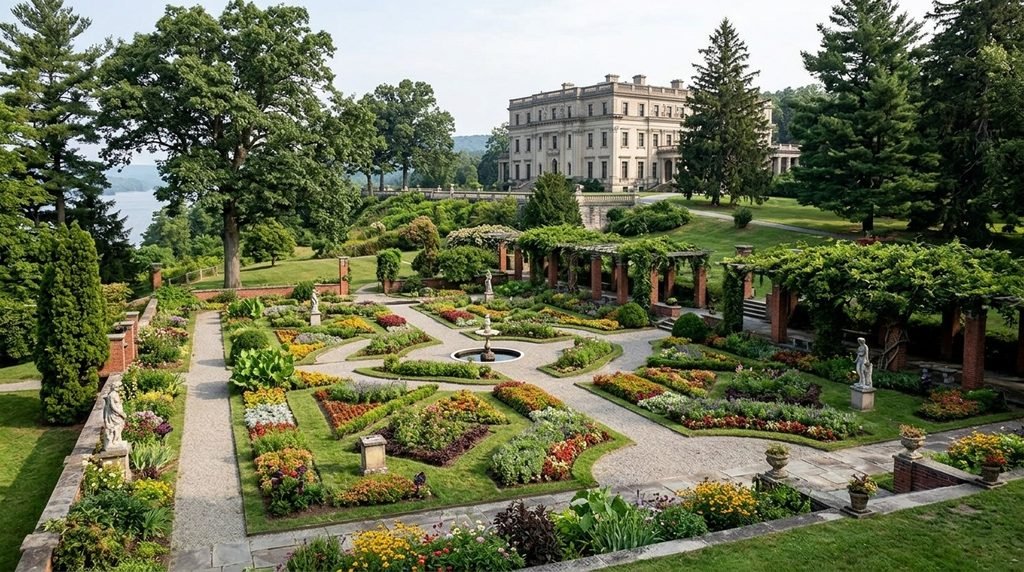
For a website focused on home improvement and gardening, the landscape story is particularly interesting.
The gardens weren’t merely decoration added around the mansion. They were an important part of the estate’s overall design.
The property’s landscape developed long before the Vanderbilt period.
Earlier owners, especially Samuel Bard and David Hosack, contributed to the development of the estate’s gardens and landscape. Hosack, for example, developed gardens and a conservatory that attracted attention during his ownership.
Later, the Langdon family developed formal garden terraces, geometric planting patterns, walks, greenhouses, and enclosing walls.
When the Vanderbilts purchased the property, they built upon this existing landscape framework.
What Can Homeowners Learn From the Vanderbilt Gardens?

There’s an unexpectedly practical lesson here.
A successful landscape doesn’t always begin with planting dozens of new things.
Instead, consider:
- The architecture of the house
- Existing mature trees
- Views from important windows
- Paths and circulation
- Sun and shade
- Garden structure
- Seasonal interest
- The relationship between outdoor rooms
The Vanderbilt estate demonstrates how a landscape can support architecture rather than compete with it.
That principle works just as well on a much smaller residential property.
You don’t need hundreds of acres to borrow the idea.
The Formal Gardens

The Vanderbilt-era gardens reflected the design preferences of the late Gilded Age.
The National Park Service notes that the formal gardens incorporated multiple terraces and that mature specimen trees planted by earlier owners remained important to the property’s visual character.
The gardens included formal geometric arrangements and structured spaces.
This creates an interesting contrast:
The architecture is formal, while the broader landscape provides a softer transition into the surrounding Hudson Valley.
That balance is one reason historic estate gardens can be such useful sources of inspiration for modern landscape design.
What Happened to Vanderbilt Mansion After the Vanderbilts?
Frederick and Louise Vanderbilt used Hyde Park primarily as a seasonal residence.
Louise died in 1926.
Frederick continued living at Hyde Park until his death in 1938. Because the couple had no children, Frederick’s estate eventually passed to Louise’s niece, Margaret Van Alen.
Van Alen ultimately conveyed the mansion, its furnishings, and approximately 200 acres to the United States government.
The property opened to the public in 1940 under the National Park Service.
This transition is significant.
Instead of disappearing into private ownership or being redeveloped, the estate became a publicly preserved historic site.
Why Is Vanderbilt Mansion Historically Important?
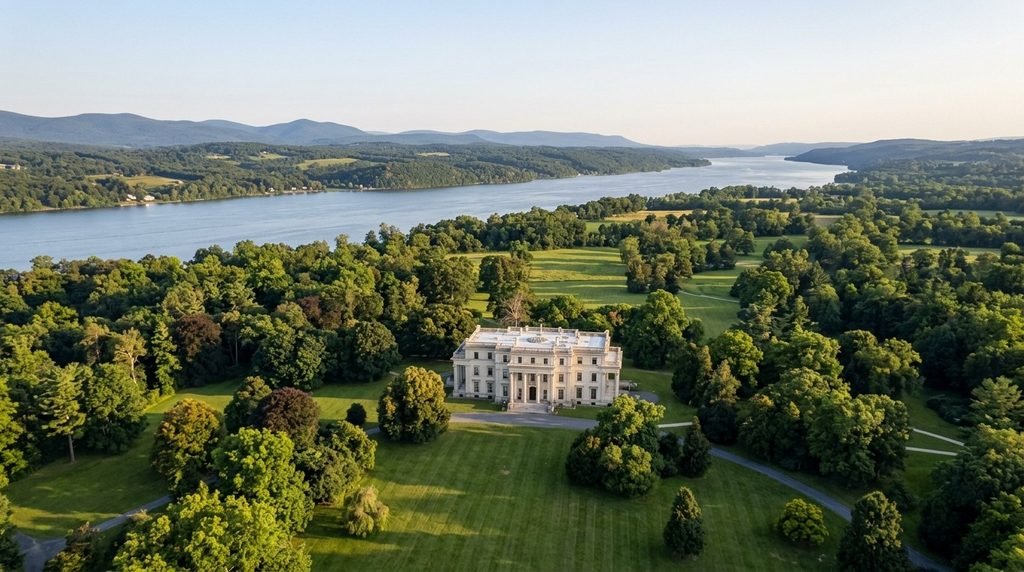
Vanderbilt Mansion is important because it preserves an unusually complete example of a Gilded Age country estate, including architecture, interiors, landscape, and the cultural story surrounding wealthy American country-house life.
The National Park Service describes the site as a window into the domestic ideals of America’s elite during the late 19th century and the social world of the Gilded Age.
Its significance comes from several layers:
Architectural Importance
The mansion demonstrates the sophisticated use of Beaux-Arts and Neoclassical ideas in American country-house architecture.
Historical Importance
It represents the lifestyle and social world of an extremely wealthy American family during the Gilded Age.
Landscape Importance
The gardens and broader estate show how architecture, landscape, agriculture, and leisure were integrated.
Preservation Importance
The National Park Service preserves the property and its historic furnishings for public interpretation.
Is Vanderbilt Mansion Worth Visiting?
Yes, especially if you’re interested in American history, architecture, historic interiors, gardens, or the Hudson Valley.
The strongest reason to visit isn’t simply the size of the house.
It’s the combination of:
- Architecture
- Interior decoration
- Historic furnishings
- Formal gardens
- Hudson River views
- Landscape history
- Gilded Age history
- National Park Service interpretation
For homeowners and garden enthusiasts, the property offers something different from a typical museum.
You can study how a historic home relates to its landscape.
For architecture enthusiasts, the proportions and classical details are worth examining.
For history lovers, the estate provides a tangible connection to the world of America’s industrial-era elite.
Planning a Visit to Vanderbilt Mansion
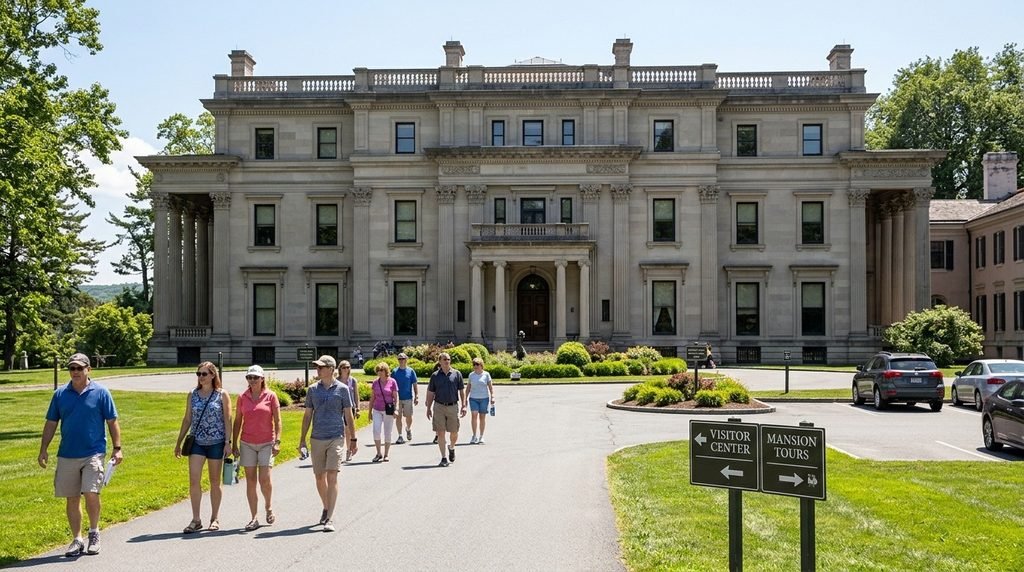
Visitor information can change, so check the official National Park Service pages before traveling.
As of the latest NPS information available in 2026, the mansion is open by guided tour only. Individual tour tickets are sold on a first-come, first-served basis at the Pavilion Visitor Center.
Current Practical Details
| Visitor Detail | Current Information |
| Location | Hyde Park, New York |
| Mansion access | Guided tour only |
| Standard individual ticket | $15 |
| Children 15 and under | Free |
| Individual reservations | Not available |
| Ticket availability | First-come, first-served |
| Visitor Center | Pavilion |
| Visitor Center hours | Generally 9 AM–5 PM |
| Payment | Credit/debit; park is cashless |
The NPS currently states that tour schedules change seasonally. During the summer and fall schedule, tours generally run from 10 AM to 4 PM, while the standard schedule generally runs from 10 AM to 3:30 PM.
Important: Tour times and operating conditions can change, so visitors should verify the official NPS schedule immediately before their trip.
Check Vanderbilt Mansion’s official NPS visitor information
A Few Things Visitors Should Know
Before heading out, keep these points in mind:
- Don’t assume the mansion is self-guided. Access is by guided tour.
- Tickets can sell out. The NPS warns that summer and October tours may sell out early.
- Arrive with some flexibility. Tour schedules can change seasonally.
- Check current accessibility information if mobility access is important for your visit.
- Allow time for the grounds. The landscape adds an important part of the Vanderbilt story.
- Check official information before traveling, particularly for hours, closures, and special conditions.
What Can Vanderbilt Mansion Teach Modern Homeowners?
This is where the story becomes surprisingly relevant to HomeWorksDaily’s audience.
You probably aren’t planning to build a 45,000-square-foot mansion.
You don’t need to.
The more useful lessons are smaller.
1. Let Architecture Guide the Landscape
A formal home can benefit from structured planting and clear garden lines.
A cottage-style house may look better with softer, less rigid planting.
The basic principle is simple:
Your landscape should feel connected to your home.
2. Protect Mature Trees
The Vanderbilt estate demonstrates the visual power of mature trees.
Large trees can:
- Frame buildings
- Create shade
- Establish scale
- Guide views
- Add seasonal character
- Make a landscape feel established
Before removing a mature tree, consider whether thoughtful pruning or landscape redesign could solve the problem instead.
3. Create Outdoor Rooms
The estate’s gardens weren’t simply one large patch of green.
Different spaces served different purposes.
Modern homeowners can use the same idea through:
- A patio
- A dining area
- A garden path
- A small sitting area
- A shaded retreat
- A structured planting bed
Even a modest backyard can feel more intentional when it has distinct zones.
4. Think About Views
One of the easiest landscaping ideas to overlook is what you’ll see from inside the house.
Look through your:
- Living room windows
- Kitchen windows
- Bedroom windows
- Entryway
- Porch
Then ask:
What should this view look like in spring, summer, fall, and winter?
That question can completely change how you approach planting.
Common Questions About Vanderbilt Mansion
Who built Vanderbilt Mansion?
Vanderbilt Mansion was designed for Frederick and Louise Vanderbilt by McKim, Mead & White. Construction took place between 1896 and 1898.
Where is Vanderbilt Mansion located?
Vanderbilt Mansion is in Hyde Park, New York, in the Hudson Valley along the Hudson River.
When was Vanderbilt Mansion built?
The mansion was built between 1896 and 1898. The National Park Service says construction took approximately 26 months.
How much did Vanderbilt Mansion cost to build?
The mansion cost approximately $660,000 to construct. The furnishings cost an additional approximately $1.5 million.
Is Vanderbilt Mansion open to the public?
Yes. The mansion is open to the public through guided tours operated by the National Park Service. Tour schedules vary seasonally.
How much does it cost to visit Vanderbilt Mansion?
The current standard entrance fee listed by the National Park Service is $15, while children age 15 and younger are free. The park is currently cashless.
Can you tour Vanderbilt Mansion without a reservation?
Individual reservations aren’t available. Tickets are issued on a first-come, first-served basis at the Pavilion Visitor Center. Group and commercial reservations follow different rules.
Are the furnishings inside Vanderbilt Mansion original?
The National Park Service states that the house and original furnishings were bequeathed to the government and that the furnishings are original.
Final Takeaway
Vanderbilt Mansion is much more than a grand historic house.
It’s a preserved snapshot of America’s Gilded Age—one where architecture, landscape design, wealth, social history, and craftsmanship all meet in the same place.
The mansion’s classical architecture tells one story. Its interiors tell another. The gardens add another layer, showing how an estate’s landscape can shape the experience of a home.
And perhaps that’s the most useful lesson for today’s homeowners.
Great design isn’t only about the building.
It’s about how the house, garden, views, paths, trees, and surrounding landscape work together.
For anyone interested in historic homes, gardening, architecture, or thoughtful home design, Vanderbilt Mansion offers plenty to study—and plenty of ideas to bring home in a much smaller, more practical form.
For more practical inspiration related to home improvement, gardening, landscaping, and home design, explore the resources available on HomeWorksDaily.