Growing watermelons can feel like giving one plant an entire section of your garden. The vines stretch, leaves spread, and before long, that little patch of soil you carefully prepared can look like a green carpet.
But here’s the interesting part: you don’t necessarily need to grow watermelon alone.
With thoughtful planning, you can combine watermelon with suitable herbs, flowers, and vegetables while making better use of your garden space. The trick isn’t simply choosing plants from a popular “companion planting” list. You need to think about sunlight, root competition, vine growth, watering, pollination, and airflow.
That’s where choosing the right watermelon companion crops becomes useful.
Quick Answer: What Are the Best Watermelon Companion Crops?
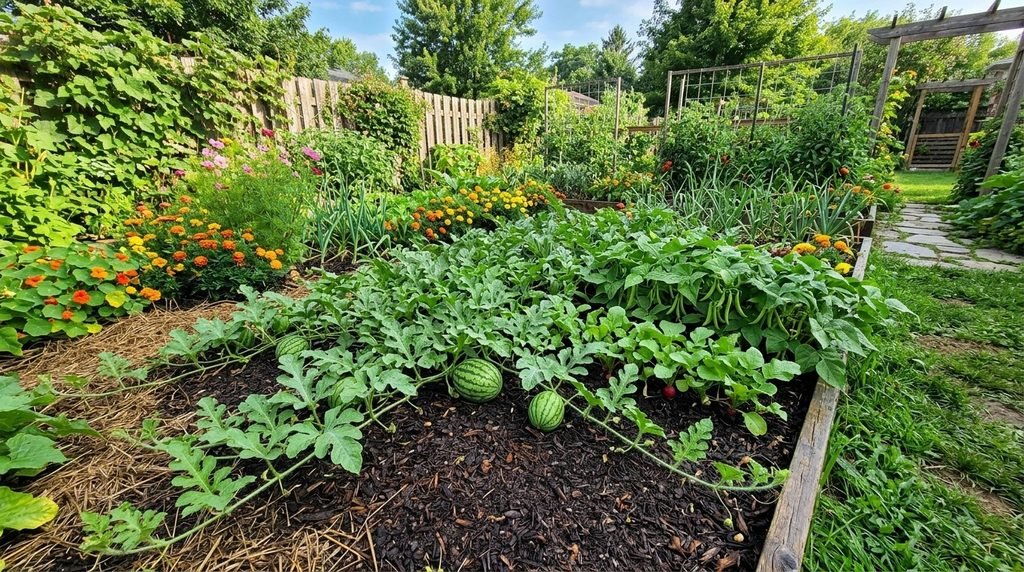
Some practical choices include bush beans, radishes, lettuce, onions, garlic, and selected flowering plants, depending on your garden layout and climate. The best companion isn’t necessarily the plant with the most impressive list of supposed benefits. It’s the plant that can share the space without competing heavily with sprawling watermelon vines.
Flowers that support pollinators can also be valuable because watermelon fruit depends on insect pollination. Watermelon flowers are receptive for only about a day, making regular pollinator activity particularly important. (Yard and Garden)
Why Companion Crops Matter in a Watermelon Garden
Watermelon isn’t a shy plant.
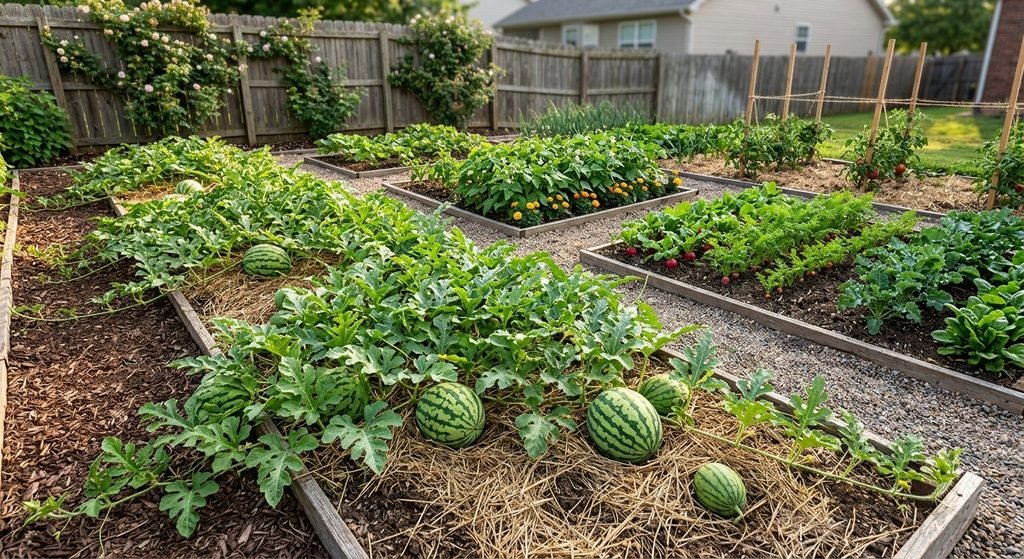
A single vine can travel several feet, with large leaves eventually covering considerable ground. That creates both an opportunity and a problem.
The opportunity is that watermelon vines can occupy otherwise unused ground. The problem is that they can also smother smaller plants, compete for resources, and make harvesting or maintenance awkward.
So companion planting should be approached as garden design, not magic.
A good companion crop should fit around the watermelon rather than fight it for the same space.
For example, a short-season crop harvested before watermelon vines become dominant can make more sense than another sprawling plant that wants the same territory.
Texas A&M AgriLife Extension notes that intercropping can improve land productivity when crops are selected and spaced carefully, while also warning that overcrowding needs to be avoided.
Best Watermelon Companion Crops
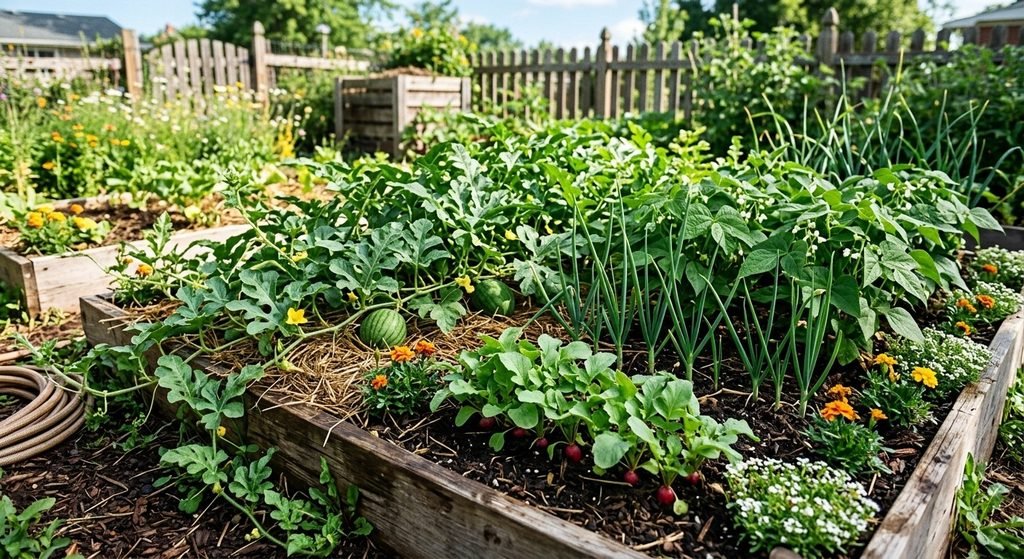
Here are several crops worth considering, with one important caveat: compatibility depends on your garden’s size, climate, variety, and planting arrangement.
1. Bush Beans
Bush beans can be useful around watermelon because they have a relatively compact growth habit compared with sprawling crops.
They’re especially interesting for gardeners trying to get more production from limited ground.
However, don’t pack beans directly into the watermelon root zone. Leave enough room for both crops to develop without creating a tangled mass of foliage.
Best use: Place compact bush beans where they receive adequate sunlight without becoming buried beneath watermelon leaves.
2. Radishes
Radishes are one of the more convenient crops to consider because they mature quickly.
That creates an opportunity.
You can grow a short-season radish crop while young watermelon plants are still small. By the time watermelon vines begin occupying more space, the radishes may already be harvested.
This is a good example of timing being just as important as plant compatibility.
Instead of asking only:
“Can these two plants grow together?”
ask:
“Can these two plants share this space at the same time?”
That’s a much better gardening question.
3. Lettuce
Lettuce can work in carefully planned arrangements, particularly early in the season when watermelon plants haven’t developed their full canopy.
But there’s a catch.
Lettuce prefers cooler conditions, while watermelon thrives during warm growing conditions. As the season progresses, watermelon leaves can also shade nearby lettuce.
So lettuce is better treated as a short-term space-sharing crop rather than something that needs to remain beside watermelon for the entire season.
4. Onions
Onions have a compact, upright growth habit that can make them easier to position than another sprawling vegetable.
Their narrow leaves don’t occupy the same horizontal space as watermelon vines.
Still, don’t assume that planting onions beside watermelon automatically protects the vines from every insect pest. Companion planting claims are often repeated more confidently than the available evidence supports.
Think of onions primarily as a space-compatible crop, rather than a guaranteed pest-control solution.
5. Garlic
Garlic is another compact crop that can potentially fit into a diversified vegetable garden.
Its upright foliage occupies relatively little ground compared with watermelon.
If you’re planning a mixed garden, garlic can be placed where it won’t be overwhelmed by watermelon leaves.
The important consideration is still spacing. A plant being considered a “companion” doesn’t mean it should be planted directly against the watermelon.
6. Flowers for Pollinators
This category deserves special attention.
Watermelon production depends on pollinating insects transferring pollen from male flowers to female flowers. Each female flower is receptive for only a short period, and insufficient pollination can result in poor fruit development.
So a diverse garden that supports pollinator activity can be valuable.
Consider suitable flowering plants based on your local growing conditions, available space, and bloom timing.
However, there’s an important nuance: more flowers don’t automatically mean more watermelon.
Other flowering plants can sometimes compete with watermelon for pollinator attention. The goal is a well-designed garden that supports beneficial insect activity rather than simply filling every available space with flowers.
Watermelon Companion Crops at a Glance
| Companion crop | Main advantage | Space concern | Best approach |
| Bush beans | Compact vegetable | Moderate | Keep outside main vine path |
| Radishes | Fast-growing | Low | Harvest before vines spread |
| Lettuce | Uses early-season space | Moderate | Grow while watermelon is young |
| Onions | Upright, compact habit | Low | Give adequate root space |
| Garlic | Narrow foliage | Low | Position away from dense vines |
| Suitable flowers | Can support pollinators | Variable | Choose location carefully |
The key takeaway is simple: growth habit matters as much as the crop itself.
Companion Crops That Support Pollinators
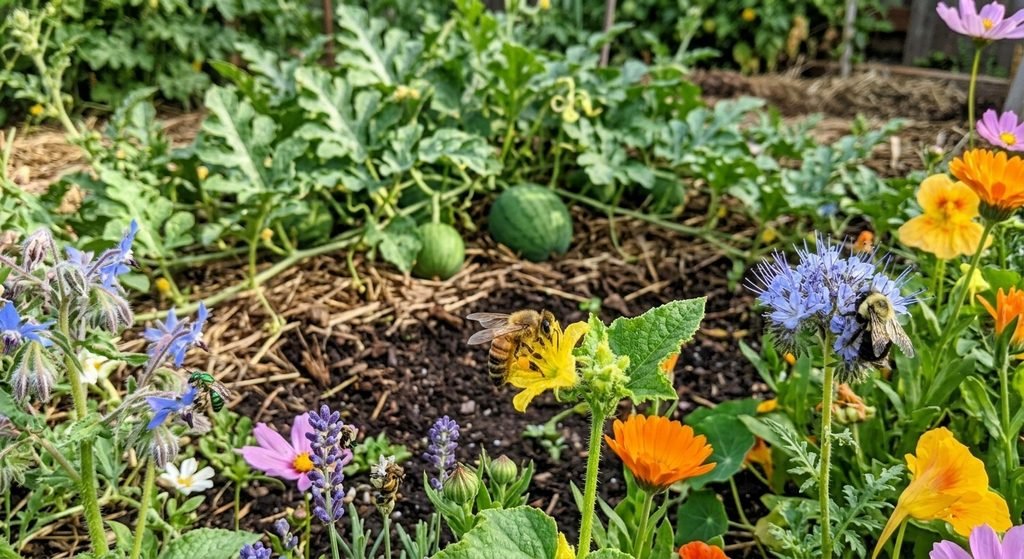
Watermelon isn’t pollinated by the wind.
Bees and other insects transfer pollen between flowers, allowing fruit to develop. Extension guidance emphasizes the importance of pollinator activity during flowering.
That makes pollinator-friendly garden planning especially relevant.
Why Pollination Matters
Watermelon plants produce separate male and female flowers on the same plant.
The female flower has a small swelling beneath it that eventually becomes the watermelon.
For fruit to develop, pollen has to reach that flower.
Research-based extension guidance reports that female watermelon flowers may need multiple bee visits for effective pollination, and poor pollination can produce misshapen or aborted fruit.
So if your watermelon vines look healthy but fruit keeps failing to develop properly, don’t immediately blame your companion crops.
Pollination may be part of the puzzle.
What Should You Avoid Planting Near Watermelon
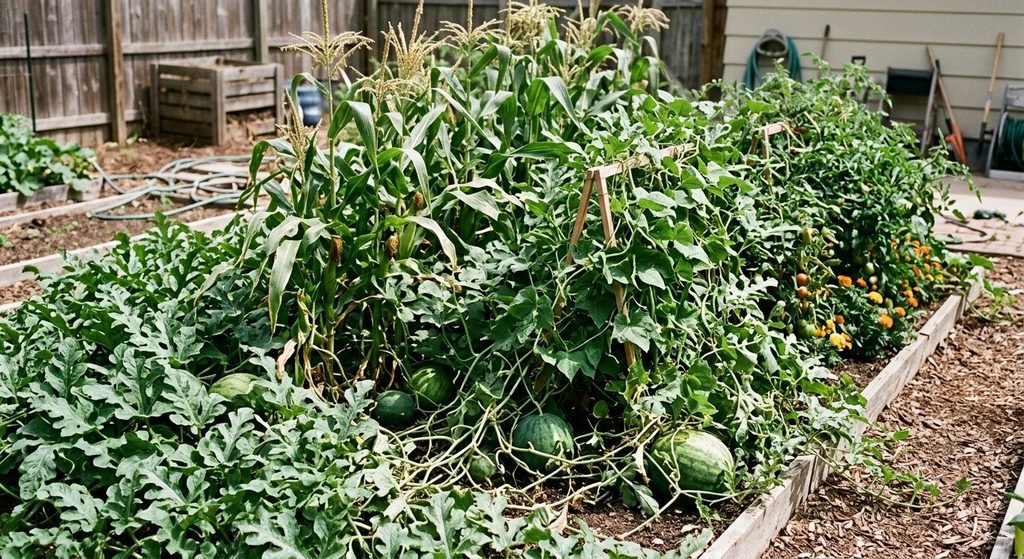
There’s a difference between a crop being scientifically proven to be “bad” for watermelon and a crop simply being awkward to grow beside it.
Many online companion-planting lists present hard rules where the real issue may simply be competition.
Be cautious with:
- Other sprawling crops
- Plants that grow much taller and cast shade
- Crops with similar pest problems
- Plants requiring substantially different watering
- Aggressive plants that overwhelm young watermelon
- Dense plantings that reduce airflow
- Crops that make harvesting difficult
The main issue is often competition rather than plant incompatibility.
For example, extension advice addressing mixed watermelon, tomato, and pepper plantings has noted that research doesn’t establish a general watermelon “toxicity” problem; instead, the large watermelon vines can create shading and space issues.
That’s a useful distinction.
Should You Plant Other Cucurbits With Watermelon?
This requires some thought.
Watermelon belongs to the cucurbit family, alongside crops such as cucumbers, squash, and melons.
Growing several cucurbits together doesn’t automatically mean one plant will harm another. But they can share pests and diseases, and several of them have vigorous growth habits.
That means a mixed cucurbit patch can become crowded surprisingly quickly.
If you have limited garden space, it may be more practical to give watermelon its own clearly defined area and place compact crops along its edges.
How to Design a Watermelon Companion Garden
Before buying seeds, grab a sheet of paper and sketch the garden.
It sounds unnecessary.
It isn’t.
Watermelon becomes much easier to manage when you know where the vines are supposed to go.
Step 1: Give Watermelon the Best Sun
Watermelon needs a sunny growing location.
Don’t position tall crops where they’ll eventually block sunlight from the watermelon.
Remember that a tiny bean plant today may look very different several weeks later.
Step 2: Plan the Vine Direction
Instead of letting vines wander randomly through the garden, decide where you want them to travel.
A garden edge can be particularly useful.
You can place watermelon near the edge of a bed and allow the vines to spread into an adjacent open area.
This leaves more room inside the bed for compact crops.
Step 3: Put Compact Crops Near the Edges
Think vertically and horizontally.
Watermelon occupies a lot of horizontal space. Compact crops can use small areas that would otherwise remain empty.
Good candidates are generally plants that:
- Stay relatively compact
- Don’t require the same sprawling space
- Mature quickly
- Don’t shade watermelon
- Have compatible water needs
Step 4: Leave Room for Maintenance
This is where many companion gardens go wrong.
A garden can look fantastic on planting day.
Three weeks later, you may not be able to reach anything.
Leave pathways or access points for:
- Watering
- Weeding
- Pest inspection
- Harvesting
- Removing damaged leaves
- Checking developing fruit
A productive garden should also be a manageable garden.
Small Garden Watermelon Layout
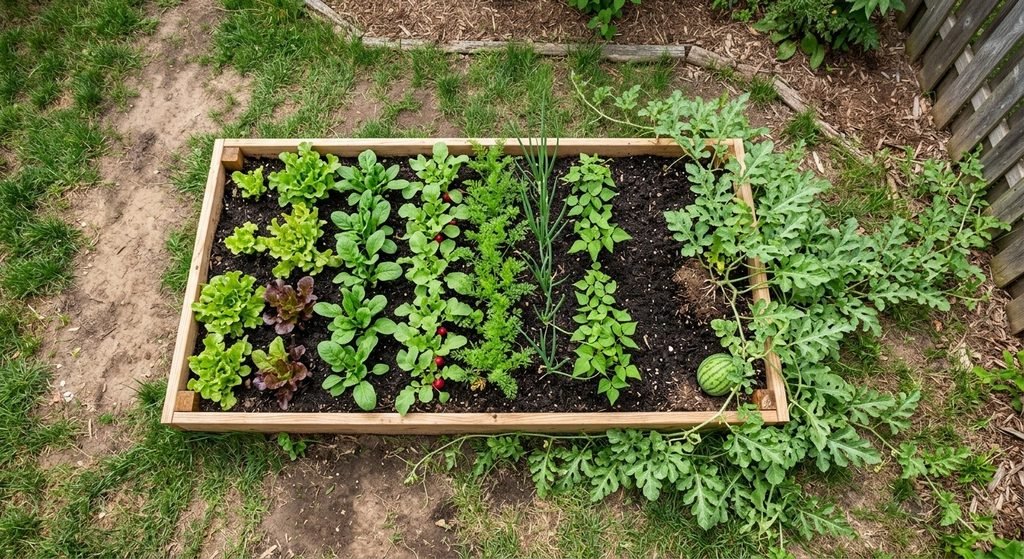
If you’re working with limited space, consider a simple arrangement:
Back/edge: Watermelon planting area
Open direction: Allow vines to trail outward
Near the base: Compact crops with modest space requirements
Outer edge: Short-season crops or suitable flowers
Don’t surround the watermelon completely.
Give the vines somewhere to go.
Raised Bed Watermelon Layout
Raised beds require even more planning.
Watermelon vines can quickly cover the surface of a raised bed, so placing the plant near an outer edge can be useful.
For example:
[ Compact crops ] [ Compact crops ]
[ Compact crops ] [ Watermelon ] → vines trail outward
This arrangement allows the watermelon to use space outside the bed while the vegetables inside continue receiving sunlight.
Just make sure the vines don’t block pathways.
Can You Grow Watermelon With Tomatoes?
Yes, they can grow in the same general garden, but that doesn’t necessarily make them ideal bed-mates.
Both need good sunlight, and mature watermelon vines can spread aggressively.
Tomatoes also need adequate airflow and sunlight.
The biggest issue is usually space and shading, rather than some mysterious chemical incompatibility between the plants. Extension guidance similarly emphasizes sunlight and physical competition when discussing mixed watermelon plantings.
If you want both, give them clearly separated growing zones.
Can You Grow Watermelon With Peppers?
The same principle applies to peppers.
They can coexist in a garden, but watermelon vines shouldn’t be allowed to smother pepper plants.
Keep pepper plants in an area where they can maintain adequate sunlight and airflow.
If watermelon vines start climbing over them, redirect the vines early rather than waiting until the garden becomes tangled.
Watering Watermelon and Companion Crops
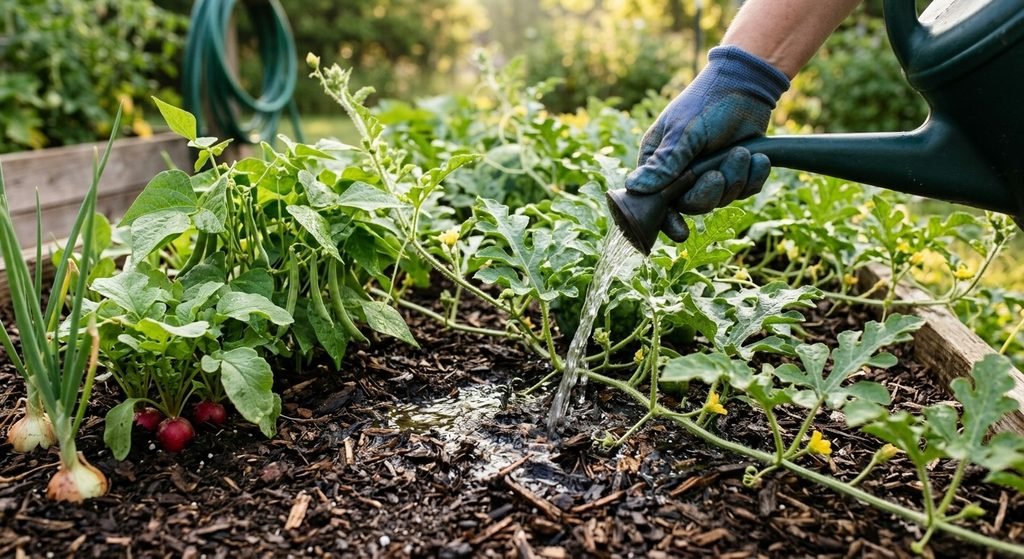
Watering is another overlooked part of companion planting.
Watermelon needs consistent moisture during establishment and fruit development, particularly during dry conditions.
But different crops don’t always have identical watering preferences.
Instead of soaking the entire garden indiscriminately, think about where the roots actually are.
Drip irrigation or carefully directed watering can make mixed plantings easier to manage. Extension resources also identify drip irrigation as an effective approach for watermelon production. (Penn State Extension)
Mulching can also help conserve soil moisture and reduce weed pressure.
Don’t Forget About Airflow
Dense vegetation can create a humid environment around leaves.
That’s not ideal when you’re trying to manage fungal and other disease problems.
A companion garden shouldn’t become a jungle simply because more plants sound better.
Give each crop enough room to breathe.
This is especially important as watermelon leaves become large and vines spread across the soil.
Common Watermelon Companion Planting Mistakes
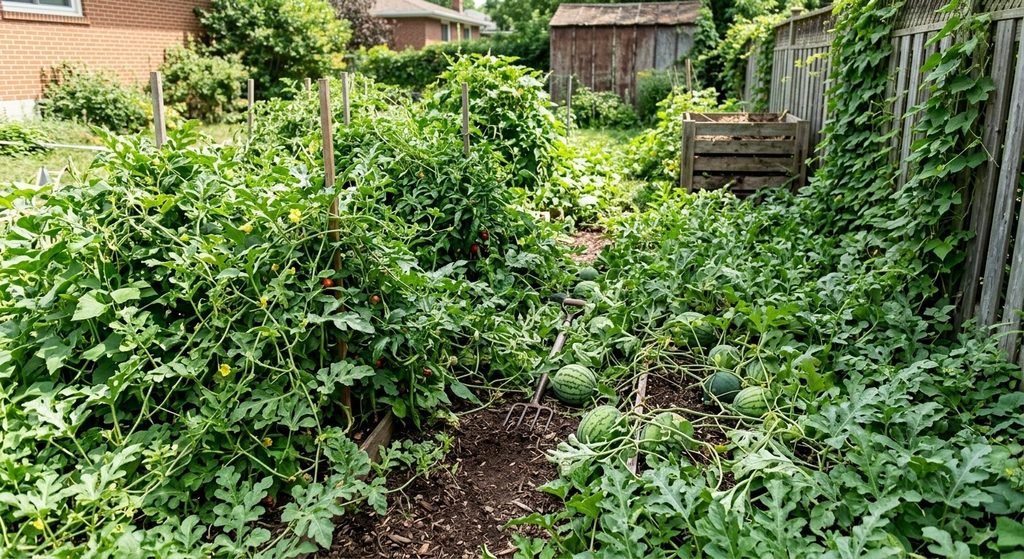
1. Planting Too Many Companions
More plants don’t automatically create a better garden.
Sometimes the best companion crop is the one you don’t plant because your watermelon needs the space.
2. Ignoring Vine Spread
The seedling looks tiny.
The mature vine doesn’t.
Plan for the mature plant, not the plant you see on planting day.
3. Choosing Tall Crops
Tall crops can shade watermelon.
Always consider mature height.
4. Crowding the Root Zone
Don’t treat every inch of soil as planting space.
Roots need room, too.
5. Believing Every Companion-Planting Claim
A long list online doesn’t automatically mean every claim has strong scientific support.
Treat claims about pest repellence, disease prevention, or dramatic yield increases cautiously unless they’re supported by reliable evidence.
6. Forgetting Pollination
Beautiful vines aren’t enough.
Without effective pollination, fruit set can suffer.
A Simple Watermelon Companion Crop Decision Guide
If your garden is small
Prioritize compact or short-season crops.
If your main goal is saving space
Use crops that can be harvested before watermelon vines reach full size.
If pollination is your priority
Maintain a garden environment that supports pollinating insects while avoiding unnecessary pesticide exposure during flowering.
If you grow watermelon in a raised bed
Plant watermelon near an edge and direct the vines outside the bed.
If you’re worried about pests
Use integrated pest management rather than expecting companion crops to solve the problem by themselves.
If you want the simplest approach
Start with one or two compatible crops instead of planting ten different companions.
Watermelon Companion Crops: The Bigger Picture
The best companion planting strategy isn’t about memorizing a perfect list.
It’s about understanding what each plant needs.
Watermelon wants:
- Plenty of sun
- Warm conditions
- Adequate moisture
- Space for vines
- Pollinating insects
- Healthy soil
- Reasonable airflow
Your companion crops need their own conditions, too.
The successful combination is the one where those needs overlap without creating too much competition.
Frequently Asked Questions
What are the best watermelon companion crops?
Compact crops such as bush beans, radishes, onions, garlic, and selected flowers can work well when properly positioned. The best choice depends on available space, growth habit, climate, and timing.
What should not be planted near watermelon?
Avoid combinations that create excessive crowding, shade, poor airflow, or strong competition for water and nutrients. Other sprawling crops can be particularly difficult in a small garden.
Can tomatoes grow near watermelon?
Yes. They can grow in the same garden, but leave enough space for both crops to receive adequate sunlight and maintain airflow. The main concern is usually physical competition rather than a proven harmful interaction.
Can peppers grow with watermelon?
They can, provided watermelon vines don’t overwhelm the pepper plants. Keep enough separation for sunlight and airflow.
Do companion plants make watermelon grow faster?
Not necessarily. Companion planting shouldn’t be treated as a guaranteed growth booster. Good soil, sunlight, moisture, nutrition, spacing, and pollination remain fundamental.
Do flowers help watermelon?
Flowers can support a diverse pollinator-friendly garden, but they don’t guarantee better watermelon production. Watermelon fruit set depends on effective insect pollination.
How much space does watermelon need?
Watermelon needs considerably more room than many compact vegetables because its vines spread extensively. Exact spacing varies by variety and production system, so follow the recommendations for your specific cultivar. Commercial recommendations can range widely depending on irrigation, variety, and system. (UGA Cooperative Extension)
Can watermelon grow in a raised bed?
Yes, but the vines can quickly occupy the entire bed. Planting watermelon near an edge and allowing vines to trail outside can make better use of the growing space.
Does companion planting prevent watermelon pests?
No companion crop should be treated as guaranteed pest protection. Monitor the plants regularly and use appropriate integrated pest-management practices when problems appear.
Can I plant watermelon next to other melons?
You can grow different melon crops in the same general garden, but consider their shared space requirements, pests, and diseases. Multiple sprawling crops can quickly become difficult to manage.
Final Takeaway
The smartest way to choose watermelon companion crops is to stop thinking of companion planting as a magic formula and start thinking like a garden designer.
Choose compact crops where possible. Use timing to your advantage. Keep tall plants from blocking sunlight. Give watermelon vines somewhere to travel. Don’t crowd the root zone. And pay close attention to pollination, because a healthy-looking watermelon plant still needs insects to transfer pollen before it can produce a good crop.
If you’re new to companion planting, don’t try to create a miniature jungle in one season.
Start simple.
One watermelon planting + one or two carefully selected companion crops can be far easier to manage than a crowded garden full of supposedly “beneficial” plants.
That’s usually the better trade-off: fewer plants competing for the same space, and more attention going toward growing healthy vines and well-pollinated fruit.