
You turn on the shower and something feels different. The water doesn’t feel quite as smooth. Maybe the dishes have started showing spots again, or the salt in the tank seems to be sitting there without going anywhere.
Then comes the obvious question: Does the water softener need repair, or is it time to replace it?
The good news is that a water softener that isn’t working properly isn’t automatically headed for the trash. Problems can range from a simple power or bypass issue to a clogged brine line, incorrect settings, or a component that actually needs service.
This guide walks through the most common problems, what you can safely check yourself, when professional help makes sense, and how to think about water softener repair versus replacement.
Can a Water Softener Be Repaired?
Yes. Many water softener problems can be repaired, but the right solution depends on the symptom, failed component, system condition, and cost of the repair.
Before replacing the entire unit, check the basics: power, bypass settings, salt level, regeneration settings, and obvious blockages. Manufacturer troubleshooting information identifies these as common areas to investigate when a softener stops regenerating or produces hard water.
If the problem involves internal valves, electrical components, persistent leaks, or repeated failures, professional service may be the safer choice.
What Is Water Softener Repair?
Water softener repair means diagnosing and correcting a problem that prevents the softener from properly treating your home’s water.
A typical softener uses resin beads inside a mineral tank to capture calcium and magnesium, the minerals associated with hard water. During regeneration, a brine solution helps restore the resin so it can continue softening water.
That means a problem can happen in several places:
- The electrical supply
- Control head or controller
- Bypass valve
- Brine tank
- Brine line
- Injector or venturi
- Drain line
- Resin bed
- Plumbing connections
- Regeneration settings
So when someone says, “My water softener isn’t working,” that’s really the beginning of the diagnosis—not the diagnosis itself.
Signs Your Water Softener May Need Repair
Your home can give you clues before the softener completely stops working.
Watch for these signs:
- Hard-water spots are returning on glassware or fixtures.
- Water no longer feels as soft during washing.
- The softener isn’t regenerating when it should.
- Salt isn’t being consumed over time.
- The brine tank has unusual water levels.
- Water is leaking around the system.
- Water pressure drops when the softener is in service.
- The control display is blank or the unit appears to have lost power.
- The system seems to regenerate continuously.
- The same problem keeps returning after a temporary fix.
Not every symptom points to a failed softener. For example, Pentair’s troubleshooting guidance lists power, bypass position, salt supply, regeneration settings, injector problems, and brine-line issues among possible causes of poor performance.
That’s why replacing the whole system based on one symptom can be premature.
Common Water Softener Problems and Causes
Different symptoms can point toward very different problems.
| Problem | Possible Cause | What to Check | Possible Solution |
| Water is still hard | No regeneration, bypass open, low salt, incorrect settings | Power, bypass, salt, settings | Correct settings or investigate regeneration |
| Salt level isn’t dropping | Salt bridge or regeneration problem | Salt tank and regeneration | Break bridge if appropriate; troubleshoot cycle |
| Unit won’t regenerate | Power interruption or controller issue | Outlet, display, settings | Restore power or seek service |
| Too much water in brine tank | Brine draw or refill problem | Brine line, valve, drain | Further diagnosis may be needed |
| Low water pressure | Restriction or softener-related blockage | Pressure with system in bypass | Identify whether restriction is inside softener |
| Resin appears in drains | Internal/distributor problem | Plumbing direction and system condition | Professional repair may be necessary |
| Soft water works inconsistently | Settings, capacity, hardness changes, regeneration issue | Programming and water hardness | Correct settings or investigate system |
| Water leaking | Connection, valve, tank, or plumbing issue | Visible connections | Repair source of leak |
Manufacturer manuals show that issues such as restricted drain lines, restricted brine lines, plugged injectors, inadequate brine draw, and valve problems can all affect operation.
How to Troubleshoot a Water Softener
You don’t need to take the system apart to start troubleshooting.
In fact, the smartest first step is usually to check the simple things that can stop a softener from doing its job.
Check the Power Supply
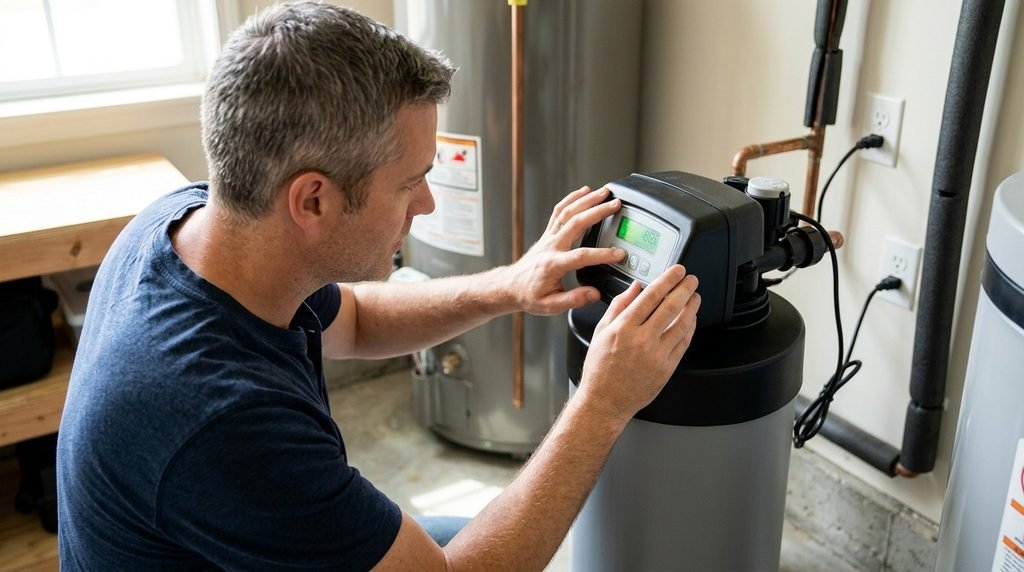
If your system has an electronic controller, start with the basics.
Check whether:
- The unit is plugged in.
- The outlet has power.
- The display is working.
- A breaker has tripped.
- A recent power outage may have affected the clock or settings.
A power interruption can prevent a system from regenerating correctly. Pentair specifically recommends checking the electrical supply when a softener fails to regenerate.
Don’t open electrical components unless you’re qualified to work on them.
Check the Bypass Valve
This is an easy one to overlook.
A softener can appear to be operating normally while water is actually bypassing the treatment system.
If your unit has a bypass valve, check its position according to the manufacturer’s instructions.
Pentair lists an open bypass valve as one possible cause of hard water.
Check the Salt or Brine Tank
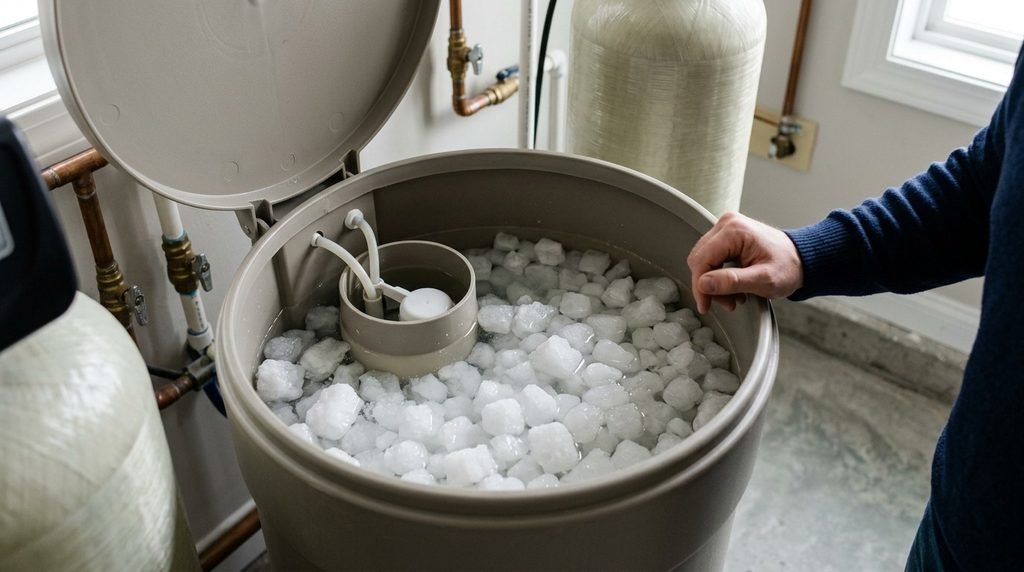
Look inside the brine tank.
Is there salt?
More importantly, is the salt actually being consumed over time?
A tank full of salt doesn’t necessarily mean everything is fine. If the salt level never changes and the water remains hard, the problem may involve regeneration or brine handling.
Don’t simply keep adding salt without figuring out why the system isn’t using it.
Look for a Salt Bridge
A salt bridge is a hardened layer of salt that can form inside the brine tank.
It can create a misleading situation: the tank appears to contain plenty of salt, but the system may not be getting the brine it needs for regeneration.
Whirlpool’s troubleshooting documentation specifically warns that water may become separated from the salt by a salt bridge, while Pentair also identifies salt bridges as a maintenance issue.
If your manufacturer’s instructions explain how to safely address a salt bridge, follow those instructions rather than aggressively hacking at the tank.
Check the Regeneration Settings
Incorrect programming can cause inconsistent softening.
Depending on the system, settings may account for factors such as:
- Water hardness
- Household water use
- System capacity
- Regeneration schedule
- Salt dosage
Pentair notes that capacity, hardness, meter settings, and salt dosage can affect how much salt a softener uses.
If your water source or household usage has changed, the old settings may no longer be appropriate.
Check for Obvious Leaks or Flow Problems
Look around the unit.
You can safely observe:
- Standing water
- Wet connections
- Kinked tubing
- Obvious drain-line problems
- Unusual sounds
- Visible damage
Don’t disassemble pressurized plumbing or internal valve components unless you know exactly what you’re doing.
A small visible clue can be useful information for a technician.
When Should You Call a Professional?
Some water softener problems are reasonable to investigate yourself. Others are better left to someone who understands the system.
Consider professional help if you find:
- A persistent water leak
- A damaged tank or valve
- Electrical problems
- Repeated regeneration failures
- Internal valve problems
- Persistent pressure problems
- Resin appearing in household plumbing
- A problem that returns after basic troubleshooting
- A complicated plumbing connection
- A system that requires component replacement
For example, Pentair’s troubleshooting information identifies problems involving distributors, injectors, valves, brine lines, and internal components that may require service or replacement.
There’s no prize for turning a small repair into a larger plumbing problem.
How Much Does Water Softener Repair Cost?
There isn’t one universal water softener repair price.
The final cost can vary considerably depending on what failed and where the system is located.
Important factors include:
- The failed component
- Softener type
- Brand and model
- System age
- Availability of replacement parts
- Labor rates in your area
- Accessibility of the equipment
- Plumbing modifications
- Whether additional problems are discovered
A simple adjustment can be very different from replacing a control valve or dealing with a plumbing problem.
That’s why it’s better to ask for a diagnosis and itemized estimate rather than assuming every repair should cost roughly the same.
If you’re comparing quotes, ask exactly what component is being repaired or replaced and what the quoted labor includes.
Water Softener Repair vs. Replacement
Sometimes repair is the sensible option.
Sometimes the better decision is to stop putting money into an aging system.
| Factor | Repair May Make Sense | Replacement May Make Sense |
| System age | Relatively newer unit | Older system with declining reliability |
| Repair cost | Reasonable compared with replacement | Large repair relative to system value |
| Problems | One isolated issue | Multiple recurring failures |
| Parts | Parts are available | Parts are difficult to source |
| Condition | Tank and major components look sound | Major components are deteriorating |
| Performance | System works well after repair | Performance remains poor |
| Long-term value | Repair restores reliable operation | New system offers a better long-term solution |
The key is to look beyond the immediate repair bill.
If a relatively small component has failed on an otherwise healthy system, replacement may be unnecessary.
On the other hand, if an older unit has experienced several failures and another major component has now failed, replacement deserves serious consideration.
How to Prevent Future Water Softener Problems
A little attention can prevent some avoidable problems.
Useful maintenance habits include:
- Keep the salt supply at the level recommended for your system.
- Periodically inspect the brine tank.
- Watch whether salt is actually being consumed.
- Check for visible leaks.
- Keep an eye on regeneration behavior.
- Follow your manufacturer’s cleaning recommendations.
- Pay attention to changes in water hardness.
- Don’t ignore recurring symptoms.
- Keep the manufacturer’s manual available.
- Have the system inspected or serviced when recommended.
Pentair recommends periodic inspection and discusses cleaning the resin bed, venturi valve, and other maintenance considerations.
Maintenance also gives you an advantage: you’ll notice when something changes instead of discovering the problem after weeks of hard water.
Questions to Ask a Water Softener Repair Professional
Before approving a repair, ask a few straightforward questions.
- What caused the problem?
- Which component failed?
- Can the existing component be repaired, or does it need replacement?
- What exactly is included in the quoted price?
- Are replacement parts readily available?
- Is the repair covered by a warranty?
- How old is the system, and does its condition justify the repair?
- Would replacement be more economical in the long run?
- Are there any other problems you found?
A good explanation should make the decision easier, not more confusing.
Frequently Asked Questions
Can a water softener be repaired?
Yes. Many problems can be repaired, including certain power, settings, brine, regeneration, valve, and flow-related issues. The appropriate solution depends on the specific system and failed component.
How do I know if my water softener is broken?
Common clues include hard water returning, failed regeneration, unusual salt consumption, low pressure associated with the system, leaks, or a controller that isn’t operating normally. However, these symptoms can have different causes, so diagnosis matters.
Is water softener repair expensive?
It depends on the problem. Labor, parts, system type, accessibility, age, and local service rates can all affect the price. A minor adjustment and a major valve or plumbing repair should not be expected to cost the same.
How long does a water softener usually last?
There isn’t a single lifespan that applies to every system. Installation quality, water chemistry, maintenance, usage, component quality, and the condition of the resin and control system all matter.
Instead of relying only on age, consider the system’s current performance, repair history, and expected repair cost.
Can I troubleshoot a water softener myself?
Yes, some basic checks are reasonable. You can typically inspect power, bypass settings, salt levels, obvious leaks, and other visible conditions while following the manufacturer’s instructions.
Electrical repairs, pressurized plumbing work, internal valve repairs, and complicated component replacement are better handled by qualified professionals.
Should I repair or replace an old water softener?
Look at the whole picture.
If the system is otherwise reliable and needs one reasonably priced repair, repairing it may make sense. If it has repeated failures, major component problems, poor performance, or expensive repairs, replacement may provide better long-term value.
Final Takeaway
A water softener problem doesn’t automatically mean you need a new system.
Start with the basics: check the power, bypass setting, salt supply, regeneration behavior, and visible signs of blockage or leakage. Then look at the bigger picture.
The smartest approach is:
Understand the symptom → identify the likely cause → check what is safe to check → compare repair and replacement → get professional help when necessary.
Good home maintenance isn’t always about replacing things quickly. Sometimes it’s about knowing which small problem deserves a repair—and which recurring problem is telling you it’s time for something different.
For more practical ideas covering home improvement, DIY projects, cleaning, gardening, and everyday home care, explore HomeWorksDaily. The site’s home-improvement section is positioned around practical homeowner content.










2 Responses