
The craftsman 28-oz dead blow hammer is CRAFTSMAN model CMHT54166, a soft-face, steel-shot-filled striking tool designed to deliver controlled impact while reducing the bounce you get from many solid-head hammers. It makes the most sense for garage, workshop, assembly, and DIY jobs where rebound or surface marking is a concern. Its main limitation is equally important: it’s a task-specific hammer, not a replacement for a claw hammer or every rubber mallet.
Picture a stubborn metal component that needs to move a fraction of an inch. A steel hammer might mark it, while a springy rubber mallet can send part of the strike back toward you. Or maybe you’re fitting an assembly together and want a firm hit without leaving a steel hammer imprint.
That’s where a dead blow starts to make sense. The goal isn’t simply “hit it harder.” It’s to make the strike more controlled.
HomeWorks Daily has not conducted hands-on or laboratory testing of this hammer. Product-specific facts in this guide are based on manufacturer and retailer documentation reviewed on September 17, 2026, with discrepancies called out rather than smoothed over.
craftsman 28-oz dead blow hammer at a Glance
CRAFTSMAN identifies the tool as model CMHT54166. The manufacturer specifies a steel-shot-filled molded head, soft striking face, steel-reinforced handle, and dead-blow action intended to reduce bounce back. Lowe’s additionally identifies the head material as polyurethane in its current listing. CRAFTSMAN’s official CMHT54166 product page
| Feature | Verified detail | Why it matters |
| Model | CMHT54166 | Helps you distinguish the 28-oz version from other CRAFTSMAN hammers |
| Tool type | Dead blow hammer | Intended for low-rebound, controlled striking |
| Advertised/head weight | 28 oz | Provides substantially more striking mass than many ordinary household hammers |
| Internal construction | Steel-shot-filled molded head | Loose shot helps suppress rebound during impact |
| Striking face | Soft face; Lowe’s identifies polyurethane | Reduces the risk of marring compared with an exposed steel face |
| Handle | Steel reinforced | Adds support through the handle and protection during an accidental over-strike |
| Flat-top feature | Listed by Lowe’s as self-standing | Lets the hammer rest upright on its head |
| Model-page warranty | Limited Lifetime Warranty | Worth verifying against current warranty terms before purchase |
| Current US price snapshot | Roughly $26.98–$29.99 across retailers checked | Useful as a comparison point, not a guaranteed price |
There is an important specification wrinkle.
CRAFTSMAN’s model page lists the product at 1.5 lb, while retailer documentation identifies 28 oz as the head weight. A complete hammer obviously cannot weigh 24 oz if its head alone weighs 28 oz. The same CRAFTSMAN catalog data also describes this non-powered hand tool as “cordless,” indicating that some structured product fields contain errors. For that reason, this guide treats 28 oz as the relevant advertised/head-weight specification and does not rely on CRAFTSMAN’s 1.5-lb product-weight field for comparisons.
What Is the craftsman 28-oz dead blow hammer?
The craftsman 28-oz dead blow hammer is model CMHT54166, a soft-face striking tool containing loose steel shot inside its molded head. The shot-filled design is intended to reduce rebound and keep more of the impact directed into the object being struck, while the softer exterior helps reduce the likelihood of surface marks.
That combination puts it somewhere between a conventional metal hammer and a simple rubber mallet in terms of how you might use it.
It isn’t designed around nails or a claw. Its advantage appears when something needs to be seated, shifted, aligned, loosened, or persuaded into position without the lively rebound of an ordinary mallet or the exposed steel face of a conventional hammer.
How Does a Dead Blow Hammer Work?
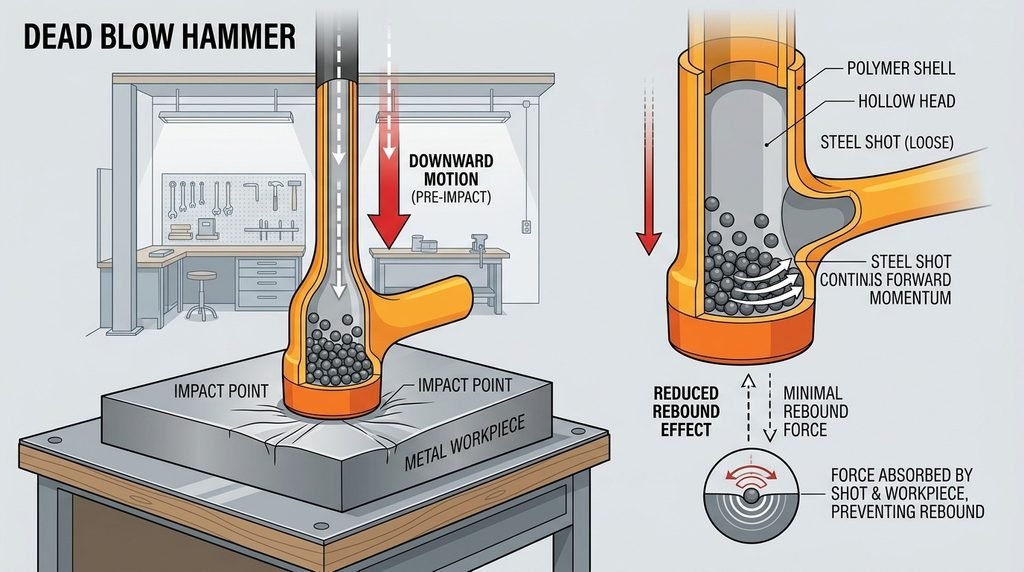
A dead blow hammer uses movable mass inside the head to change what happens during and immediately after impact.
As you swing, the loose steel shot moves inside the head. When the outer head contacts the workpiece and rapidly slows, the shot continues moving forward briefly. That delayed movement extends the transfer of momentum and opposes the tendency of the hammer to spring backward. Manufacturers of shot-filled dead blows describe the result as less post-strike rebound and better-controlled contact.
In practical terms, imagine tapping a stubborn component sideways into alignment. With a conventional resilient mallet, part of the energy can return as bounce. With a shot-filled dead blow, the head feels “deader” after contact because the internal shot helps damp that return motion.
There’s no magic multiplication of energy. What changes is how the moving mass behaves during the impact event and how much rebound you have to control afterward.
That matters most when a second unintended bounce could strike an adjacent part, finished surface, your hand, or something else in a confined work area.
What Makes This CRAFTSMAN Hammer Different?
Reduced rebound
CRAFTSMAN describes the CMHT54166’s dead-blow function as eliminating bounce back when striking hardened surfaces. A more cautious real-world description is that the design is intended to greatly reduce rebound; actual movement will still depend on your swing, workpiece, angle, and surface.
Reduced rebound can make repeated alignment strikes easier to control because you spend less effort stopping and repositioning a bouncing hammer.
Steel-shot-filled head
CRAFTSMAN specifies a molded head filled with steel shot. This is the heart of the dead-blow mechanism rather than a cosmetic feature.
It also explains why a dead blow shouldn’t be thought of as simply “a rubber hammer with a different shape.” The moving internal mass changes how the head reacts at impact.
Soft striking surface
CRAFTSMAN says the soft face helps prevent marring. That wording is worth preserving. “Soft face” does not mean “impossible to damage anything.”
A forceful strike can still dent thin sheet metal, compress soft wood, bruise veneer, crack brittle material, or transfer dirt embedded in the hammer face. If cosmetic damage would be costly, make a light test strike in a hidden location or use an appropriate protective block.
Steel-reinforced handle
The handle incorporates steel reinforcement, which CRAFTSMAN says provides strength and over-strike protection.
Here’s the thing: an over-strike happens when the neck or handle contacts the work rather than the intended hammer face. Reinforcement gives that area structural support when a swing misses slightly. It doesn’t mean repeated intentional striking with the handle is acceptable.
Where Does a 28-Oz Dead Blow Hammer Make Sense?
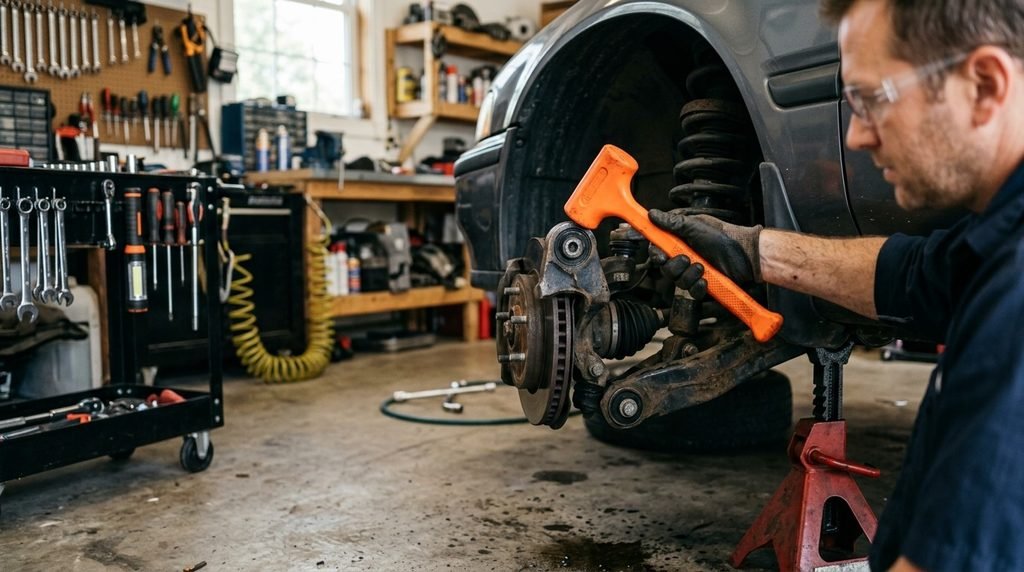
A 28-oz dead blow makes the most sense when controlled force matters more than nail-driving versatility.
Automotive and mechanical work
This is one of the clearest use cases. CRAFTSMAN itself includes its 28-oz dead blow hammer in the recommended tool list for a front-suspension component replacement project. CRAFTSMAN’s front-suspension DIY project guide
Potential jobs include positioning components, seating assemblies, persuading parts into alignment, or moving something where an exposed steel hammer face would be undesirable.
That doesn’t mean every stuck automotive part should be hammered. Service procedures, component construction, bearings, threads, seals, and surrounding parts all matter.
Furniture and household assembly
For flat-pack furniture, shelving, workbench components, frames, and other assemblies, a dead blow can be useful when pieces need firmer seating than finger pressure provides.
The catch is the 28-oz mass. If you only need tiny corrective taps on lightweight furniture, a smaller rubber or plastic mallet is often easier to control.
Workshop positioning
Dead blows are especially useful for positioning parts in jigs, fixtures, machine setups, or other jobs where you want something to move without the hammer immediately springing away.
For homeowners building out a broader tool collection, tool choice matters just as much for cutting as it does for striking. HomeWorks Daily’s guide to different types of saws and their uses is a useful next step when planning a practical DIY toolkit. The saw guide is currently featured on the site.
Tent stakes and outdoor setup
CRAFTSMAN has also specifically promoted the CMHT54166 for driving tent stakes. That use benefits from decent striking mass and less exposed steel at the point of contact.
Inspect the face afterward if you’ve been hitting dirty, rocky, or abrasive objects.
craftsman 28-oz dead blow hammer Pros and Cons
| Pros | Cons |
| Shot-filled head reduces rebound | Not designed to replace a nail-driving claw hammer |
| Soft face lowers the risk of marring compared with exposed steel | Soft striking material can still be cut or worn by unsuitable targets |
| 28-oz size provides meaningful striking mass | More hammer than necessary for very light assembly |
| Steel-reinforced handle supports repeated striking and accidental over-strikes | Extra mass can become tiring if the job requires hundreds of light swings |
| Useful for automotive alignment, workshop assembly, and positioning | No claw, peen, or hard steel striking face for jobs that require those features |
| Smaller/lighter option than CRAFTSMAN’s 45-oz dead blow | Heavy-duty seized components may call for a heavier or specialized striking tool |
CRAFTSMAN 28-Oz Dead Blow Hammer vs Rubber Mallet
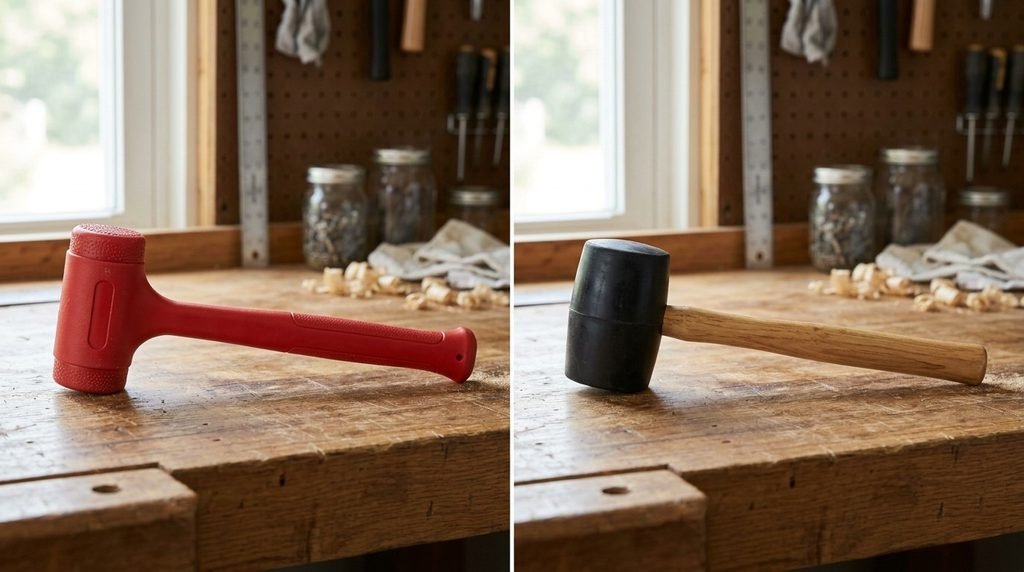
A dead blow hammer is generally the better choice when you need more controlled striking force with less rebound. A rubber mallet is often preferable when the job primarily requires gentle positioning and a lighter, more forgiving strike. Neither is universally better.
| Feature | CRAFTSMAN Dead Blow | Typical Rubber Mallet |
| Internal moving mass | Yes, steel shot | Usually no |
| Rebound | Designed to minimize it | More dependent on rubber elasticity |
| Striking character | Firm, controlled, “dead” impact | Softer and often springier |
| Surface protection | Soft face helps reduce marring | Rubber face also reduces metal-on-surface marking |
| Best fit | Seating, alignment, automotive/workshop positioning | Light assembly, gentle positioning, flooring or furniture tasks where appropriate |
| Weight consideration | 28-oz head provides substantial mass | Many options are lighter |
| Main limitation | Can be excessive for delicate tapping | May not deliver the same low-rebound, concentrated strike |
If you’re nudging cabinet parts together, a modest rubber mallet may be all you need.
If you’re trying to shift a stubborn mechanical component without having the tool spring back after each strike, this is where the dead blow starts to make more sense.
Dead Blow Hammer vs Regular Hammer
A regular claw hammer is the better tool for driving and removing nails. CRAFTSMAN describes its claw-hammer line specifically around those jobs, while its dead-blow products are built around reduced rebound and controlled striking.
For everyday DIY work, that distinction matters.
Don’t buy a dead blow expecting it to become the hammer you use for hanging pictures, framing a wall, pulling bent nails, or general carpentry. It has no claw, and repeatedly driving nail heads with a soft face is a poor match for the tool.
A dead blow is better viewed as the second hammer you add once your projects create a need for it.
Is 28 Oz the Right Weight?
For many homeowners, 28 oz is substantial enough to make the dead-blow mechanism useful without moving into CRAFTSMAN’s heavier 45-oz model.
For context, CRAFTSMAN currently offers common claw/general-purpose hammers in the 16–20 oz range and a 45-oz dead blow alongside this 28-oz model.
So 28 oz isn’t a featherweight tapping mallet.
That additional mass is useful when seating or shifting parts. On the other hand, if the job involves repeated light taps, delicate materials, overhead work, or a user who benefits from a lighter tool, the extra weight may become an unnecessary burden.
The bigger question is not, “Is 28 oz enough?”
Ask: How much force does the job actually need, and how precisely can I control it?
Who Is This Hammer Best For?
The CMHT54166 makes the strongest case for itself if you:
- Regularly work on cars, garage projects, or mechanical assemblies where controlled striking is useful.
- Need to position or seat components without the rebound of a conventional mallet.
- Work around finished metal, wood, or other surfaces where an exposed steel hammer face creates unnecessary marking risk.
- Assemble furniture, fixtures, workshop projects, or household components that occasionally require a firm seating blow.
- Already own a conventional claw hammer and want a complementary task-specific striking tool.
- Want meaningful striking mass but don’t need CRAFTSMAN’s heavier 45-oz dead blow.
Who Should Probably Choose Something Else?
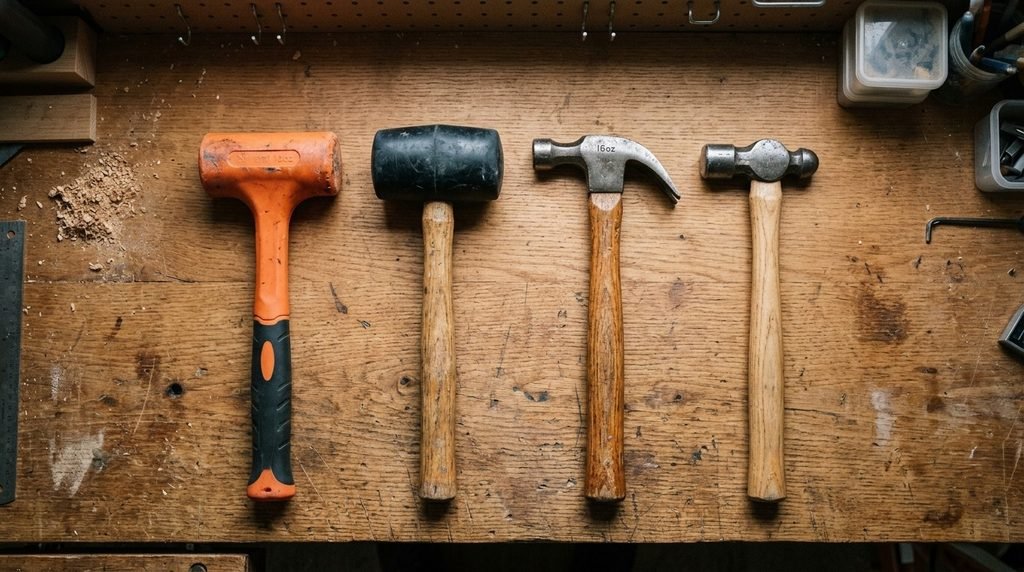
| Your main job | More appropriate tool | Why |
| Driving and pulling nails | Claw hammer | Designed specifically for nail work |
| Very light furniture or flooring adjustments | Rubber or soft assembly mallet | Easier to control when only gentle movement is needed |
| Peening, riveting, or metal shaping | Ball-peen hammer | Purpose-built steel faces for metalworking |
| Striking appropriate punches or metalworking tools | Ball-peen or specified striking hammer | A soft polyurethane face can be damaged by sharp or concentrated targets |
| Heavy stubborn assemblies requiring more mass | Heavier dead blow, such as a 45-oz model, if the job permits | More striking mass where the service procedure calls for it |
| Wood-chisel work | Appropriate wood/nylon mallet or tool specified by the chisel maker | Chisels concentrate force into a small area and are not what this broad soft face is primarily designed around |
CRAFTSMAN describes its ball-peen line as intended for metalworking and shaping, while its claw hammers are intended for driving and removing nails. Those distinct product categories are a useful reminder that no single hammer design handles every striking job well.
The same principle applies to home repairs generally: diagnose the job before choosing a tool. For example, HomeWorks Daily’s guide to common water softener repairs focuses on identifying the actual problem rather than reaching for a generic fix.
What Surfaces Shouldn’t You Strike With It?
A soft-face dead blow shouldn’t be treated as a universal striking tool just because it’s less likely to mark a workpiece.
Avoid striking:
- Sharp metal corners, exposed cutting edges, or other objects capable of slicing into the face.
- Another hammer.
- Chisels, punches, or similar concentrated striking tools unless their manufacturer specifically calls for a soft-face hammer.
- Energized electrical components; a steel-reinforced handle should not be confused with a certified insulated electrical tool.
- Fragile surfaces simply because the hammer is described as “soft.” Impact force can still dent, crack, chip, or compress material.
A technical data sheet for another polyurethane-faced dead blow specifically warns that sharp objects can damage the polyurethane face, which is a sensible general limitation for soft polymer-faced striking tools.
Can Repeated Impact Damage the Outer Coating?
Yes. A soft striking face is a working surface, not an indestructible shell.
Polyurethane dead-blow manufacturers commonly design their coatings to resist cuts, chipping, cracking, tearing, and abrasion, but “resistant” does not mean immune. Sharp edges, protruding threads, abrasive surfaces, contaminated workpieces, and repeated off-center hits can progressively damage a soft face.
Inspect the hammer rather than judging it only by age. Deep cuts, cracking, bulging, missing material, exposed internal structure, or other significant damage are reasons to stop using the tool and check the manufacturer’s replacement/warranty guidance.
What to Check Before Buying
First, confirm the model number. You want CMHT54166 if you’re shopping for the 28-oz version; CRAFTSMAN also sells a 45-oz dead blow under model CMHT54169.
Then consider the job rather than the brand name alone. Is reduced rebound actually useful to you? Do you need a soft face? Is 28 oz appropriate, or are most of your jobs light enough for a smaller mallet?
There are also two purchasing details worth checking carefully.
Warranty wording is inconsistent. The CMHT54166 product page lists a Limited Lifetime Warranty, while CRAFTSMAN’s broader warranty page says new CMHT hammers fall under its Full Lifetime Warranty category. Because the manufacturer’s own pages do not line up cleanly, verify the coverage applicable to CMHT54166 at the time of purchase rather than relying on a secondary seller’s wording. CRAFTSMAN’s current warranty information
Pricing and availability vary. In retailer pages checked for this update, Lowe’s displayed $26.98, Ace Hardware $27.99, and Acme Tools $29.99. Acme’s category page listed the hammer in stock, while a second, older Lowe’s URL said the item was no longer sold there. That makes the high-$20 range a useful September 17, 2026 comparison point—not a guaranteed national price or stock status. Ace Hardware’s current CMHT54166 listing
Before adding it to your toolbox, also check the seller’s current return policy and inspect the tool on arrival for face, handle, or shipping damage.
Safety and Proper Use
A dead blow still stores and delivers a substantial amount of energy. The soft face and reduced rebound do not remove normal striking-tool hazards.
OSHA notes that improperly used or maintained hand tools can cause severe injuries, and hammering work can generate flying material. General hammer guidance also emphasizes selecting the correct tool, inspecting it before use, maintaining a secure stance, and making square rather than glancing strikes. OSHA’s hand and power tool safety resources
For practical use:
- Wear appropriate safety glasses or goggles when striking materials that may produce chips or fragments.
- Check the soft face and handle for cracks, deep cuts, looseness, or other damage before use.
- Keep the face and grip clean enough to maintain control.
- Use stable footing and make sure you have clearance for the full swing.
- Keep fingers and other people out of the striking area.
- Strike squarely rather than clipping an edge with a glancing blow.
- Don’t use the side of the hammer as the striking face.
- Stop if the outer head becomes seriously damaged; this hammer contains steel shot, so a breached head shouldn’t remain in service.
- Follow the instructions for the component you’re working on rather than assuming hammering is acceptable.
Visibility matters too. For inspection and setup in a dim garage, attic, cabinet, or utility area, hands-free illumination can be useful; HomeWorks Daily’s Sofirn HS21 headlamp review discusses work-friendly flood lighting in those situations. For repeated striking, make sure the whole workspace and swing path are clearly illuminated rather than depending on a narrow moving beam.
Is the craftsman 28-oz dead blow hammer Worth Buying?
It makes the most sense for a homeowner who already understands why reduced rebound matters.
If your projects regularly involve automotive work, workshop assemblies, fitting parts, furniture construction, mechanical positioning, or controlled blows around surfaces you don’t want to hit with exposed steel, the CMHT54166 fills a genuine gap between a standard hammer and a lightweight rubber mallet.
It may be unnecessary if most of your hammer use consists of nails, picture hooks, basic carpentry, or a few gentle furniture taps each year.
At the retailer prices seen during this update, the question isn’t really whether the hammer is expensive. The more useful question is whether you have jobs that call for the mechanism. A specialized tool that solves a recurring problem makes sense. One that duplicates tools you already use successfully probably doesn’t.
Frequently Asked Questions
What is a 28-oz dead blow hammer used for?
A 28-oz dead blow hammer is used for controlled striking jobs where you want substantial impact with less rebound than a conventional solid-head hammer. Typical applications include positioning components, seating assemblies, automotive work, workshop setup, furniture assembly, and other tasks where an exposed steel face may be undesirable.
The CRAFTSMAN 28-oz model is also included in the company’s own front-suspension DIY tool list.
Does a dead blow hammer bounce?
A dead blow hammer is specifically designed to reduce bounce, but it’s safer to think “much less rebound” rather than assume absolutely zero movement under every condition.
Loose steel shot continues moving inside the head during impact, helping damp the hammer’s tendency to spring away from the workpiece.
Will a CRAFTSMAN dead blow hammer damage surfaces?
It can. CRAFTSMAN says the soft face helps prevent marring; it does not guarantee that every material will remain undamaged.
Thin metal can dent, soft wood can compress, fragile finishes can crack, and grit trapped on the face can scratch a surface. Use controlled force and test delicate materials before committing to a harder strike.
Is a dead blow hammer better than a rubber mallet?
A dead blow hammer is usually better when reduced rebound and a firmer controlled strike are priorities. A rubber mallet is often better for light positioning jobs where less mass and a gentler strike are more useful.
They overlap, but they are not interchangeable for every task.
Is 28 oz heavy enough for automotive work?
Yes, for many automotive jobs—but not every one. CRAFTSMAN specifically lists its 28-oz dead blow among the tools for a front-suspension component replacement project, which supports its relevance for automotive DIY.
A badly seized component or procedure requiring considerably more impact may call for the 45-oz dead blow, another specified hammer, a puller, a press, or a completely different removal method.
Can you use a dead blow hammer for woodworking?
Yes, selectively. A soft-face dead blow can be useful for seating assemblies, positioning fixtures, or persuading joints where reduced rebound is helpful.
It isn’t automatically the right tool for delicate joinery or striking wood chisels. A lighter rubber, nylon, or traditional woodworking mallet may offer better control depending on the material and tool being struck.
How long does a dead blow hammer last?
There is no verified service-life figure for the CMHT54166, so a responsible answer cannot promise a number of years.
Useful life depends on frequency of use, what is being struck, impact force, storage, contamination, and damage to the soft face. Inspect it regularly and remove it from use if the head or handle becomes significantly cracked, cut, loose, deformed, or otherwise unsafe.
What model is the CRAFTSMAN 28-oz dead blow hammer?
The verified model number is CMHT54166. CRAFTSMAN’s heavier 45-oz dead blow is model CMHT54169, so checking the model number is useful when comparing retailer listings.
Who Should Actually Buy This Hammer?
The craftsman 28-oz dead blow hammer is worth considering if controlled strikes, reduced rebound, and a softer contact surface solve problems you regularly encounter in the garage, workshop, or around DIY assemblies.
Its main strength is control after impact. Its main trade-off is specialization: 28 oz can be excessive for delicate taps, and this hammer can’t drive and pull nails like a claw hammer or perform the shaping work of a ball-peen hammer.
For occasional lightweight assembly, a rubber mallet may be all you need. For ordinary carpentry, keep the claw hammer. But if you regularly find yourself trying to move or seat components without steel-on-surface contact and without the mallet bouncing back, the CMHT54166 has a clear job in the toolbox.
And if you’re building that toolbox one task at a time, continue with HomeWorks Daily’s guide to 15 different types of saws to make the same job-first decision on your cutting tools.








One Response