There’s a particular kind of frustration that happens when you open a closet in the morning and can see… almost nothing.
You reach for a shirt, move a few hangers aside, and suddenly you’re playing a guessing game with your wardrobe. A ceiling light may brighten the room, but the back of the closet can remain surprisingly dark.
That’s where battery-powered lighting can make a real difference.
The best battery operated lights for closet use simple installation, useful illumination, and convenient controls to make dark shelves, corners, and hanging spaces easier to navigate—without requiring new electrical wiring.
But here’s the catch: the brightest light isn’t necessarily the best choice. A motion sensor, beam coverage, mounting method, battery access, and even light color can matter just as much.
This guide explains what to look for, which types work best in different closets, and how to choose a setup that won’t become another home-improvement purchase you regret.
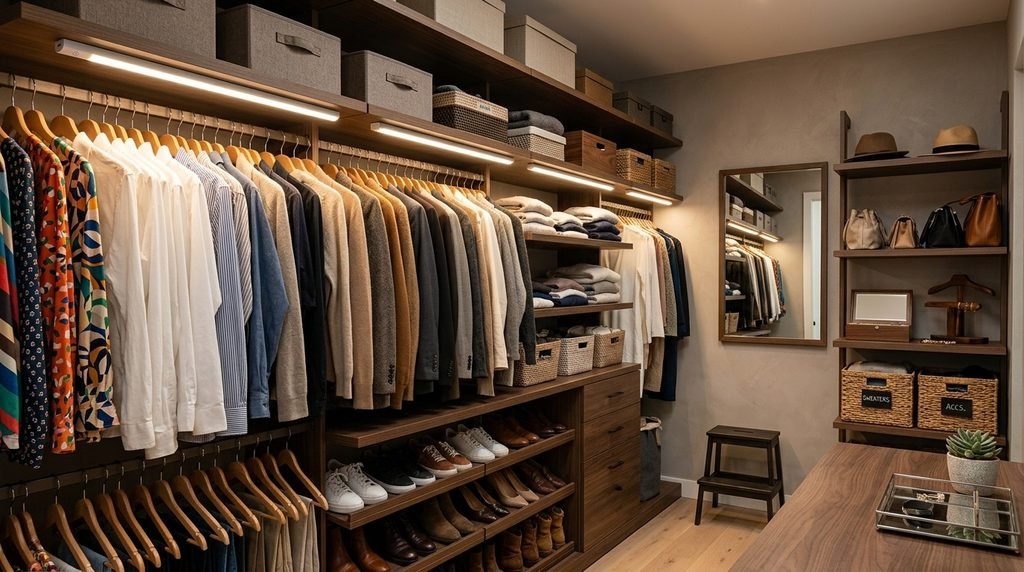
What Are the Best Battery Operated Lights for Closet?
For most closets, a rechargeable LED light bar with motion sensing is a practical starting point because it can provide broad illumination without permanent wiring. For smaller spaces, puck lights or compact stick-on LEDs can be easier to position, while magnetic lights are useful when you want simple removal for charging or repositioning.
The right choice depends mainly on:
- Closet size and depth
- How often the light is used
- Where shadows occur
- Whether you want automatic activation
- How frequently you want to recharge or replace batteries
- Whether you can drill into the wall
- How easy the light is to remove
- Whether you need broad or focused illumination
In other words, choose the lighting design around the closet—not the other way around.
Why Battery-Operated Closet Lights Make Sense
Traditional wired lighting can be excellent, but adding a new electrical fixture isn’t always practical.
You may be renting. The closet might be too small for major electrical work. Or perhaps you simply don’t want to turn a straightforward lighting upgrade into a weekend wiring project.
Battery-operated lights solve much of that problem.
They can generally be installed with minimal disruption and can be especially useful for:
- Reach-in closets
- Linen closets
- Pantries
- Cabinets
- Storage cupboards
- Wardrobes
- Apartment closets
- Basement storage areas
- Under-shelf spaces
The biggest advantage isn’t just that these lights run without a wall outlet. It’s flexibility.
You can put light exactly where you need it.
Types of Battery-Operated Closet Lights
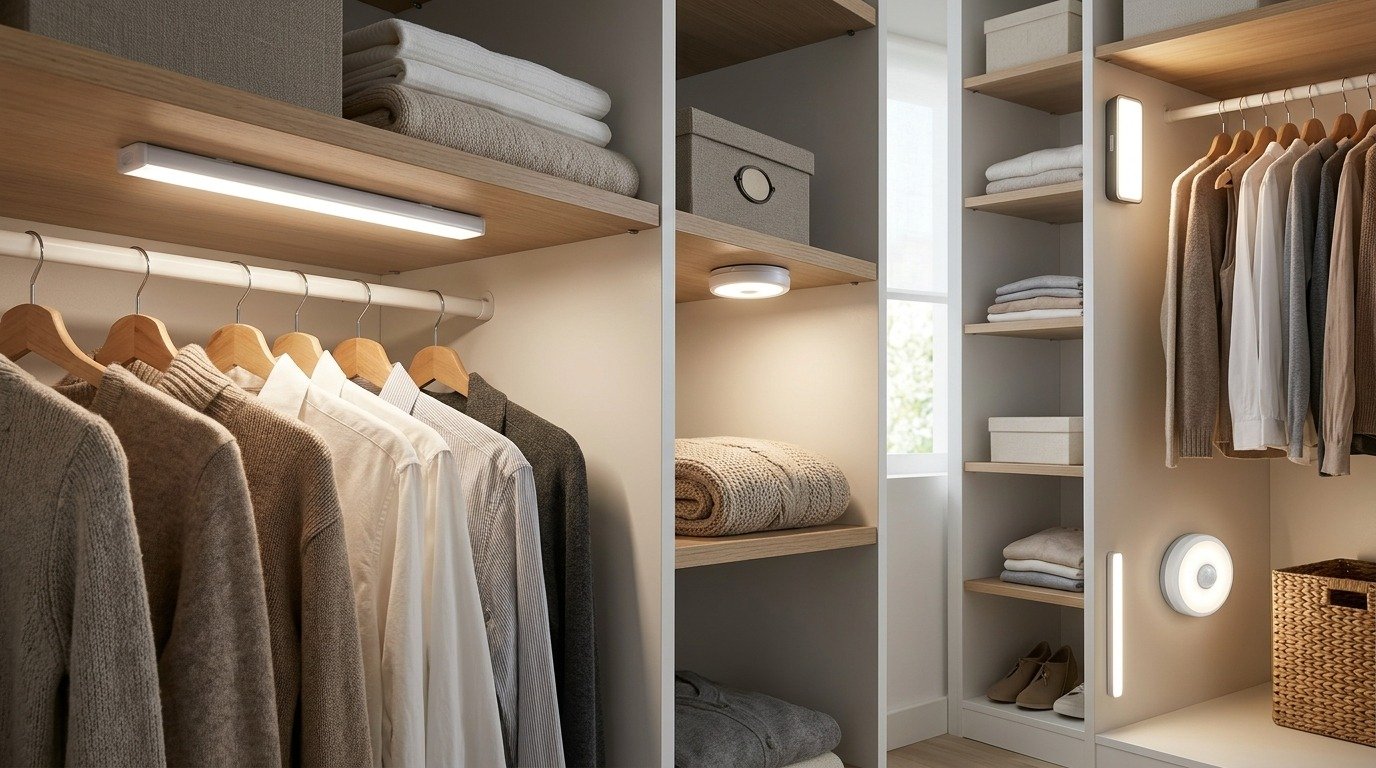
Not every battery-powered light behaves the same way. Understanding the main types makes shopping much easier.
Motion-Sensor Lights
Motion-sensor lights turn on when movement is detected within the sensor’s range.
They’re particularly convenient when your hands are full of clothes or storage boxes.
Best for:
- Frequently used closets
- Walk-in closets
- Entry closets
- Closets where you don’t want to search for a switch
Advantages:
- Hands-free operation
- Convenient at night
- Can reduce unnecessary runtime
Potential drawbacks:
- Sensors need correct positioning
- Very sensitive sensors may activate unnecessarily
- Poor placement can cause the light to switch off while you’re still inside
That last point is easy to overlook. A sensor that works perfectly in a hallway isn’t necessarily ideal inside a deep closet.
Rechargeable LED Light Bars
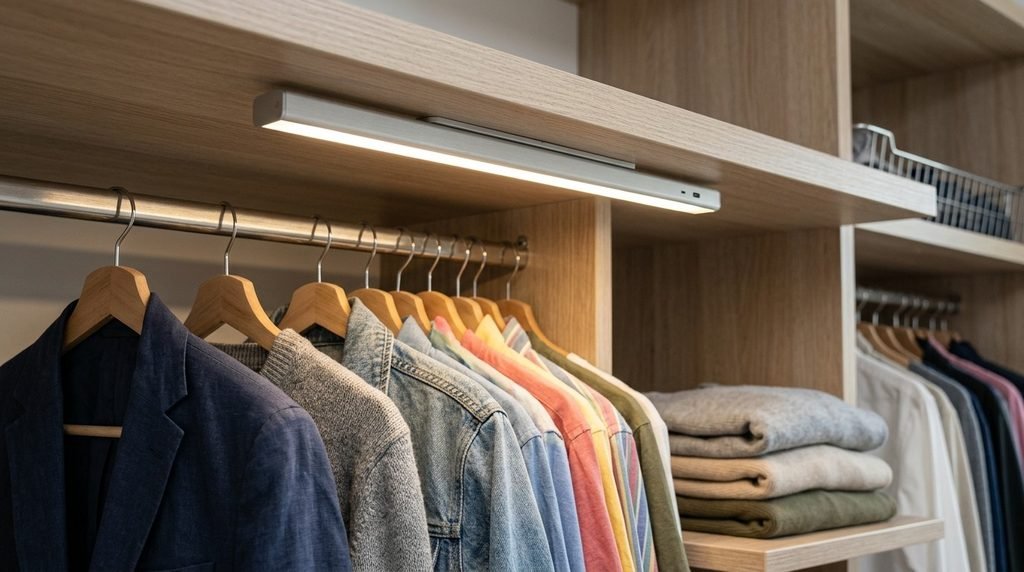
Rechargeable light bars are among the most versatile options for closet lighting.
Their longer shape can spread illumination across a wider section of hanging clothes or shelving than a tiny puck light.
Best for:
- Medium and large closets
- Shelves
- Wardrobe interiors
- Long hanging sections
Look for a design that can be removed easily for charging. Magnetic mounting can be especially convenient because the light can stay attached to a mounting plate while the light itself is removable.
Stick-On LED Lights
Stick-on lights are designed for quick installation.
They’re often compact and useful when you don’t want to drill holes.
Best for:
- Renters
- Small closets
- Cabinets
- Shelves
- Temporary lighting improvements
The main issue is the mounting surface.
Dusty, textured, damp, or unsuitable surfaces can reduce how well adhesive mounting works. Clean the mounting area and follow the manufacturer’s installation instructions rather than assuming every adhesive will stick equally well.
Puck Lights
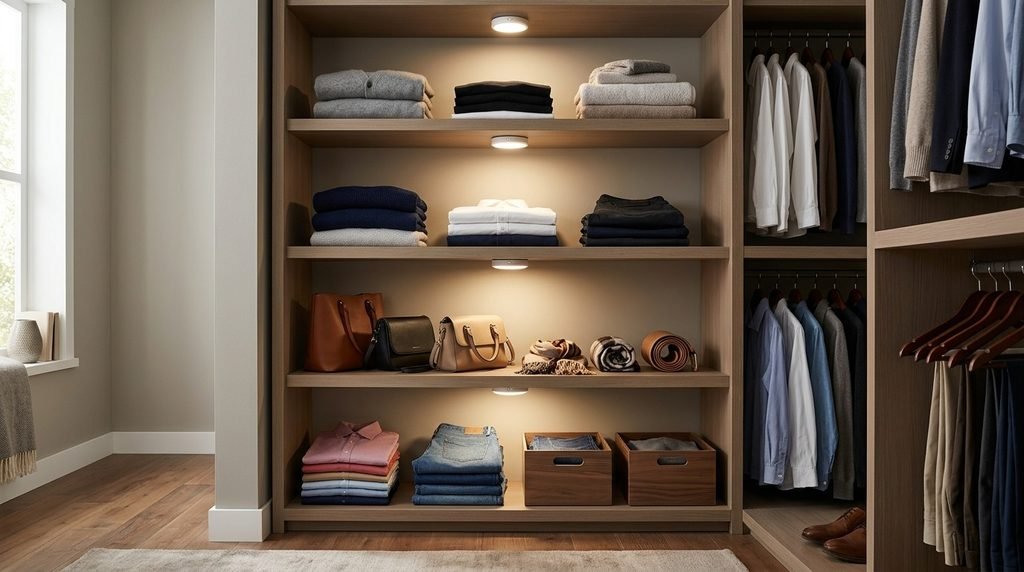
Puck lights are small, round fixtures that provide concentrated illumination.
Instead of lighting an entire closet from one location, you can position several around the areas that need attention.
Best for:
- Shelves
- Small storage spaces
- Cabinets
- Individual dark areas
They’re useful when one large light would create shadows or when the closet has several separate shelves.
The trade-off is that multiple lights mean multiple points to manage and potentially multiple batteries or charging routines.
Magnetic Closet Lights
Magnetic lights can be especially practical when the light needs to be removed frequently.
For example, imagine mounting a light inside a closet and being able to pull it down when it needs charging. That’s considerably more convenient than removing an entire adhesive-mounted fixture.
Best for:
- Renters
- Frequently recharged lights
- Flexible installations
- Metal surfaces or compatible mounting plates
The key is checking exactly how the magnetic mounting system works. Some lights use magnets built into the fixture, while others rely on a separate magnetic mounting plate.
Touch-Activated Lights
Touch lights require a physical tap rather than movement detection.
They can work well where you want control over exactly when the light turns on.
Best for:
- Small closets
- Cabinets
- Drawers
- Low-traffic storage spaces
They’re simple, but they aren’t as convenient as motion activation when both hands are occupied.
Quick Comparison: Which Closet Light Type Is Best?
| Light Type | Best For | Main Benefit | Potential Drawback |
| Motion sensor | Frequently used closets | Hands-free operation | Sensor placement matters |
| Rechargeable light bar | Medium/large closets | Broad illumination | Requires charging |
| Stick-on LED | Rentals and small spaces | Easy installation | Adhesive may not suit every surface |
| Puck light | Shelves and cabinets | Focused lighting | May need multiple lights |
| Magnetic light | Flexible installations | Easy removal | Mounting system varies |
| Touch light | Small storage areas | Simple manual control | Requires physical activation |
There isn’t one universal winner. The better question is: which style solves the specific lighting problem in your closet?
What Should You Look for in a Closet Light?
A product can look impressive on a shopping page and still be frustrating once it’s installed.
Before buying, consider these features.
1. Brightness
Brightness matters, but don’t treat the largest lumen number as an automatic victory.
A very bright light aimed at one small area can leave other parts of the closet in shadow. A moderately bright light with good coverage may be more useful.
Think about where the light goes, not simply how bright the light is at its source.
2. Beam Coverage
This is one of the most overlooked factors.
A long light bar can spread illumination along a row of clothes or shelves. A small puck light produces a more concentrated pool of light.
For a deep closet, coverage can matter more than simply increasing brightness.
3. Battery Type
Consider whether the light uses:
- Replaceable disposable batteries
- Built-in rechargeable batteries
- Rechargeable batteries that can be replaced
- Another manufacturer-specified power system
Frequent users may prefer rechargeable designs because they don’t have to repeatedly purchase disposable batteries.
Occasional users may find replaceable batteries perfectly practical.
There’s no need to pay extra for a feature you’ll rarely use.
4. Battery Access
Here’s a small detail shoppers often overlook.
Once a light is mounted near the top of a closet, changing its batteries shouldn’t become a mini renovation.
Before installing, ask:
Can I easily reach the charging port or battery compartment?
If the answer is no, reconsider the mounting position.
5. Motion Sensor Performance
If you choose a motion sensor light, sensor behavior matters.
Check:
- Detection range
- Activation method
- Auto-off behavior
- Whether the sensor can detect movement where you plan to install it
The goal is simple: the light should come on when you need it and stay on long enough to be useful.
6. Mounting Method
Common mounting methods include:
- Adhesive backing
- Screws
- Magnetic mounting
- Clips
- Manufacturer-specific brackets
For renters, removable options are generally more attractive.
For a permanent installation, a more secure mounting method may make sense.
7. Light Color
Color temperature changes how a space feels.
A warmer light can feel softer and more relaxed, while a cooler light can create a brighter, more task-oriented appearance.
For a closet where you’re choosing clothing, consider how the light affects your ability to distinguish colors.
Don’t choose solely based on what looks bright in a product photo.
Best Battery-Operated Closet Lights for Different Situations
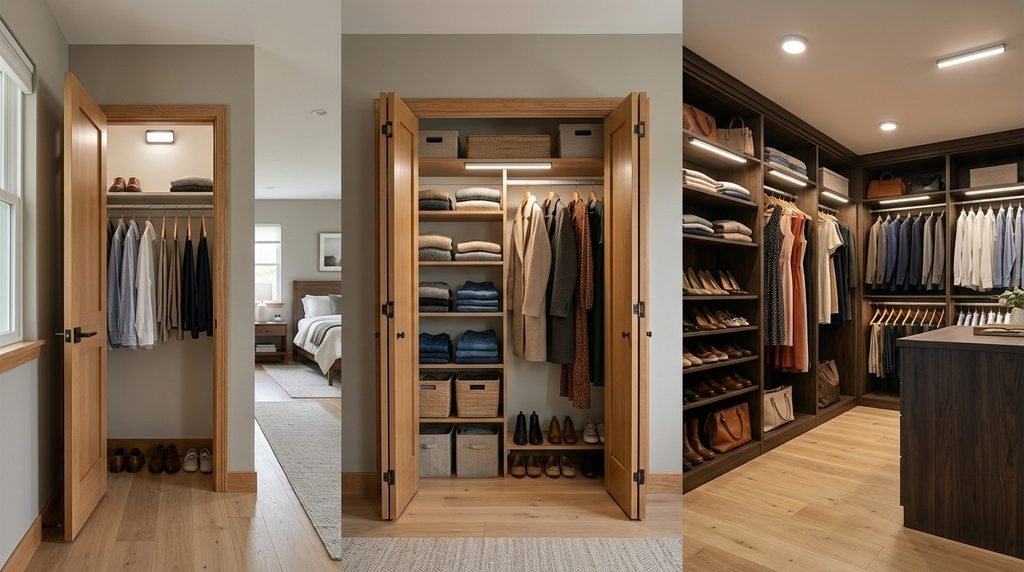
The “best” option changes depending on the space.
Best for a Small Closet
A compact puck light, stick-on LED, or small motion-sensor light may be enough.
You don’t necessarily need a long light bar if the closet is shallow and has only a small dark area.
Prioritize:
- Compact size
- Easy installation
- Simple activation
- Adequate coverage
Best for a Walk-In Closet
A longer rechargeable LED light bar may be more practical for a larger closet.
If the closet has several sections, using multiple strategically positioned lights can provide more even illumination than trying to light everything from one location.
Prioritize:
- Coverage
- Battery capacity
- Rechargeability
- Motion sensing
- Easy removal for charging
Best for a Rental
Look for a light that doesn’t require permanent electrical work.
Adhesive or magnetic mounting can be useful, but check the mounting instructions and the condition of the surface before installation.
Prioritize:
- Removable mounting
- Lightweight design
- No hardwiring
- Easy repositioning
Best for Dark Shelves
A puck light can work particularly well when the problem is concentrated in one shelf or compartment.
Position the light so that stored items don’t block the illumination.
Prioritize:
- Compact size
- Focused illumination
- Easy access
- Appropriate mounting
Best for Frequent Use
If the closet is opened many times every day, rechargeable lighting deserves serious consideration.
Repeatedly replacing disposable batteries can become inconvenient over time.
Prioritize:
- Rechargeable power
- Convenient charging
- Reliable activation
- Easy removal
- Battery access
Best for Occasional Use
If the closet is opened only occasionally, a simple battery-powered LED may be all you need.
There’s little reason to overcomplicate a low-use storage space.
Prioritize:
- Simple controls
- Long shelf/storage practicality
- Low maintenance
- Affordable installation
Rechargeable vs. Disposable Battery Closet Lights
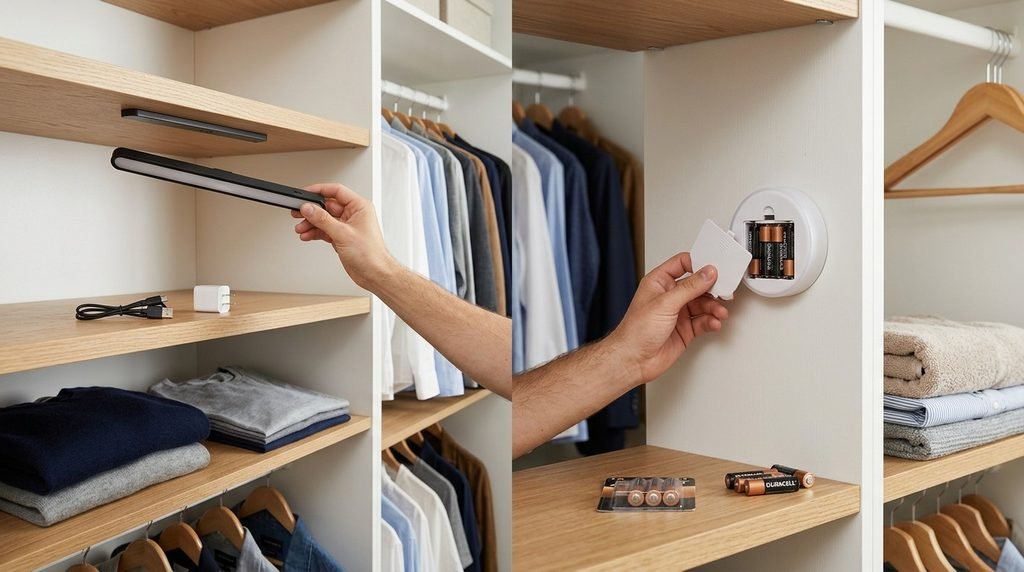
Which is better?
Neither is automatically better. It depends on how you use the light.
| Factor | Rechargeable | Disposable Battery |
| Frequent use | Usually convenient | Batteries may need replacing more often |
| Occasional use | Convenient, but charging is needed | Simple for infrequent use |
| Charging access | Important | Not required |
| Long-term routine | Requires charging | Requires replacement batteries |
| Installation | Easy if charging port is accessible | Easy if battery compartment is accessible |
For a frequently used closet, rechargeable lighting can be attractive because charging replaces repeated battery purchases.
For a rarely opened linen cupboard, simplicity may matter more.
Why Brightness Isn’t Everything
Imagine two lights.
Light A is extremely bright but illuminates a narrow area.
Light B is slightly less intense but spreads light evenly across your clothes and shelves.
Which one is better?
In a closet, Light B may be more useful.
That’s because the practical goal isn’t to create the brightest possible spot. It’s to make the contents of the closet easier to see.
Look at:
- Light direction
- Beam spread
- Mounting position
- Closet depth
- Shelf arrangement
- Clothing density
A well-positioned light can outperform a poorly positioned brighter one.
Where Should You Install a Closet Light?
Placement can make or break the result.
For a typical reach-in closet, a light positioned toward the upper front or upper-middle area can help illuminate the hanging space.
For shelves, position the light so that the shelf contents don’t block the beam.
For deeper closets, consider whether one light actually reaches the back.
A useful approach is to identify the darkest area first.
Don’t automatically place the light where installation is easiest.
Place it where it solves the problem.
A Simple Placement Test
Before permanently mounting the light:
- Hold it in the proposed position.
- Open the closet normally.
- Check the back corners.
- Look underneath shelves.
- Move clothing around.
- Check whether your body blocks the light.
- If using a motion sensor, test whether movement triggers it.
- Confirm that you can still access the battery compartment or charging port.
This simple test can save you from remounting the light later.
Do Motion Sensor Closet Lights Save Battery?
They can reduce unnecessary operating time because the light isn’t running continuously, but actual battery life depends on the particular light, sensor behavior, usage pattern, and battery system.
A motion sensor isn’t magic.
If the sensor activates every time someone walks past the closet—or repeatedly turns on because movement inside the closet keeps triggering it—it can still consume power.
Sensor placement matters.
For a closet, the ideal setup is one where the sensor detects you entering or reaching into the space without being constantly triggered by irrelevant movement.
Common Mistakes to Avoid When Buying Closet Lights
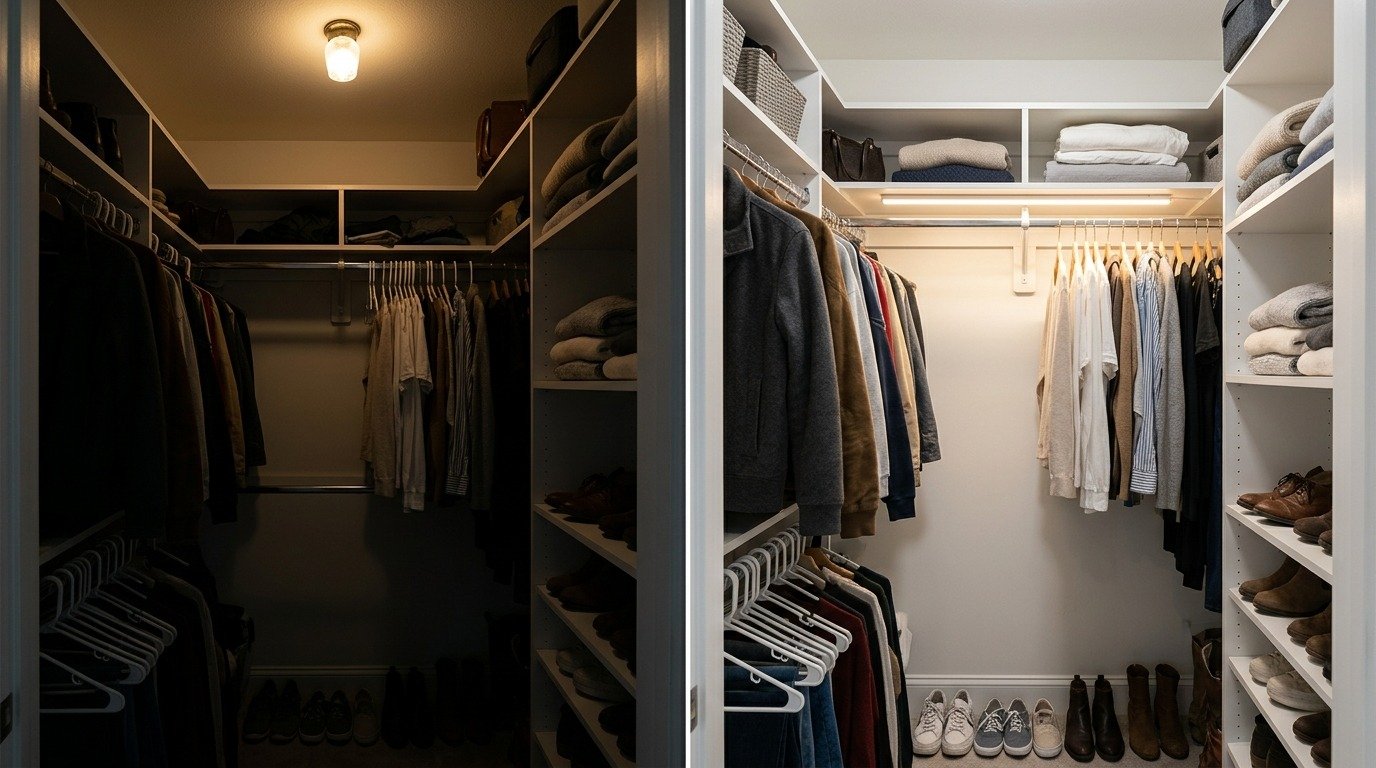
Choosing Brightness Without Considering Coverage
A bright light isn’t useful if it leaves half the closet dark.
Ignoring Battery Access
Think about charging or replacing batteries before mounting the fixture.
Installing the Sensor in the Wrong Location
A blocked or poorly positioned sensor can make an otherwise good light frustrating to use.
Trusting Adhesive on Every Surface
Mounting performance depends on the surface and installation conditions. Follow the manufacturer’s instructions.
Buying the Largest Light
More isn’t always better.
A large light may be unnecessary for a small closet and can take up valuable space.
Choosing Based Only on Price
The cheapest option isn’t necessarily the least expensive over time if it requires frequent battery replacement or proves difficult to use.
Forgetting About Shadows
Clothes, shelves, and your own body can block light.
Think about illumination from the user’s perspective.
Installing Before Testing
If possible, test the proposed position before committing to permanent mounting.
Are Battery-Operated Closet Lights Safe?
Battery-operated LED lights are designed for convenient low-voltage lighting, but safe use still depends on following the manufacturer’s instructions.
Keep these basics in mind:
- Use the specified battery type.
- Don’t use damaged batteries.
- Follow charging instructions for rechargeable models.
- Don’t modify the electrical components.
- Keep batteries away from young children where appropriate.
- Avoid placing lights where excessive heat could become an issue.
- Follow the manufacturer’s mounting and operating instructions.
- Dispose of used batteries according to local requirements.
For a simple closet-lighting project, there’s usually no reason to improvise with electrical components.
How to Choose the Right Closet Light in 5 Steps
If you’re standing in a store—or scrolling through dozens of online listings—use this quick process.
Step 1: Measure the Space
Know the approximate width, depth, and height of the area you’re trying to illuminate.
Step 2: Identify the Dark Spot
Is the problem:
- The entire closet?
- One shelf?
- The back wall?
- The floor?
- A hanging section?
This determines the type of light you need.
Step 3: Choose the Activation Method
Decide whether you prefer:
- Motion
- Touch
- Manual switch
- Remote control
For hands-free access, motion sensing is usually the most convenient.
Step 4: Decide How You Want to Power It
Consider how often you’ll use the light and whether charging or battery replacement is easier for you.
Step 5: Check Installation Before Buying
Make sure the mounting method works with your closet surface and that you can still access the light for charging or battery changes.
What Features Are Worth Paying More For?
Not every premium feature deserves your money.
Some upgrades can genuinely improve daily use.
Worth Considering
- Reliable motion sensing
- Easy removal for charging
- Good light coverage
- Convenient battery access
- Secure mounting
- Useful brightness control
- Appropriate size
Features to Consider Carefully
- Remote controls you may rarely use
- Excessive brightness for a tiny closet
- Complicated smart features
- Decorative designs that sacrifice useful coverage
- Features that make charging or maintenance harder
The best purchase is usually the one that makes the closet easier to use—not the one with the longest feature list.
A Simple Decision Guide
Use this as a quick starting point:
| Your Situation | Consider |
| Small closet | Compact LED or puck light |
| Deep closet | Light bar with broad coverage |
| Hands-free use | Motion sensor |
| Rental property | Adhesive or magnetic mounting |
| Frequent daily use | Rechargeable model |
| Occasional use | Simple battery-powered light |
| One dark shelf | Puck or focused light |
| Multiple shelves | Several strategically positioned lights |
| Frequent charging | Easily removable magnetic design |
Frequently Asked Questions
What are the best battery operated lights for closet?
For many closets, a rechargeable LED light bar with motion sensing offers a useful combination of coverage and convenience. Smaller closets may need only a compact puck or stick-on LED light.
How bright should a closet light be?
There’s no single brightness level that’s ideal for every closet. Consider the closet’s size, depth, shelf arrangement, and how evenly the light spreads rather than choosing based only on brightness.
Are motion sensor closet lights worth it?
They can be, especially when you frequently enter the closet with your hands full. They’re also convenient at night because you don’t need to locate a switch.
Are rechargeable closet lights better?
Rechargeable lights can be more convenient for frequent use because they avoid repeated disposable-battery replacement. For occasional-use spaces, conventional battery-powered models may be simpler.
Can battery-operated closet lights be mounted without drilling?
Many battery-operated lights are designed for adhesive, magnetic, or other non-permanent mounting methods. Always check the manufacturer’s mounting instructions and whether the surface is suitable.
What color light is best for closets?
The ideal color depends on preference and purpose. If you’re choosing clothes, consider a light that lets you distinguish colors comfortably rather than simply selecting the brightest-looking option.
Where should a closet light be placed?
Position the light where it illuminates the darkest areas without being blocked by clothing or shelving. Test the location before permanently mounting it.
Do motion sensor lights save battery?
They can help reduce operating time by switching off when no movement is detected. Actual battery life depends on the light, sensor settings, frequency of use, and battery system.
Can one light illuminate an entire walk-in closet?
Sometimes, but not always. A single well-positioned light may work in a compact walk-in closet, while larger or divided closets often benefit from multiple strategically positioned lights.
The Bottom Line
The best battery operated lights for closet aren’t necessarily the brightest, most expensive, or most feature-packed.
They’re the ones that solve the actual problem.
For a small closet, a compact LED or puck light may be enough. For a deeper wardrobe, a rechargeable light bar can provide better coverage. If convenience is the priority, motion sensing is hard to beat. And if you need to recharge the light regularly, an easy-to-remove magnetic design can save a surprising amount of frustration.
Before buying, think about the space first: where is it dark, how often will you use the light, how will it be mounted, and how will you power it?
Answer those four questions and your choices become much easier.
And if you’re working on other parts of your home, explore more practical home-improvement and gardening ideas from HomeWorksDaily for projects that make everyday spaces easier to live in.
Final Takeaway
Choosing the best battery operated lights for closet comes down to one simple question: what does your closet actually need?
A small closet may only need a compact puck or stick-on LED light, while a deeper wardrobe can benefit from a longer rechargeable light bar with wider coverage. If convenience matters most, a motion sensor can eliminate the hassle of finding a switch. For renters or anyone avoiding drilling, magnetic and adhesive mounting options can make installation much easier.
Before you buy, focus on these five things:
- Coverage: Make sure the light reaches the areas you actually need to see.
- Brightness: Don’t assume the brightest light is automatically the most useful.
- Power: Choose rechargeable or replaceable batteries based on how frequently you’ll use the light.
- Activation: Motion sensors are convenient, while touch or manual controls offer more direct control.
- Installation: Choose a mounting method that suits your closet surface and allows easy access for charging or battery replacement.
The best closet light isn’t the one with the longest feature list. It’s the one that makes your closet easier to see, easier to use, and easier to maintain.
Take a few minutes to assess your closet before purchasing, and you’ll have a much better chance of choosing a light that genuinely fits the space rather than simply looking good on a product page.