
Walk into a hardware store looking for “a saw” and you may discover a small problem: there isn’t really such a thing as one saw for every job.
There are compact hand saws, fast power saws, precision tools for trim, aggressive tools for demolition, and specialized saws designed for everything from curves to branches. Some look surprisingly similar but perform completely different jobs.
So, which one belongs in your toolbox?
The answer depends on what you’re cutting, how you’re cutting it, how much precision you need, and how often you’ll use the tool.
In this guide to the types of saws, we’ll break down the major hand, power, specialty, and gardening saws, explain what they’re best at, compare them side by side, and help you choose the right tool without buying more saw than your project actually needs.
Quick Answer: What Are the Main Types of Saws?
The main types of saws fall into four practical groups:
- Hand saws: Manually operated and useful for simple cuts, repairs, woodworking, and garden work.
- Power saws: Motor-driven tools designed to make cutting faster and often more efficient.
- Specialty saws: Designed for particular cuts or materials, such as drywall, tile, or intricate curves.
- Gardening saws: Built for cutting branches, shrubs, and other plant material.
The most useful saw isn’t necessarily the most powerful one. A homeowner cutting a few boards for a shelf may have little reason to buy a large stationary machine, while someone building cabinets will benefit from much more precise equipment.
The project should choose the saw—not the other way around.
Types of Saws at a Glance
Here’s a quick way to see how the major saw types differ:
| Saw Type | Best For | Beginner Friendly? | Typical Material | Main Advantage |
| Hand saw | General wood cuts | Yes | Wood | Simple and inexpensive |
| Coping saw | Curved cuts | Yes | Wood | Excellent control |
| Hacksaw | Cutting metal | Yes | Metal/plastic | Interchangeable blades |
| Backsaw | Precise woodworking | Yes | Wood | Clean, controlled cuts |
| Pruning saw | Cutting branches | Yes | Green/dry wood | Compact garden tool |
| Circular saw | Straight cuts | With practice | Wood | Fast and versatile |
| Jigsaw | Curves and cutouts | With practice | Wood, plastic, some metals | Excellent maneuverability |
| Reciprocating saw | Demolition | With practice | Wood, metal, plastic | Aggressive cutting |
| Miter saw | Crosscuts and angles | With training | Wood | Fast, repeatable cuts |
| Table saw | Long, accurate cuts | More advanced | Wood | Excellent repeatability |
| Band saw | Curves and resawing | Intermediate | Wood/metal | Continuous blade |
| Scroll saw | Intricate patterns | Intermediate | Thin wood | Fine detail |
| Oscillating saw | Flush/detail cuts | With practice | Wood, plastic, metal | Access to tight areas |
| Tile saw | Tile cutting | With training | Tile | Designed for tile |
The table is a starting point, not a buying order. The best choice depends on the exact cut you’re trying to make.
Types of Hand Saws
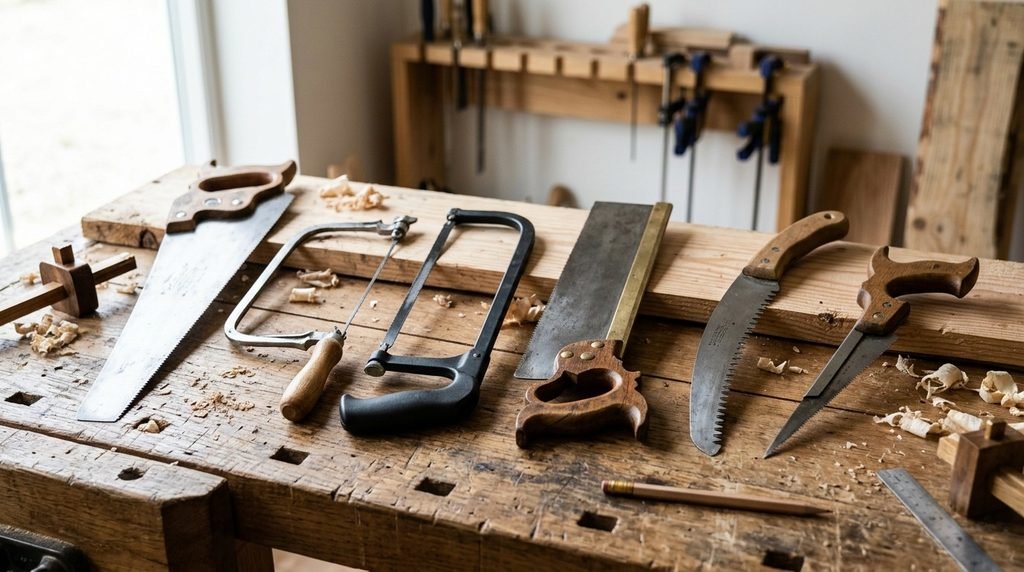
Hand saws have one major advantage that’s easy to overlook: simplicity.
There’s no motor, battery, extension cord, or complicated setup. For a small repair, that can be a feature rather than a limitation.
Hand Saw
The traditional hand saw is one of the most recognizable saws in a basic toolbox.
It’s primarily used for cutting wood and is useful for jobs such as:
- Cutting lumber
- Trimming boards
- Building simple shelves
- Making basic repairs
- Cutting framing material
Its biggest advantage is convenience. Grab the saw, secure the material, and get to work.
The downside is equally obvious: you supply the cutting power.
For occasional household projects, though, that’s often perfectly acceptable.
Best for: General-purpose wood cutting.
Consider another saw when: You have a large number of cuts or need highly consistent precision.
Coping Saw
A coping saw has a narrow blade stretched across a U-shaped frame.
Its design makes it particularly useful for curved and intricate cuts.
It’s commonly used for:
- Curved woodworking
- Cutting small shapes
- Trim work
- Craft projects
- Fitting joints
The narrow blade can navigate curves that would be difficult for a conventional hand saw.
If you’re cutting a straight board, however, a coping saw isn’t the obvious choice.
Best for: Detailed curved cuts.
Hacksaw
A hacksaw is primarily associated with cutting metal, although the right blade can also handle certain plastic materials.
Its replaceable blade makes it useful for tasks such as cutting:
- Metal pipe
- Bolts
- Threaded rod
- Plastic tubing
- Small metal components
Blade selection matters here. A hacksaw isn’t simply a frame that magically cuts every material; the blade has to match the job.
Best for: Small metal-cutting jobs.
Main limitation: It’s relatively slow compared with powered metal-cutting tools.
Backsaw
A backsaw has a stiffened back along the top of its blade. That reinforcement helps keep the blade rigid, which makes the saw useful for controlled woodworking cuts.
It’s particularly suited to:
- Joinery
- Trim work
- Fine woodworking
- Straight, accurate cuts
A backsaw is a good example of why “more powerful” doesn’t always mean “better.” When precision matters more than speed, a controlled hand tool can be exactly what you need.
Pruning Saw
A pruning saw is designed specifically for cutting branches and woody plant material.
It’s smaller and easier to maneuver than many garden power tools, making it useful for:
- Removing small to medium branches
- Pruning shrubs
- Garden maintenance
- Cutting awkward branches where larger tools aren’t practical
If you’re working in a garden rather than a workshop, a pruning saw may be more useful to you than several woodworking saws.
Keyhole Saw
A keyhole saw has a narrow blade designed for making openings or cuts in materials such as drywall.
It’s useful for:
- Drywall cutouts
- Small openings
- Curved or irregular cuts
- Installing fixtures
Its narrow blade makes it possible to start and navigate cuts where a conventional hand saw would be awkward.
Types of Power Saws
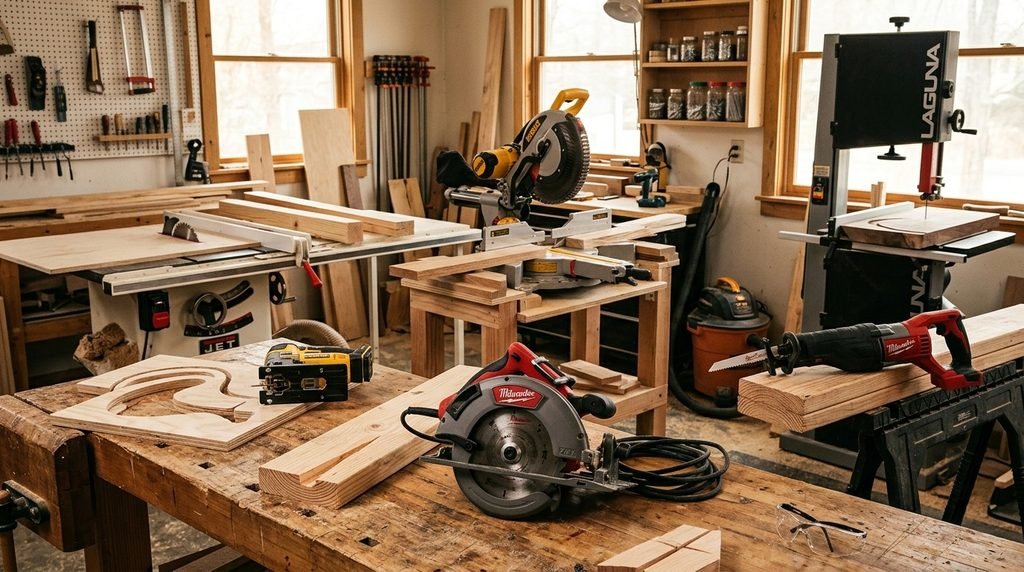
Power saws change the equation.
Instead of relying entirely on your arm, the motor drives the blade. That can make repetitive cutting dramatically faster—but it also means the tool deserves more respect.
OSHA notes that power and hand tools can cause serious injuries when improperly used or maintained, and woodworking machinery presents hazards including blade contact, kickback, flying material, and other machine-related risks.
Circular Saw
A circular saw uses a rotating circular blade and is one of the most versatile portable power saws.
It’s particularly useful for straight cuts in materials such as wood.
Common applications include:
- Cutting plywood
- Cutting lumber
- Building framing
- DIY furniture
- Decking projects
- General construction work
Depending on the blade, circular saws can make crosscuts or rip cuts in wood.
Why it’s popular: One tool can handle a surprisingly wide range of straight-cutting jobs.
Main limitation: It isn’t the natural choice for intricate curves.
For a homeowner who does regular DIY work, a circular saw can be one of the most useful power tools to own.
Jigsaw
A jigsaw uses a narrow blade that moves rapidly up and down.
Its strength is maneuverability.
It’s particularly useful for:
- Curved cuts
- Cutouts
- Shapes
- Countertop openings
- Small woodworking projects
- Pattern work
If a circular saw is the tool you’d reach for when you want a long straight cut, a jigsaw is often the better choice when the cut needs to turn.
The blade should match the material and desired finish.
Best for: Curves, cutouts, and controlled shape cutting.
Reciprocating Saw
A reciprocating saw has a blade that moves back and forth.
It’s often associated with demolition and rough cutting.
Typical applications include:
- Removing old lumber
- Cutting through framing
- Demolition
- Cutting pipes
- Removing branches
- Renovation work
It’s fast and aggressive, but precision isn’t its main selling point.
If you’re carefully cutting an attractive piece of furniture, this probably isn’t your first choice.
If you’re tearing out an old structure, its aggressive cutting action can be extremely useful.
Miter Saw
A miter saw is designed for making accurate crosscuts and angled cuts.
It’s particularly useful for:
- Trim
- Baseboards
- Framing
- Molding
- Repeated crosscuts
- Angled cuts
Its strength is repeatability.
If you’re cutting many pieces to the same length, setting up a miter saw can make the job much more efficient than repeatedly measuring and cutting by hand.
Table Saw
A table saw has a circular blade mounted in a table surface.
It’s especially useful when you need controlled, repeatable cuts through larger pieces of wood.
Common applications include:
- Ripping boards
- Cutting plywood
- Furniture construction
- Cabinet work
- Repetitive straight cuts
This is a more advanced category of tool.
A table saw can be incredibly useful, but it also requires proper setup, workspace, guarding, and operating technique. OSHA specifically emphasizes machine guarding, appropriate equipment, training, and keeping hands away from the point of operation when using woodworking machinery. (OSHA)
For someone who only makes an occasional shelf, buying one may be excessive.
For a serious workshop, it can become a central tool.
Band Saw
A band saw uses a continuous loop of toothed blade running around wheels.
It’s particularly useful for:
- Curved cuts
- Irregular shapes
- Resawing
- Woodworking
- Some metalworking applications
Unlike a jigsaw, the band saw is generally a stationary machine.
Its continuous blade gives it a different cutting action and makes it particularly valuable in workshops where curved or specialized cuts are common.
Specialty Saws You Might Not Know About
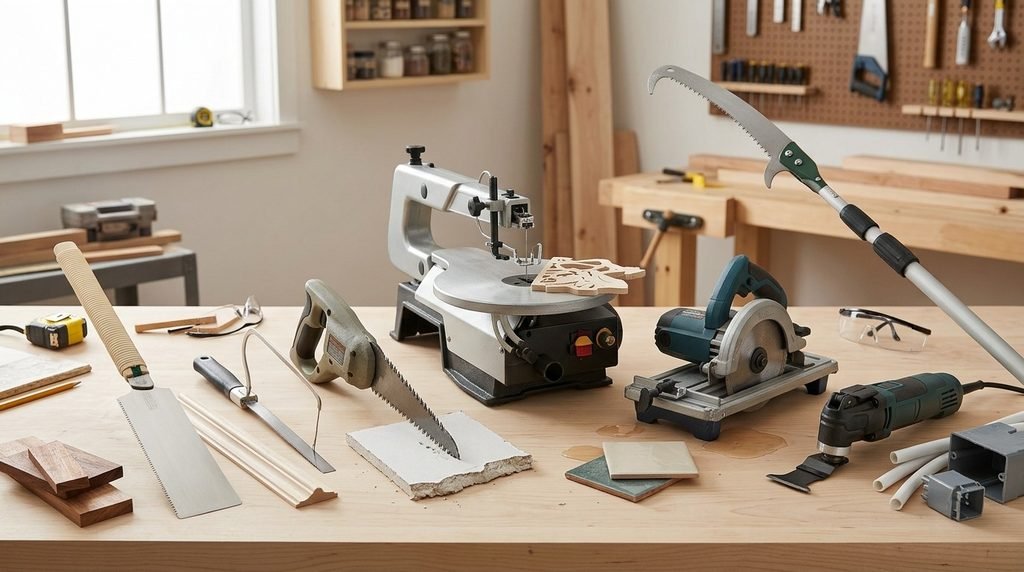
Not every saw needs to live in a beginner’s toolbox.
Some exist because a particular cutting problem is difficult enough to justify a specialized tool.
Scroll Saw
A scroll saw is designed for delicate, intricate cutting.
It’s useful for:
- Decorative patterns
- Thin wood
- Detailed shapes
- Craft projects
- Intricate woodworking
Think of it as a precision-oriented tool rather than a construction workhorse.
Oscillating Saw
An oscillating multi-tool can use different accessories for cutting, scraping, sanding, and other tasks.
With a cutting blade attached, it’s useful for situations where access is difficult.
Examples include:
- Flush cuts
- Cutting door jambs
- Removing small sections of material
- Cutting in tight spaces
- Renovation work
Its biggest advantage is often access, not raw cutting speed.
Japanese Pull Saw
Japanese pull saws work differently from many Western-style hand saws: the cutting action is primarily performed on the pull stroke.
They’re valued for controlled, fine cuts and are popular among woodworking enthusiasts.
They’re especially useful for:
- Fine joinery
- Trim
- Flush cuts
- Detailed woodworking
Flush-Cut Saw
A flush-cut saw is designed to trim material nearly flush with a surface.
It can be useful when removing:
- Dowels
- Pegs
- Shims
- Protruding wood
- Other small projections
It’s a specialty tool, but when you need it, a normal saw can feel unnecessarily awkward.
Tile Saw
Tile requires a different approach from ordinary lumber.
Tile saws are designed specifically for cutting tile, and the blade and cutting system are suited to this material.
They’re useful for:
- Floor tile
- Wall tile
- Remodeling
- Bathroom projects
- Kitchen projects
If a project involves substantial tile work, using equipment specifically designed for the material is generally preferable to improvising with a wood-cutting saw.
Drywall Saw
A drywall saw is a compact hand saw with a pointed blade designed for cutting drywall.
It’s useful for:
- Electrical openings
- Outlet cutouts
- Small drywall repairs
- Fixture openings
It’s inexpensive and simple, making it a handy tool for renovation work.
Pole Saw
A pole saw extends your reach for pruning branches.
It can be particularly useful when branches are too high to reach comfortably from the ground.
Depending on the design, pole saws can be manual or powered.
Best for: High branches and garden maintenance.
Which Type of Saw Is Best for Different Projects?
Instead of memorizing 15 saw names, start with the project.
| Project | Recommended Saw | Why |
| Cutting a board by hand | Hand saw | Simple and inexpensive |
| Building shelves | Circular saw | Good for straight cuts |
| Cutting curves | Jigsaw | Easy to maneuver |
| Cutting trim | Miter saw | Fast, repeatable angled cuts |
| Long straight cuts | Circular/table saw | Designed for straight cutting |
| Repetitive board cuts | Miter/table saw | Excellent repeatability |
| Demolition | Reciprocating saw | Fast, aggressive cutting |
| Cutting branches | Pruning saw/pole saw | Designed for garden work |
| Cutting metal pipe | Hacksaw | Practical for smaller jobs |
| Detailed wood patterns | Scroll saw | Fine control |
| Fine joinery | Backsaw/Japanese pull saw | Precision-oriented |
| Cutting drywall | Drywall saw | Designed for drywall |
| Cutting tile | Tile saw | Designed for tile |
| Flush trimming | Flush-cut/oscillating saw | Works close to surfaces |
The important lesson is simple:
Choose the saw based on the cut you need, not the saw that looks most impressive.
Hand Saw vs. Power Saw: Which Should You Choose?
There’s no universal winner.
| Factor | Hand Saw | Power Saw |
| Speed | Slower | Usually faster |
| Cost | Usually lower | Usually higher |
| Portability | Excellent | Varies |
| Setup | Minimal | Can require setup |
| Noise | Low | Higher |
| Precision | Depends on skill and saw | Often easier for repeatable cuts |
| Maintenance | Low | More involved |
| Small repairs | Excellent | May be unnecessary |
| Large projects | More labor-intensive | Usually more efficient |
| Learning curve | Generally lower | Varies by tool |
A hand saw can be the smarter choice when you’re making only a handful of cuts.
Why plug in a power tool, set it up, find a suitable workspace, and deal with noise when a simple hand saw can finish the job?
On the other hand, cutting dozens of boards manually can become tedious quickly.
The right question isn’t:
“Which saw is better?”
It’s:
“Which saw makes this particular job easier, safer, and more controllable?”
How to Choose the Right Saw
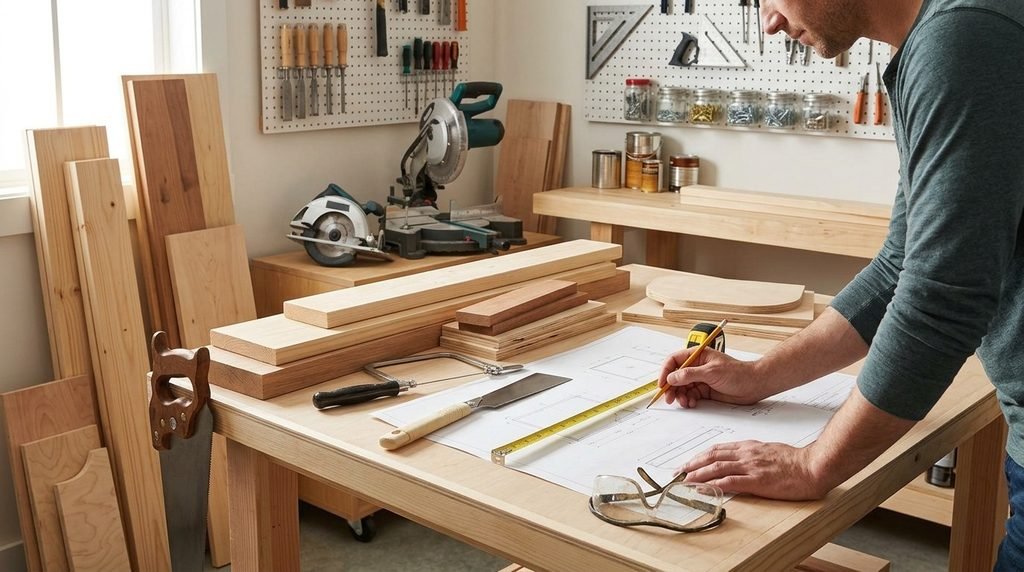
Before buying a saw, answer these questions.
1. What material are you cutting?
Wood, metal, drywall, tile, plastic, and garden branches don’t necessarily require the same blade or saw.
Start with the material.
2. What type of cut do you need?
Do you need:
- A long straight cut?
- A crosscut?
- A rip cut?
- A curve?
- A small opening?
- An angled cut?
- A flush cut?
The desired cut often narrows your choices dramatically.
3. How much precision do you need?
A demolition project and a furniture project have very different standards.
If the cut will be highly visible, precision becomes more important.
4. How many cuts are you making?
One cut and 100 cuts are different problems.
A hand saw may be perfectly sensible for one or two cuts. Repetitive work can justify a power saw.
5. How often will you use it?
If this is a one-time project, renting or borrowing a specialized tool may make more sense than buying one.
6. What’s your workspace like?
A large stationary saw requires substantially more space than a compact hand saw.
Consider storage and working room before purchasing.
7. What blades are available?
A saw is only as useful as the blade suited to the job.
Blade tooth design, material, and configuration can affect cutting performance.
8. What’s your skill level?
A beginner doesn’t necessarily need the most advanced tool.
Sometimes a simpler saw gives you more control while you’re learning.
9. What’s your budget?
Don’t automatically buy the cheapest tool, but don’t buy equipment you’ll rarely use simply because it has more features.
10. What safety features does it have?
For powered saws, guarding and other safety features aren’t optional details to ignore.
OSHA emphasizes using appropriate equipment, keeping guards functional, inspecting equipment, and training operators on woodworking machinery. (OSHA)
Best Saws for Beginners
If you’re building your first DIY toolbox, you don’t need 15 saws.
A sensible starting collection might include:
Best basic hand saw: Hand saw
It’s inexpensive, portable, and useful for straightforward wood cuts.
Best versatile beginner power saw: Circular saw
For homeowners doing regular DIY work, its ability to make straight cuts makes it particularly useful.
Best for curved cuts: Jigsaw
If your projects involve shapes or cutouts, a jigsaw fills a gap that a circular saw can’t.
Best for small metal repairs: Hacksaw
It’s simple and useful for cutting smaller metal components.
Best for garden work: Pruning saw
For homeowners with trees and shrubs, a pruning saw can be more immediately useful than a woodworking specialty saw.
Best for trim: Miter saw
If you’re regularly installing trim or making repeated crosscuts, a miter saw can save considerable time.
You don’t need to buy all of these at once.
Start with the jobs you actually do.
Common Saw-Blade Types and What They Do
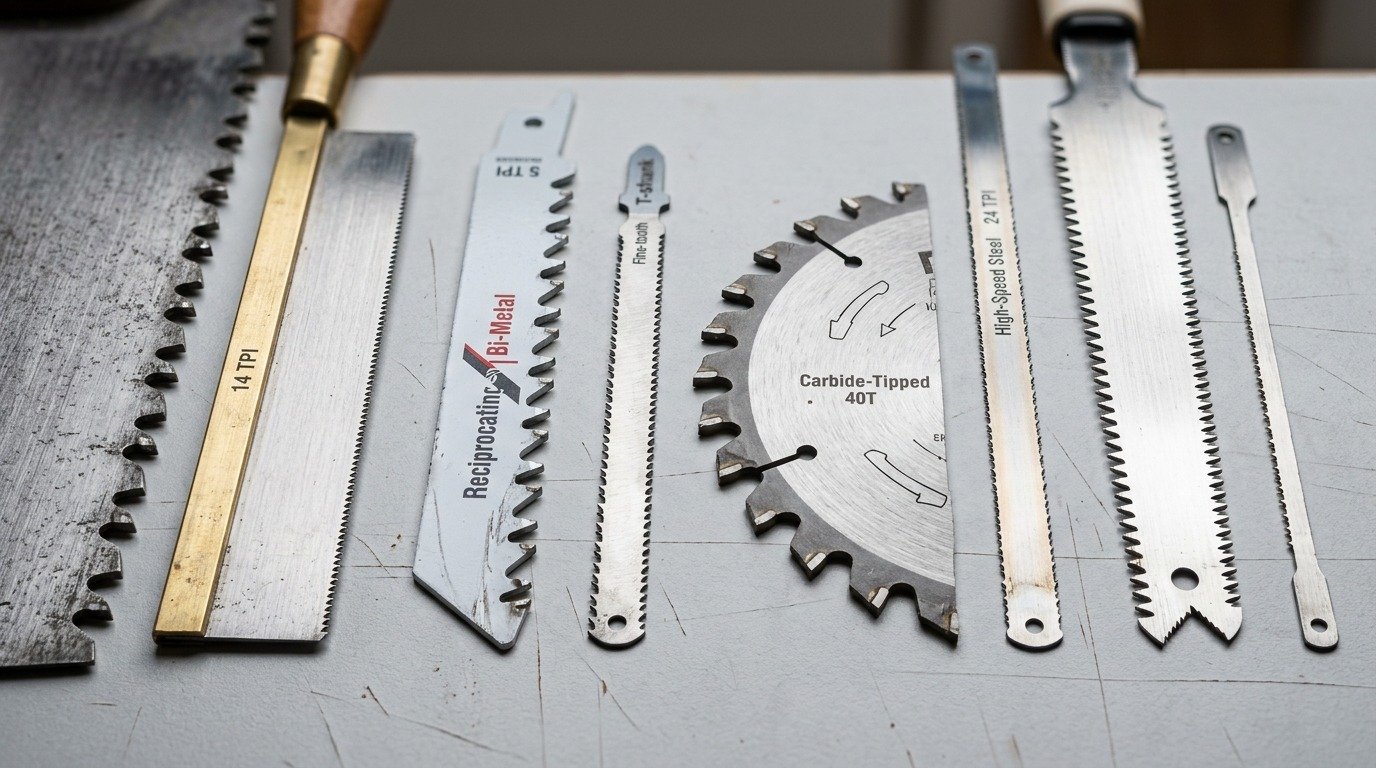
Choosing the saw is only half the equation.
The blade matters enormously.
Two blades designed for the same saw can produce very different results.
Tooth Count
Generally, blade tooth density affects the balance between cutting speed and finish.
A coarse blade can remove material quickly, while a finer-toothed blade can be more appropriate when a smoother cut is important.
But the ideal choice depends on the material and blade design.
Tooth Shape
Different tooth geometries are designed for different cutting applications.
The shape influences how aggressively the blade removes material and how it interacts with the workpiece.
Blade Material
Blade construction also affects durability and cutting performance.
For demanding applications, the appropriate blade material can make a significant difference.
Fine vs. Coarse Teeth
As a general practical rule:
- Coarser teeth: Often favor faster material removal.
- Finer teeth: Often favor smoother, more controlled cutting.
Don’t treat this as an absolute rule. Blade manufacturers specify intended applications for good reason.
OSHA also emphasizes using the correct blade for the cutting action and keeping blades properly maintained.
Common Mistakes People Make When Choosing a Saw

Buying based only on price
The cheapest tool isn’t necessarily the best value.
A tool that struggles with your project can waste time and materials.
Choosing a saw that’s too powerful
More power doesn’t automatically mean better results.
A demolition saw isn’t a replacement for a precision woodworking tool.
Using the wrong blade
Even a high-quality saw can perform poorly when paired with an inappropriate blade.
Ignoring the type of cut
A saw designed primarily for straight cuts isn’t going to suddenly become a precision curve-cutting tool.
Start with the cut.
Buying a specialty tool for one small project
Before purchasing an expensive specialty saw, ask yourself whether you’ll realistically use it again.
Forgetting workspace requirements
A large saw can be difficult to use safely when your workspace is cramped.
Ignoring safety features
Guards and safety systems aren’t cosmetic accessories.
OSHA notes that improperly guarded woodworking machinery can expose operators to serious injuries and stresses the importance of functional guards and appropriate safeguards.
Choosing a tool before understanding the material
Wood isn’t tile. Tile isn’t metal. Metal isn’t drywall.
Material should influence your blade and saw selection.
Saw Safety Basics
Saws deserve respect whether they’re manual or motorized.
For power equipment especially, follow the manufacturer’s instructions and applicable safety guidance.
Important basics include:
- Wear appropriate eye protection.
- Use hearing protection where noise levels warrant it.
- Keep hands away from the cutting area.
- Secure the material properly.
- Use the correct blade for the material and cut.
- Inspect blades and equipment before use.
- Keep guards in place and functioning.
- Disconnect power before maintenance or blade changes when applicable.
- Keep the work area clear.
- Don’t operate damaged equipment.
- Keep loose clothing, jewelry, and hair away from moving machinery.
- Don’t bypass safety devices.
OSHA specifically warns about blade contact, kickback, flying particles, and other hazards around woodworking machinery. It also recommends proper guarding, appropriate equipment, training, inspection, and suitable personal protective equipment.
For fixed woodworking machinery, OSHA’s regulations also address guarding and controls, while portable circular saw requirements include upper and lower blade guards.
When in doubt, stop. A few extra minutes spent checking the setup are far cheaper than an avoidable injury.
Frequently Asked Questions About Types of Saws
What are the main types of saws?
The major categories include hand saws, power saws, specialty saws, and gardening saws. Common examples include hand saws, circular saws, jigsaws, reciprocating saws, miter saws, table saws, band saws, hacksaws, coping saws, pruning saws, and specialty tools.
How many different types of saws are there?
There isn’t one universally accepted number because saws can be categorized by design, power source, application, blade style, and industry. The practical approach is to learn the major saw families and understand what each is designed to cut.
What is the most useful saw for a beginner?
For general household woodworking, a basic hand saw is a simple starting point. If you’re doing regular DIY projects, a circular saw or jigsaw can expand your capabilities significantly.
Which saw is best for straight cuts?
A circular saw is a versatile choice for portable straight cuts. A table saw can be especially useful when you need controlled, repeatable straight cuts in a workshop.
Which saw is best for cutting curves?
A jigsaw is one of the most practical choices for curved cuts. A coping saw works well for smaller manual woodworking projects, while a band saw or scroll saw may be better suited to certain workshop applications.
What is the difference between a jigsaw and a circular saw?
A circular saw uses a rotating circular blade and is primarily suited to straight cuts. A jigsaw uses a reciprocating narrow blade and is much easier to maneuver around curves and cutouts. (OSHA)
What is the difference between a miter saw and a table saw?
A miter saw is particularly useful for crosscuts and angled cuts, especially when you need repeated pieces of the same length. A table saw is more versatile for ripping and other controlled cuts through larger stock.
Which saw is best for cutting branches?
For smaller branches, a pruning saw can be practical. For higher branches, a pole saw may provide useful additional reach. Larger or more demanding work may require a different tool and appropriate training.
Should a beginner buy a hand saw or power saw?
Start with the type of work you actually expect to do. A hand saw is inexpensive and simple for occasional cuts. A power saw can make regular DIY work faster but requires greater attention to setup, operation, and safety.
What type of saw is best for DIY home projects?
There isn’t one answer. A circular saw is versatile for straight wood cuts, a jigsaw is useful for curves and openings, a miter saw is valuable for trim, and a pruning saw is useful for garden maintenance.
Final Takeaway: Choose the Cut, Then Choose the Saw
There are plenty of types of saws, but you don’t need to memorize every one—or buy every one.
Start with the project.
If you’re cutting boards, look at a hand saw or circular saw. Need curves? A jigsaw or coping saw may be more appropriate. Installing trim? A miter saw can make repeated angled and crosscuts easier. Tearing something apart? That’s where a reciprocating saw makes more sense. Working in the garden? A pruning saw or pole saw may be exactly what you need.
And don’t overlook the blade. The saw provides the mechanism, but the blade determines much of how that mechanism interacts with the material.
The best toolbox isn’t the one with the most saws.
It’s the one with the right saw for the jobs you actually do.











2 Responses