
A homeowner with a modest lawn doesn’t necessarily need a riding mower. A walk-behind machine can be easier to store, simpler to maneuver around trees and garden beds, and practical for routine mowing. But if you’re searching for a lawn mower John Deere push option, there’s an important detail to understand first: John Deere’s current U.S. information includes commercial walk-behind mowers, while several familiar residential JS push-mower models are listed as non-current.
That makes the buying decision a little different from simply picking the newest model on a retailer’s shelf. You need to consider whether you’re buying new or used, your lawn’s size and terrain, the mower’s power system, cutting requirements, maintenance needs, and the availability of parts and service.
Quick Answer: Is a John Deere Push Mower Worth Considering?
A John Deere push or walk-behind mower can be worth considering when you want a maneuverable mower and don’t need the capacity of a riding machine. However, model availability matters because John Deere’s current U.S. walk-behind listings are primarily commercial equipment, while older residential push models such as the JS series are identified in John Deere’s documentation as non-current.
For a homeowner, the practical decision is:
- Small, relatively flat lawn: A conventional push mower can be a sensible choice.
- Larger lawn or frequent mowing: A self-propelled mower may reduce effort.
- Steep or difficult terrain: Maneuverability and operator effort become especially important.
- Very large property: A riding or zero-turn mower may be more appropriate.
- Buying an older John Deere: Verify the exact model, parts availability, manual, and condition before purchasing.
The brand name is only one part of the decision. The right mower is the one that matches your lawn and the amount of work you’re willing to do.
What Is a John Deere Push Lawn Mower?
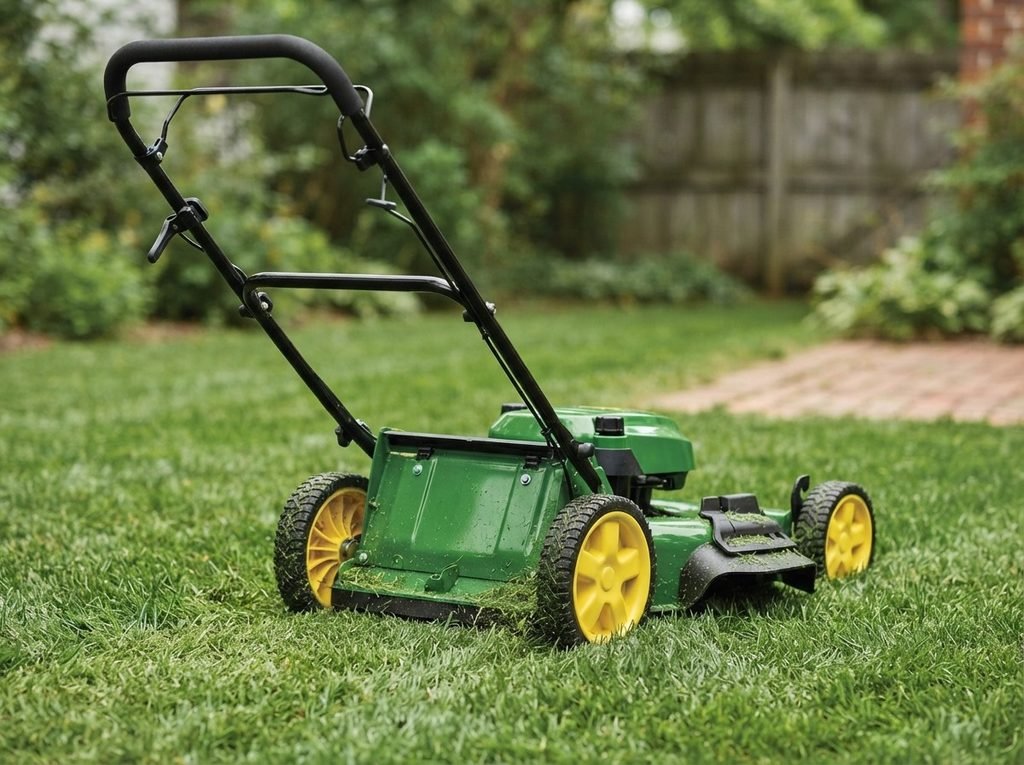
A push lawn mower is a walk-behind mower that the operator physically moves across the lawn. Unlike a self-propelled mower, it doesn’t use its own drive system to move forward.
John Deere has produced several types of walk-behind mowing equipment over the years. Its official documentation includes older residential MowMentum JS models and current commercial walk-behind machines. The company also provides manuals and maintenance resources for walk-behind equipment.
It’s useful to distinguish push mower from walk-behind mower:
- A push mower requires the operator to provide the forward movement.
- A self-propelled walk-behind mower moves under its own power.
- A commercial walk-behind mower can be much larger and more powerful than a typical residential push mower.
So, don’t assume every John Deere machine described as “walk-behind” is a lightweight push mower designed for a typical suburban backyard.
Why Consider a John Deere Push Mower?
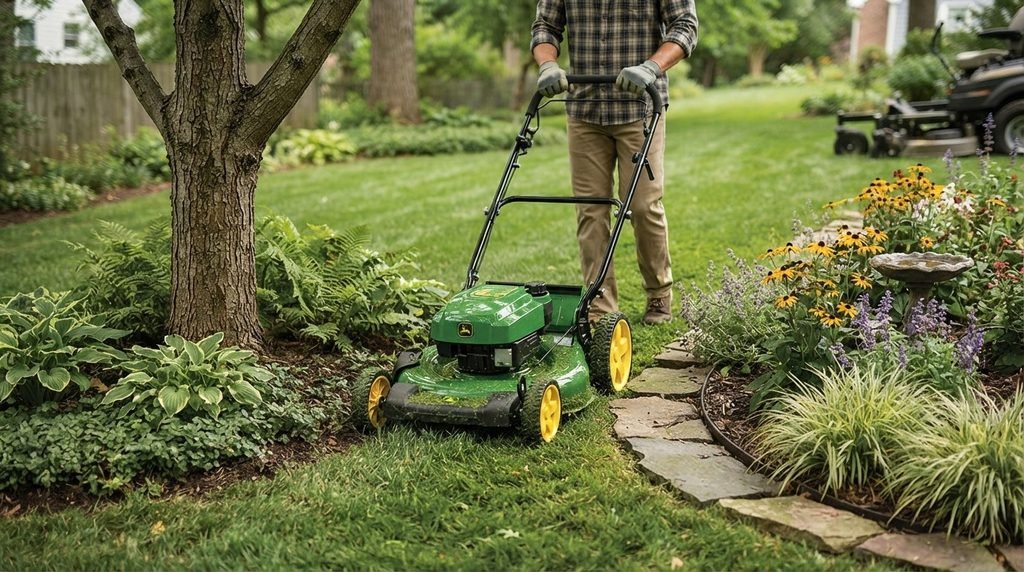
The biggest advantage of a push mower is straightforward: you control its movement directly.
That can be useful when the lawn contains obstacles or narrow areas where a larger machine would be awkward.
Maneuverability
A walk-behind mower can make it easier to work around:
- Trees
- Flower beds
- Fences
- Garden borders
- Narrow passages
- Small irregular sections of lawn
If your yard is broken into several small areas, maneuverability may matter more than having a very wide cutting deck.
Storage
A smaller walk-behind mower generally takes less storage space than a riding mower.
That matters if your garage, shed, or storage area is already crowded with gardening equipment.
Simpler Lawn-Care Setup
For a relatively small lawn, you may not need a riding mower’s additional size and complexity.
A walk-behind mower can handle the basic job without requiring a large parking area or dedicated riding-mower storage.
Limitations to Consider
A push mower isn’t automatically the best choice.
You provide the forward effort, so mowing a large lawn can become tiring. Hills, thick grass, uneven terrain, and frequent mowing can make a self-propelled mower considerably more attractive.
Another issue is availability. John Deere’s current U.S. quick-reference information lists commercial walk-behind models such as the W36M, W36R, W48M, W48R, W52R, and W61R, while older JS residential models appear under non-current equipment. (John Deere)
That distinction is important when you’re researching a “John Deere push mower” online.
Key Features to Look For
The exact specifications depend on the model, so always check the manufacturer’s documentation for the particular mower you’re considering. Still, several characteristics deserve attention.
Cutting Width
Cutting width determines how much grass the mower covers in one pass.
A wider cutting deck can reduce the number of passes required, but it isn’t automatically better. A narrower mower can be easier to maneuver around obstacles and through restricted spaces.
Choose cutting width based on your lawn layout, not just the largest number available.
Engine or Power System
Older residential John Deere push mowers commonly used gasoline engines, while mower technology varies across different product categories and generations.
For a used mower, investigate:
- Engine condition
- Starting behavior
- Maintenance history
- Fuel-system condition
- Replacement-part availability
Don’t rely on the model name alone.
Height Adjustment
Cutting height is one of the most important lawn-care settings.
Grass should generally not have more than about one-third of its leaf height removed in a single mowing. Penn State Extension and Utah State University Extension both recommend the one-third rule as a useful mowing guideline.
A mower with convenient height adjustment makes it easier to adapt your mowing to grass type, season, and growing conditions.
Grass Collection
Consider whether you want to:
- Bag clippings
- Discharge them
- Mulch them
Leaving appropriately sized clippings on the lawn can return nutrients to the turf. USU Extension notes that clippings can be recycled into the lawn when mowing practices are appropriate.
Maneuverability
Think about how the mower will actually move around your property.
A machine that looks impressive on paper may be frustrating if your yard has tight corners, trees, slopes, or multiple small lawn sections.
Build Quality
If you’re evaluating a used John Deere, inspect the physical machine rather than assuming the brand guarantees its condition.
Look for:
- Excessive rust
- Damaged deck components
- Worn wheels
- Loose controls
- Damaged handles
- Missing safety components
- Signs of poor maintenance
John Deere’s documentation specifically emphasizes using the correct safety procedures and maintaining equipment properly.
Maintenance Requirements
A mower is easier to own when routine maintenance is straightforward.
Before buying, find the exact operator’s manual for the model. John Deere provides manuals and maintenance information for its equipment, and its serial-number guidance can help identify a particular mower.
John Deere Push Mower Comparison
A direct model-to-model comparison can be misleading because John Deere’s lineup changes and some older residential models are no longer current.
The following comparison is therefore based on equipment categories and verified John Deere documentation, rather than invented current specifications.
| Mower category | Best suited to | Main advantage | Main consideration |
| Older residential John Deere push mower | Smaller home lawns | Simple walk-behind format | Model may be non-current |
| Older residential self-propelled walk-behind | Small-to-medium lawns | Less pushing effort | Used condition varies |
| Current commercial walk-behind | Professional or demanding mowing | Larger, commercial-oriented equipment | Usually excessive for a small home lawn |
| Reel mower | Appropriate fine turf situations | Precise cutting | More specialized maintenance |
| Riding mower | Larger properties | Covers large areas with less walking | More storage and higher equipment commitment |
John Deere’s official reference material currently identifies several commercial walk-behind models, while JS26, JS36, and JS46 are documented as non-current MowMentum walk-behind models.
For that reason, don’t buy an older John Deere simply because the listing says “push mower.” Identify the exact model first.
How to Choose the Right Push Mower for Your Lawn
There isn’t a universal lawn-size cutoff that determines whether a push mower is appropriate. Lawn shape, terrain, grass growth, and the operator’s comfort can matter just as much.
For Small Yards
A push mower can be a practical fit when:
- The lawn is relatively flat.
- There are plenty of obstacles to navigate.
- Storage space is limited.
- You don’t mind walking behind the mower.
- Mowing doesn’t take an excessive amount of time.
For Medium-Sized Lawns
A push mower can still work, but think about the physical effort involved.
If mowing takes long enough that pushing the machine becomes uncomfortable, self-propelled equipment may be worth considering.
For Uneven Ground
Uneven lawns demand more attention to maneuverability and operator control.
Before buying, consider whether the mower is comfortable to handle across the actual terrain rather than relying solely on its advertised features.
For Slopes
Slopes deserve particular caution. Follow the specific safety instructions in the mower’s operator manual, and don’t assume a mower is suitable for a slope simply because it can physically travel across it.
John Deere’s walk-behind mower manuals include dedicated safety information covering operation on slopes.
For Narrow Spaces
This is where a compact walk-behind mower can shine.
If you have narrow strips between landscaping features, a smaller machine may save time because you can position it more easily.
John Deere Push Mower vs. Other Mower Types
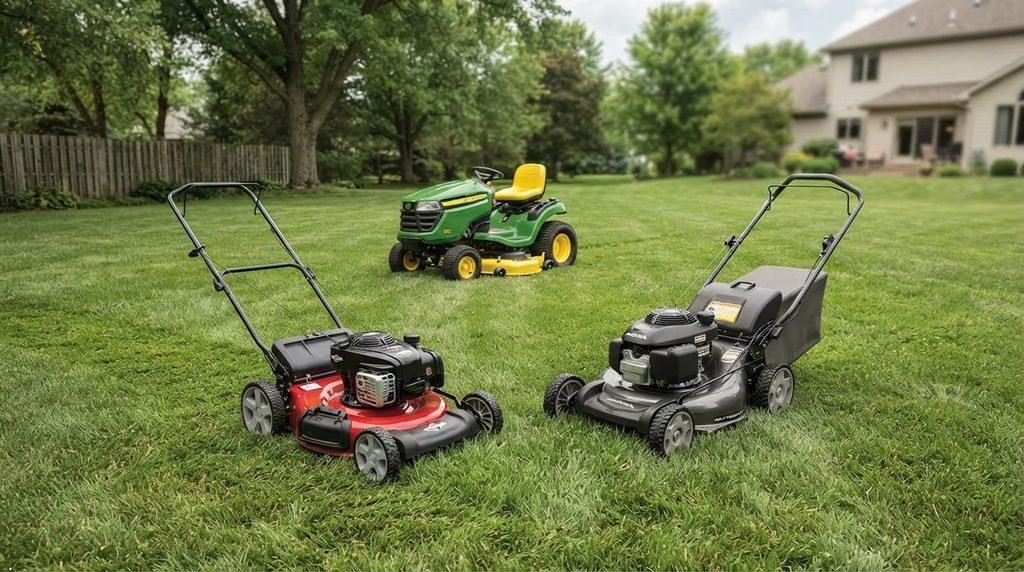
The best choice depends on the job rather than the logo on the machine.
Push vs. Self-Propelled
A push mower requires you to provide the forward movement.
A self-propelled mower does that work for you.
Choose push when simplicity, control, and a smaller lawn are priorities.
Choose self-propelled when the lawn is larger, hilly, or simply tiring to mow manually.
Push vs. Battery-Powered
Battery-powered mowers can reduce fuel handling and engine-related maintenance. However, runtime, battery charging, replacement-battery cost, and the size of the lawn all matter.
For electric equipment, check the manufacturer’s specifications for the specific model rather than assuming every battery mower has the same runtime.
Push vs. Riding Mower
A riding mower makes more sense when walking behind a mower for the entire job is impractical.
A push mower, meanwhile, generally makes more sense when:
- The lawn is relatively manageable.
- Storage is limited.
- You want a walk-behind machine.
- Maneuverability is important.
Push vs. Reel Mower
Reel mowers use a different cutting mechanism from rotary mowers. UMN Extension explains that reel mowers can produce a very fine cut but are more specialized and aren’t well suited to debris-filled lawns or higher cutting heights.
For ordinary residential lawn maintenance, a rotary walk-behind mower is often the more versatile category.
Maintenance Tips
Good maintenance isn’t just about extending mower life. A well-maintained mower also helps produce a cleaner cut.
Keep the Blade Sharp
A dull blade can tear grass rather than cutting it cleanly. UMN Extension recommends keeping mower blades sharp and notes that dull blades can leave frayed grass ends.
Follow the exact blade-maintenance instructions for your model.
Clean the Mower
Grass clippings and debris can accumulate around the mower deck.
Clean the machine according to the manufacturer’s instructions, and avoid maintenance methods that could damage electrical components or other parts.
Check Before Mowing
Before each mowing session, inspect the mower for obvious problems.
Pay attention to:
- Loose or damaged parts
- Wheels
- Handle and controls
- Blade condition
- Grass buildup
- Safety features
Never remove or bypass built-in safety features.
Follow the Manual for Engine Maintenance
Gas-powered models have different maintenance requirements from battery-powered equipment.
Don’t guess about:
- Oil type
- Oil-change intervals
- Fuel procedures
- Spark plugs
- Air filters
Use the operator’s manual for the exact mower.
Store It Properly
Where possible, keep the mower protected from excessive moisture and weather.
For seasonal storage, follow the manufacturer’s recommendations rather than applying a generic procedure to every mower.
Common Buying Mistakes to Avoid
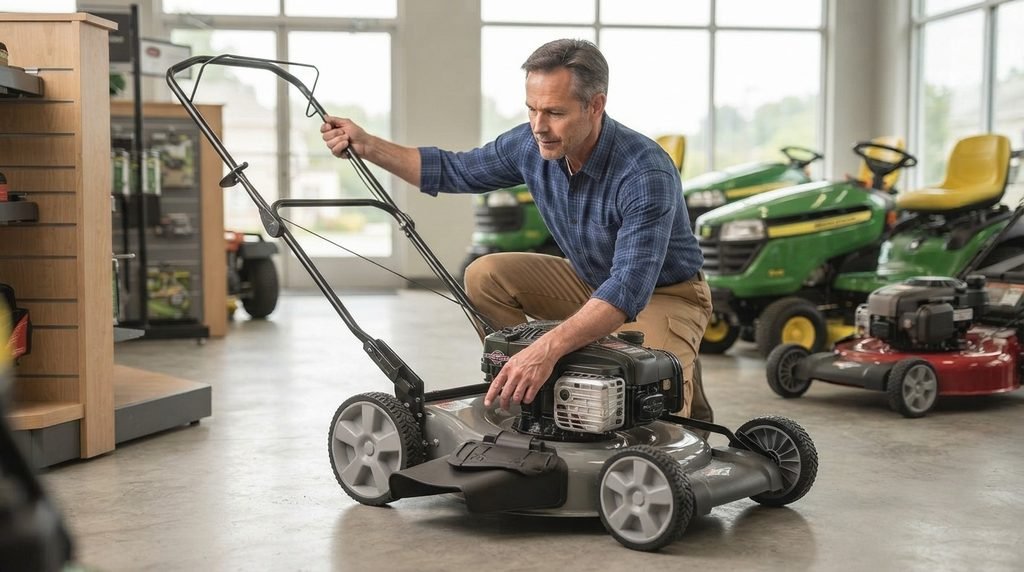
1. Buying Only for the Brand
John Deere is a recognizable equipment brand, but the brand name doesn’t tell you whether a particular used mower has been maintained properly.
Condition and model compatibility matter.
2. Ignoring Whether the Model Is Current
This is particularly important with John Deere push mowers.
John Deere’s official resources distinguish between current and non-current walk-behind equipment.
If you’re buying used, identify the exact model and confirm that manuals and replacement parts are still reasonably accessible.
3. Choosing Based Only on Cutting Width
A wider mower isn’t always more useful.
If your lawn contains many obstacles, maneuverability can be more valuable than shaving a few passes off mowing time.
4. Ignoring Terrain
A flat backyard and a sloped, uneven property create very different mowing demands.
Consider terrain before deciding between push and self-propelled equipment.
5. Forgetting Storage
Measure your available storage space before buying.
A mower that fits your lawn but doesn’t fit comfortably in your shed or garage isn’t a practical purchase.
6. Looking Only at Upfront Price
The purchase price is only part of ownership.
Consider:
- Routine maintenance
- Replacement parts
- Blade service
- Fuel or charging
- Storage
- Repairs
- Local service availability
Is a John Deere Push Mower Right for You?
A John Deere push mower may make sense if you have a manageable lawn, value maneuverability, have adequate time for mowing, and find a model with good parts and service support.
It may be less suitable if:
- Your property is large.
- You regularly mow steep areas.
- You find pushing tiring.
- You need to finish mowing quickly.
- You’re considering an old mower with uncertain parts availability.
One especially important point is that “John Deere push mower” doesn’t necessarily mean a current residential product. The company’s U.S. documentation lists several older residential JS models as non-current while its current walk-behind category includes commercial equipment.
If you’re shopping for a used machine, the exact model number is therefore more useful than the general product description.
Frequently Asked Questions
Is a John Deere push mower good for small lawns?
Yes, a push mower can be a practical option for a small, relatively flat lawn. It can provide good maneuverability without the size and storage requirements of a riding mower. The important point is to match the mower to your lawn and verify the exact model if you’re purchasing an older John Deere machine.
Are John Deere push mowers easy to maintain?
Maintenance depends on the specific model and power system. Routine care generally includes keeping the mower clean, maintaining a sharp blade, inspecting safety components, and following the manufacturer’s service schedule. John Deere provides model-specific manuals and maintenance resources, so the exact operator’s manual should be your primary reference.
What size lawn is suitable for a push mower?
There isn’t one universal lawn-size limit. A push mower can work well on smaller properties, particularly when the lawn is relatively flat and doesn’t take excessive time to mow. For larger or sloped lawns, a self-propelled mower may reduce physical effort and make the job more manageable.
Is a push mower better than a self-propelled mower?
Neither is automatically better. A push mower gives you direct control and can be simple for manageable lawns. A self-propelled mower is often more comfortable when you’re covering more ground or dealing with challenging terrain. Think about lawn size, slope, mowing frequency, and your willingness to push before choosing.
How often should a push mower be maintained?
Maintenance frequency depends on the model and how heavily it is used. Perform basic inspections regularly and follow the service intervals in the operator’s manual. Blade condition deserves particular attention because sharp blades produce cleaner cuts.
What should I look for when buying a John Deere push mower?
Start with the exact model number. Then check the mower’s condition, cutting width, height adjustment, power system, collection or discharge options, maneuverability, maintenance history, and parts availability. For an older mower, verifying the model through John Deere’s documentation can help you avoid buying equipment that is difficult to support.
What mowing height should I use?
The correct height depends on the grass species and growing conditions. As a general principle, avoid removing more than one-third of the grass blade in a single mowing. Extension guidance commonly recommends this approach because removing too much at once can stress turf.
Are older John Deere push mowers still worth buying?
They can be, but condition and support are critical. John Deere identifies several older JS residential walk-behind models as non-current. Before purchasing one, confirm the exact model, inspect its condition, locate the appropriate manual, and investigate whether the parts you are likely to need remain available.
Final Takeaway
Choosing a lawn mower John Deere push option is less about finding a famous brand name and more about finding the right match for your lawn.
For a smaller, manageable yard, a push mower can offer straightforward operation and useful maneuverability. For larger or more demanding properties, self-propelled or riding equipment may make more sense.
If you’re considering John Deere specifically, identify the exact model before you buy. That’s especially important with used equipment because John Deere’s current U.S. resources distinguish current commercial walk-behind machines from older, non-current residential JS models.
Finally, don’t overlook the basics: cutting height, blade condition, terrain, storage, maintenance, and parts availability. Those everyday factors will have a much bigger impact on your ownership experience than a product badge alone.










One Response